

The monsoon doesn’t knock, it seeps in.
You don’t see it coming. But suddenly your white walls wear a faint grey mustache. The corners flake. The paint bubbles. And just like that, your living room starts smelling like a half-shut godown.
Every Indian home knows this battle.
Old buildings in Mumbai. Builder flats in Noida. Independent homes in Coimbatore. Wherever there’s high humidity, dampness finds a way in.
But here’s the catch: it’s not just rainwater causing the problem.
Moisture doesn’t need a leak. It just needs air that won’t move

And that’s where the conversation changes from waterproofing to cooling. From civil work to airflow systems. From blame to behaviour.
Because the real issue isn’t just about water on your walls. It’s about how your air circulates.
The unseen connection: why bad cooling causes damp walls
We tend to treat walls and ACs as separate. One is paint and plaster. The other is comfort tech.
But in reality, your cooling choices can control your moisture levels especially in monsoon-prone zones.
When warm, humid air enters a room and isn’t dehumidified, it sticks. Quite literally. It clings to walls, seeps into the plaster, and stays. Poorly ventilated rooms become moisture traps. And ironically, older air conditioners worsen this.
Here’s why:
1. Conventional ACs cool the air but don’t dry it.
2. They lower the temperature without reducing the humidity.
3. That drop in temp actually helps moisture condense on surfaces.
It’s like placing a cold soda can on a wooden shelf. Beads of water form. That’s your wall. Every evening.
So what’s the fix? Dry the air. Don’t just cool it
Which brings us to an underrated hero in Indian homes: AI-enabled air conditioners with dehumidifying modes.
Not fancy tech for showroom talk. Functional, strategic upgrades that solve very real problems in everyday homes.
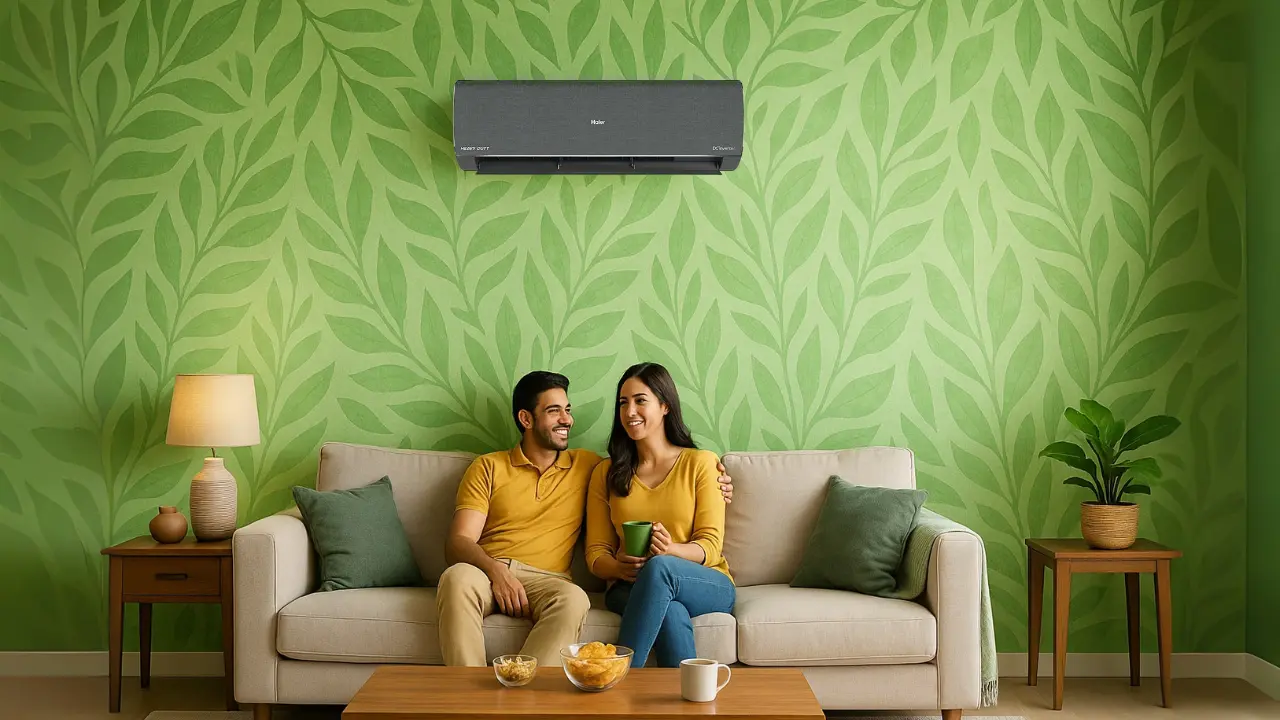
Take the Haier 1.6 Ton 5-Star Gravity AI Series AC, for instance. This is where the magic happens:
- AI Self-Adjusting Cooling – It senses the room’s real-time temperature and humidity, and adjusts airflow accordingly.
- Built-in Dehumidification Mode – Designed for Indian monsoons, it actively pulls moisture from the air before it settles.
- Antibacterial Filters – Because moisture attracts mold and mold attracts health bills.
The best part? It does all this while staying silent, power-efficient, and sleek enough to disappear into your interiors.
Don’t repaint. Rethink
Too often, our response to dampness is cosmetic.
- Scrape.
- Putty.
- Repaint.
- Repeat.
But this is a classic treatment-vs-root-cause problem. If the air doesn’t change, neither will the wall.
Instead, here’s a smarter 3-layered approach:
1. Fix obvious cracks and leaks. Civil fixes still matter.
2. Install an AI-enabled AC with dehumidifier mode. Especially in rooms that face the sun or have poor ventilation.
3. Run it regularly during high-humidity hours. Not just at night when you’re sleeping but evenings too.
A drier room feels colder even at a higher temperature.

This is counterintuitive but powerful.
When the air is dry, your body loses heat faster. That means even at 26°C, you’ll feel as cool as 22°C in a humid space. Which also means:
- Less energy consumed
- Less load on your appliance
- Less wall damage from condensation
Cooling smarter is not just about comfort. It’s a structural preservation hack.
Why Indian homes need to upgrade how they think about ACs
There was a time when buying an air conditioner meant one thing: how fast can it cool?
That time is gone.
Today, climate change has changed everything. Summers are longer. Monsoons are wetter. And cities like Chennai, Kolkata, and Guwahati are seeing 90%+ humidity for days on end.
In this new reality, ACs have to do more than cool. They need to manage moisture, optimise energy, and support air quality all while matching the aesthetic of modern homes.
And yes, the Haier Gravity Series does that too with its premium matte finish that doesn’t stick out like a white box from the 90s.
Think of your AC like a climate manager not just a temperature remote

That shift changes how we buy, install, and run them.
Because the real cost of ignoring humidity isn’t just discomfort it’s:
- Mould on your wardrobe
- Peeling paint in your puja room
- Musty smells in linen cabinets
- Sinus issues and chest congestion
- High electricity bills for low satisfaction cooling
And it starts silently. Just a damp patch in one corner. Until it spreads.
Final takeaway: Moisture isn’t just a bathroom problem anymore
It’s living in our bedrooms, drawing rooms, and WFH setups.
The solution? Smarter, season-aware appliances. And design thinking that connects comfort with care.
Which is exactly why a dehumidifying, AI-powered AC is no longer a luxury. It’s an architectural necessity in the Indian climate.
Especially if you love your walls.