
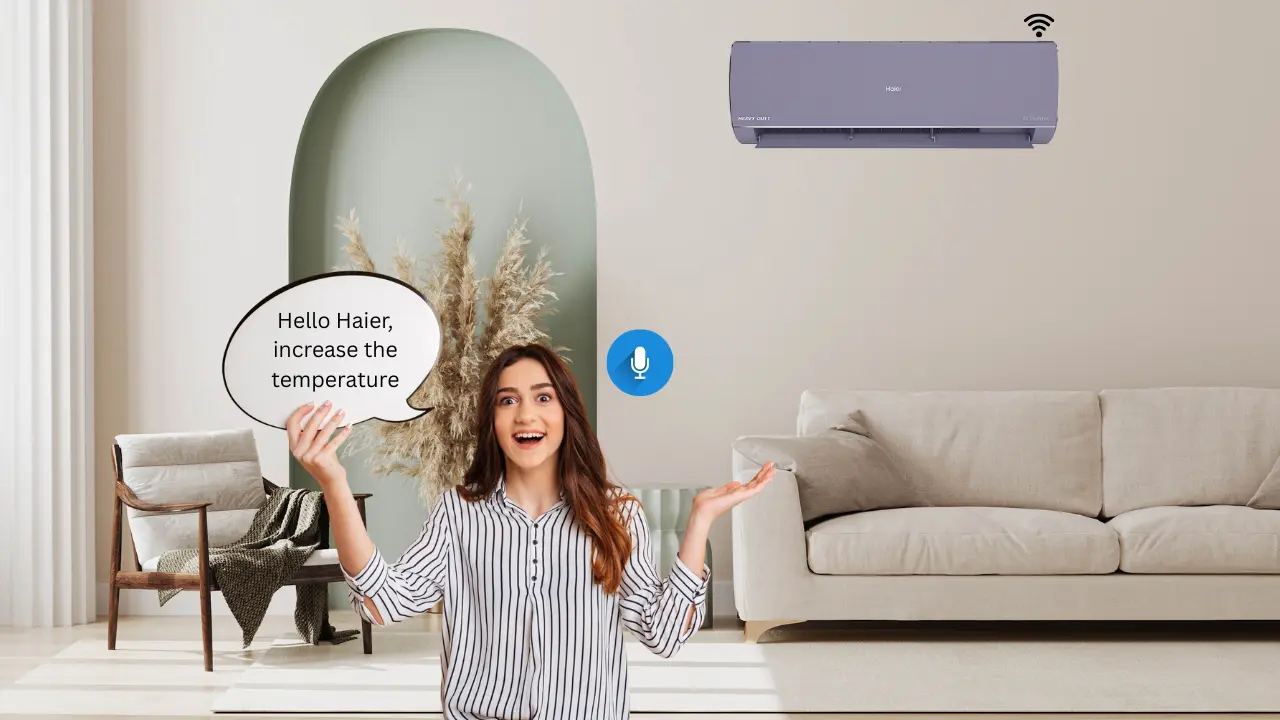

Direct Voice Control in AI ACs lets you control your air conditioner by speaking to it directly, without a remote, app, or even WiFi.
You say what you need. The AC listens, understands, and responds in real time. It removes friction from everyday cooling and turns comfort into a simple, natural interaction.
This is not about novelty. It is about less effort for the same outcome.
The moment that explains why this matters
It is 11:45 pm.
The lights are off.
Your phone is charging in another room.
The AC feels slightly colder than needed.
You could get up.
You could hunt for the remote.
Or you could just say, “Hello Haier, increase the temperature.”
And the room adjusts.
That is Direct Voice Control working quietly in the background.
Not flashy.
Just considerate.
So what exactly is Direct Voice Control in AI ACs?
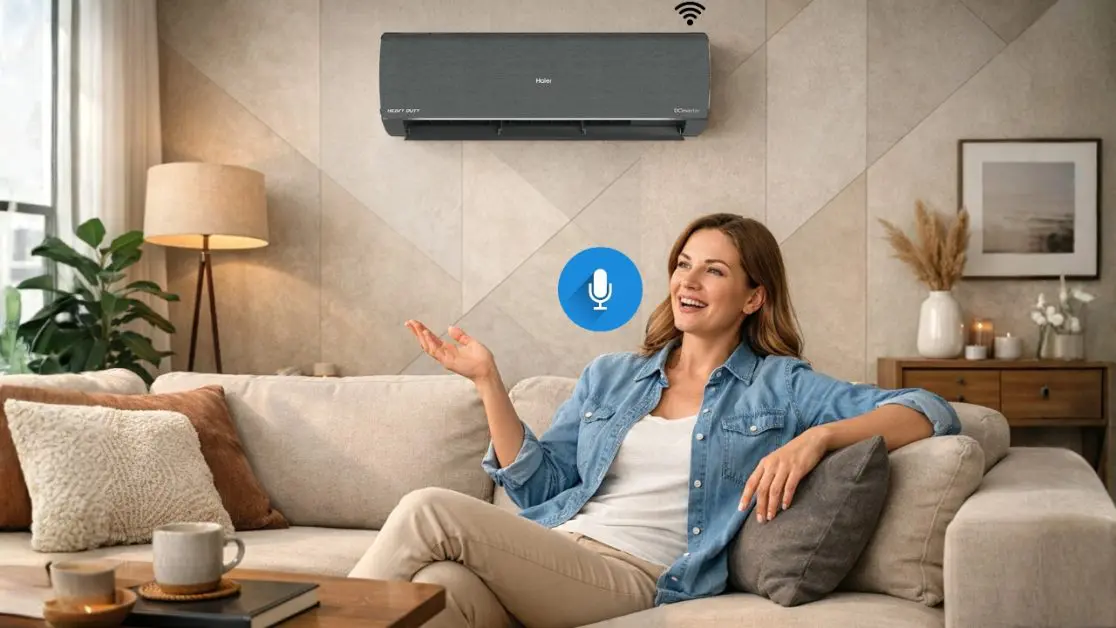
Direct Voice Control means the AC has built-in voice recognition hardware and software. You talk to the AC itself, not to your phone or a smart speaker.
There is no dependency chain.
- No phone unlocking
- No app opening
- No WiFi requirement in many cases
According to Haier’s AI AtmoX, Direct Voice Control works even without an internet connection in select models, because the voice commands are processed locally within the AC system.
That detail matters more than it sounds.
Why traditional smart control still feels like work
Most “smart” ACs added layers instead of removing effort.
You still had to:
- Find your phone
- Open the app
- Wait for the network
- Hope the command went through
Smart, but not simple.
Direct Voice Control flips that system.
The control surface becomes the room itself.
If you are in the room, you are in control.
How Direct Voice Control actually works inside the AC
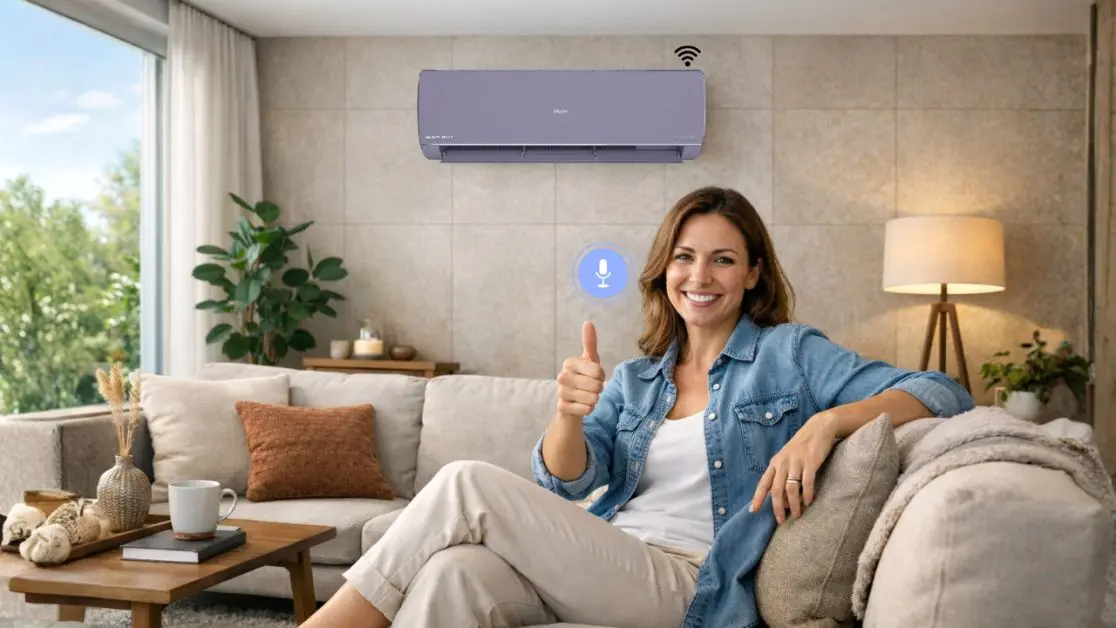
This is not magic. It is systems design.
Inside an AI AC with Direct Voice Control, three things work together:
1. Onboard microphones
These listen for a wake phrase and commands, even from across the room.
2. Embedded AI processing
Commands are interpreted locally, which means faster response and fewer failures.
3. Climate intelligence
The AC does not just follow instructions blindly. It adjusts output based on current conditions, room temperature, and usage patterns.
In Haier AI ACs powered by AI AtmoX, voice control sits alongside AI Climate Control, AI Pre-Cooling, and AI Target Cooling as part of a larger adaptive system, not a standalone feature
That integration is the real upgrade.
What can you actually say to a Direct Voice Control AC?
This is where practicality matters.
Common voice commands include:
- Turn the AC on or off
- Increase or decrease temperature
- Change modes like Cool or Eco
- Adjust fan speed
- Activate specific AI modes
You are not memorising scripts.
You are speaking normally.
The system is designed for real homes, not demo rooms.
Why this feels different in Indian homes
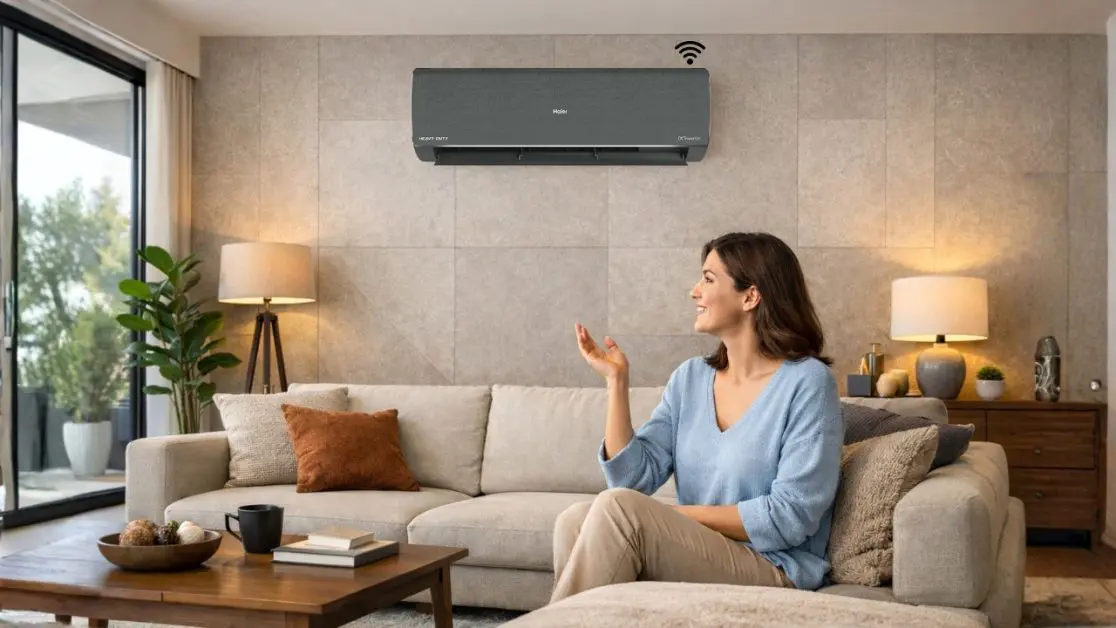
India is not a one-room, one-user country.
Homes are shared.
Rooms are multifunctional.
Power conditions vary.
Direct Voice Control fits this reality better than app-based control.
In family homes
Parents, grandparents, and children can all use the AC without learning apps or settings.
In rental apartments
There is no setup friction or account dependency.
During power or network fluctuations
Local voice processing keeps things working when connectivity does not.
Convenience here is not a luxury.
It is accessible.
Direct Voice Control versus app-based control
Both exist. They serve different needs.
Here is a simple comparison.
| Aspect | App Control | Direct Voice Control |
| Requires phone | Yes | No |
| Requires internet | Usually | Not always |
| Speed | Depends on network | Instant |
| Ease for all users | Medium | High |
| Late night usability | Low | High |
This is not about replacing apps.
It is about choosing the least effort option at the moment.
The hidden benefit nobody talks about
Direct Voice Control reduces overcooling.
That sounds odd at first.
But think about it.
When adjusting temperature requires effort, people delay it.
They tolerate discomfort longer.
They forget to switch modes.
When adjustment is effortless, people fine-tune more often.
Small changes.
Shorter run times.
Better energy alignment.
This is how convenience quietly supports efficiency.
How Direct Voice Control fits into AI Climate Control

Voice control is the interface.
AI Climate Control is the brain.
In Haier AI ACs, the system learns:
- Your usage patterns
- Time of day preferences
- Seasonal behaviour
- Room conditions
So when you say, “Make it comfortable,” the system does not guess.
It infers.
According to the AI AtmoX framework, the AC continuously analyses environmental and behavioural data to balance comfort and energy savings automatically.
Voice becomes intent.
AI becomes execution.
What Direct Voice Control is not
Clarity matters.
It is not:
- A gimmick for ads
- A replacement for remotes
- A dependency on smart speakers
It is simply another input layer.
But it is the most human one.
Who benefits the most from this feature?
Working professionals
Hands full. My mind is tired. Fewer steps matter.
Parents
No teaching. No explanation. Just speak.
Senior family members
No learning curve. No screens.
New homeowners
One less system to manage during setup.
Technology succeeds when it disappears into routine.
Why this feature signals a bigger shift
Direct Voice Control is not about ACs.
It is about how we expect systems to behave.
We are moving from:
- Manual control
to - Context-aware response
From:
- User adapting to machines
to - Machines adapting to users
Once you experience voice-first comfort, going back feels oddly heavy.
A simple way to think about it
Credits: Haier India,
Remotes are instructions.
Apps are workflows.
Voice is intention.
The closer technology gets to intention, the more natural it feels.
Where Haier fits into this story
Haier’s approach with AI AtmoX is not about stacking features.
It is about building a connected comfort system.
Direct Voice Control sits alongside:
- AI Pre-Cooling that anticipates arrival
- AI Target Cooling that focuses airflow
- AI Eco modes that manage energy use
- Electricity monitoring for awareness
All of these work better when control is immediate and frictionless.
Mentioning the brand here matters because systems only work when designed together.
What this means for everyday living
Less interruption.
Less decision fatigue.
More comfort without thinking about it.
The best technology does not demand attention.
It gives time back.
The insight worth remembering
Comfort is not about more control.
It is about easier control.
Direct Voice Control in AI ACs is not a future feature.
It is a present expectation.
And once it becomes normal, everything else feels unnecessarily complicated.