


The sound shaking your living room during a boxing match or an F1 race isn’t the neighbour’s subwoofer, it’s Dolby Atmos on a modern TV, making every cheer, crash, and clap feel like it’s happening right beside you.
Why sound feels more real than ever
Every Indian household has lived this scene, the family gathers for a cricket final, snacks lined up, lights dimmed, and then boom. The roar of the stadium feels so close you almost check if a crowd has formed outside your window.
That’s the leap Dolby Atmos has brought into living rooms. No more flat, one-directional sound. Now, audio doesn’t just come at you, it surrounds you. Overhead, behind, to the side it builds a three-dimensional soundscape where your home feels like the venue itself.
What makes Atmos different?
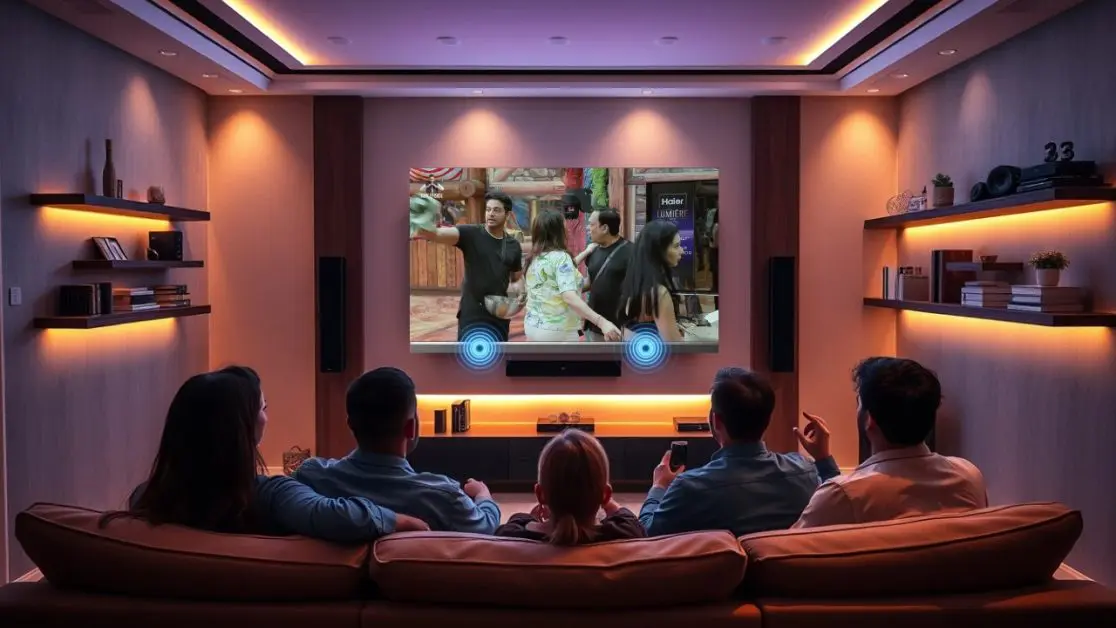
Think of the old days. Watching an action scene felt like seeing a flat painting colourful but contained. With Dolby Atmos, the same scene turns into a theatre performance where sound moves like actors across a stage.
- In a car chase, tires screech from left to right across the room.
- In a concert film, the singer’s voice stays centred while the guitar riff hangs in the air beside you.
- In a cricket replay, the ball hitting the bat doesn’t just thud it cracks sharply, echoing like it does in Wankhede or Chepauk.
It’s not volume. It’s placement. And that’s what tricks your brain into believing you’re inside the moment.
Why the boom belongs to the TV, not the fight
Here’s the irony: many of us assume a big sound needs big speakers. A chunky soundbar. Maybe even a separate woofer tucked in a corner.
But today’s premium TVs like Haier’s Mini LED H65M95EUX and H75M95EUX carry Dolby Atmos with Harman Kardon speakers built right in. That “boom” during a boxing knockout? That’s 60 watts of carefully tuned audio bouncing around your walls.
And because the visuals are paired with Dolby Vision IQ, brightness and contrast adjust automatically to the room’s lighting, so both sound and picture feel consistently immersive.
In other words: it’s not just the fight you’re watching. It’s the fight as if you were ringside.
When homes turn into arenas and theatres

Sound has always defined memory.
- Ask anyone who’s attended a cricket match the crowd noise stays with them long after the score fades.
- Think of Ganesh Chaturthi aarti; the bells and chants carry the emotion as much as the visuals.
- Or the way a rainstorm feels heavier when you hear thunder rolling from far away.
Dolby Atmos taps into that same emotional wiring. It takes ordinary screen time and gives it event status.
That’s why a rainy Saturday binge session with friends feels like a mini PVR theatre. Or why watching Kingdom on OTT becomes a household event rather than just another weekend watch.
The hidden system at play
Here’s the real trick: the leap forward isn’t just about speakers.
It’s a system of three upgrades working together:
1. Dolby Vision IQ – adjusts brightness and colour in real time, depending on your room’s lighting.
2. Mini LED panel with local dimming – sharp contrast, deep blacks, and crisp details at 4K.
3. Dolby Atmos tuned with Harman Kardon + Total sonic tech – multidirectional sound without cluttering your space.
That’s why households upgrading to Haier’s Mini LED TVs don’t just say “the picture is great.” They talk about how they felt during the match, the movie, or the festival replay.
Everyday examples: where Atmos quietly changes life
This isn’t just about dramatic sports or cinema moments. Atmos shows up in the quieter corners of daily living too.
- Morning yoga – the calm flute feels like it’s flowing through the room, not from a box.
- Kids watching cartoons – characters don’t sound squashed; they bounce across the space, making playtime livelier.
- Evening news – the anchor’s voice is crisp, while background sound sits where it belongs, not in your face.
It’s the difference between hearing and being present.
But do you really need it?
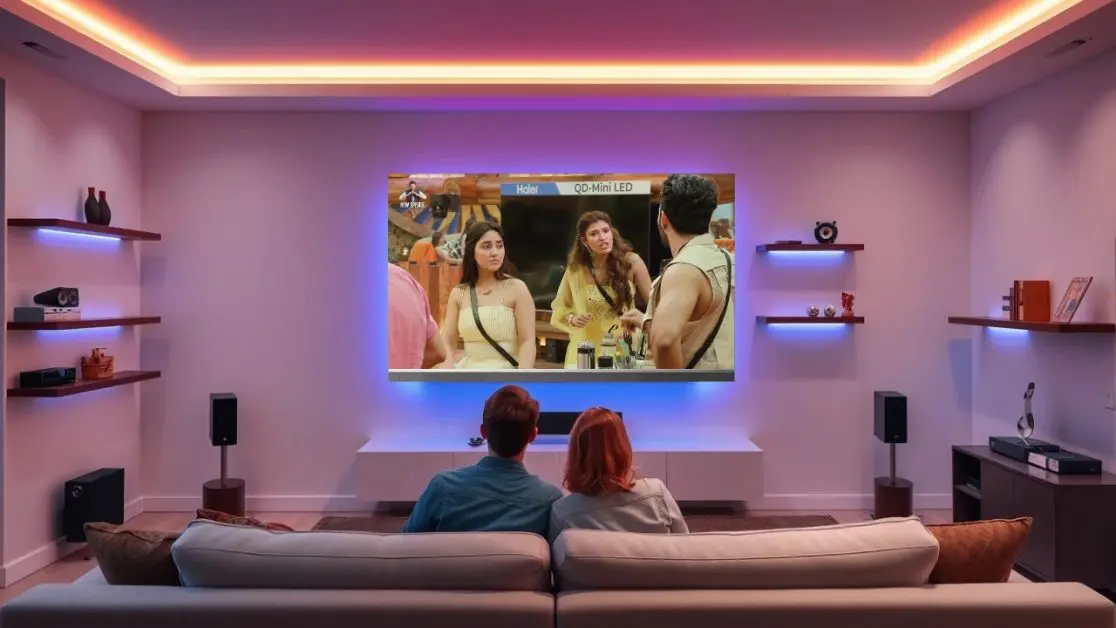
That’s the real question. Because every innovation asks for a choice.
- One option is sticking with a regular LED TV. It works. You’ll see the picture, you’ll hear the dialogue.
- The second option is adding a soundbar or home theatre setup. More equipment, more cost, more space.
- The third option that Haier has leaned into is integrating Atmos and premium speakers directly into the TV. No clutter, no learning curve. Just sit down, press play, and feel the upgrade.
For Indian homes where living rooms double up as dining areas, play zones, or even work-from-home spots, simplicity matters as much as spectacle. That’s why the third option resonates.
From tech spec to lived experience
On paper, terms like 144Hz and MEMC, VRR, ALLM, QD-Mini-LED sound like jargon. But lived out, they mean something simple:
- Sports without motion blur.
- Games without lag.
- Movies without washed-out colours.
When you stack those with Atmos sound, you get what people casually describe as: “Yaar, it feels like the real thing.”
The larger pattern – why it matters for Indian households

Zoom out for a moment. What’s really happening here?
Technology in Indian homes is shifting from functional to experiential. Fridges aren’t just about storage, they’re about freshness and festive prep. Microwaves aren’t just about reheating, they’re about pizza nights and guilt-free samosas.
And TVs aren’t just about showing pictures. They’re about recreating the sensory richness of real life colour, detail, sound, and feeling.
Dolby Atmos isn’t just a feature. It’s a signal of where home technology is headed: invisible upgrades that make life feel fuller without demanding more effort from us.
Implications for the future of home viewing
If you’re setting up a new home, Atmos-enabled TVs save you the hassle of piecing together separate gear. If you’re upgrading after years, it’s the leap that makes you say, “Why didn’t I do this earlier?”
And for families balancing budgets, space, and aesthetics, integrated Atmos in Mini LED range is a rare case where less equipment equals more immersion.
The future of home viewing isn’t about louder. It’s about being smarter, sharper, and more present.
Final thought
The next time a neighbour wonders if you’ve set up a theatre at home, smile. Tell them it’s just the TV. Because in 2025, that’s no longer a modest claim. It’s the truth.