


Cold months make everyday cooking harder for elderly family members because joints stiffen, balance weakens, and open flames feel riskier indoors.
Safer winter cooking is not about stopping elders from cooking. It is about redesigning the kitchen system so warmth, timing, and effort work in their favor.
That shift matters more than we admit.
Because in most Indian homes, winter is when elders cook the most comfort food.
Winter changes the rules of the kitchen.
On paper, nothing changes in winter.
Same stove. Same pans. Same recipes.
In real life, everything shifts.
Hands feel slower. Floors feel colder. Steam fogs glasses. Long standing hurts knees more than it did in October.
This is the part families underestimate.
Most kitchen risks for elders do not come from carelessness. They come from fatigue plus cold. That combination quietly increases accidents.
According to Indian safety studies, winter months see a rise in minor kitchen burns and slips among seniors, especially during early mornings and evenings when temperatures drop and lighting is softer.
The problem is not skill. It is the environment.
Why elders still insist on cooking in winter

Ask any parent or grandparent why they cook even when help is available.
The answer is rarely about food.
It is about rhythm.
Cooking is memory. Control. Purpose. Routine.
Removing them from the kitchen does not make them safer. It makes them restless.
The smarter question is different.
How do we make cooking safer without taking it away?
Safety in winter is a system, not a warning
Most advice sounds like this:
- Be careful
- Do not rush
- Avoid open flames
None of this works.
Because systems beat instructions every time.
A safer winter kitchen for elders comes from redesigning how cooking happens, not reminding who is cooking.
Let us break this system down.
Heat exposure is the first hidden risk
Cold kitchens push elders closer to flames.
They lean in. They hover longer. They warm their hands near burners.
This is where burns happen.
One option is thicker clothing.
The second is better ventilation and faster cooking.
The third is controlled heat appliances that do not require proximity.
The third option quietly wins.
When cooking time reduces and heat is enclosed, elders spend less time near direct flames.
That is not convenient. That is safety.
Standing time is the second risk nobody tracks

Winter stiffens joints.
Standing for 30 minutes feels different than standing for 10.
Long recipes amplify pain. Pain causes distraction. Distraction causes spills.
Here is the pattern.
- Long cooking equals fatigue
- Fatigue reduces balance
- Reduced balance increases slips
Shorter cooking cycles reduce the entire chain.
This is where modern appliances stop being luxury and start being protective.
Why closed cooking matters more in winter
Indian kitchens traditionally rely on open systems.
Open stove. Open flame. Open pans.
In winter, this creates three problems for elders.
- Heat escapes, so cooking takes longer
- Steam condenses, fogging vision
- Hands move closer to risk zones
Closed cooking systems reverse this logic.
They trap heat. They finish faster. They reduce exposure.
Microwaves and convection systems, when used correctly, are not shortcuts. They are stabilizers.
The misconception about microwave safety
Many elders still think microwaves are unsafe or confusing.
This belief often comes from early models and poor demonstrations.
Modern microwaves operate with preset menus, enclosed heating, and automatic shut-off systems.
For elders, this matters because:
- No bending over flames
- No guessing temperature
- No constant monitoring
In fact, controlled cooking reduces accidental burns significantly compared to open stovetop use, especially in winter months.
Haier’s 30L Convection Microwave with In-Built Air Fryer is one such example where preset menus handle time and temperature automatically, reducing the need for constant adjustment and supervision. These features are designed to simplify use rather than complicate it
The insight here is bigger than the product.
Predictability creates safety.
Winter safety improves when choices reduce effort
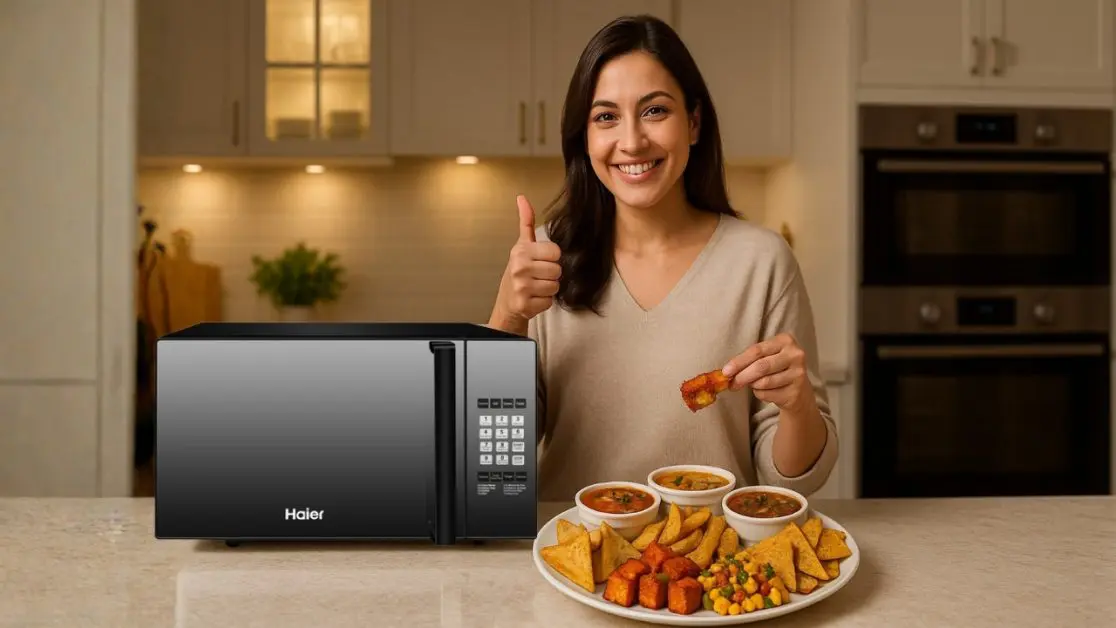
Safer cooking for elders does not require dozens of changes.
It requires fewer decisions.
Let us look at three common winter cooking scenarios.
Scenario 1: Reheating leftovers
Old pattern:
Pan on the stove. Lid half-open. Stirring required.
Safer pattern:
Covered reheating with preset timing.
Cost: Slight learning curve.
Benefit: No flame contact, no stirring, no overcooking.
Scenario 2: Making evening snacks
Old pattern:
Oil heating. Standing nearby. Timing by guesswork.
Safer pattern:
Air frying or convection cooking with auto settings.
Cost: Appliance familiarity.
Benefit: No oil splatter, no open heat, faster results.
Scenario 3: Early morning tea or breakfast prep
Old pattern:
Cold floor. Gas ignition. Long standing.
Safer pattern:
Minimal prep using enclosed heating and pre-set cycles.
Cost: Small routine shift.
Benefit: Reduced standing time and joint strain.
This is not about modernizing elders.
It is about modernizing systems around them.
Kitchen layout matters more in winter
Cold amplifies poor design.
Slippery tiles feel worse. Low lighting feels dimmer. Crowded counters feel tighter.
Small layout tweaks reduce risk instantly.
- Anti-skid mats near cooking zones
- Clear counter space to reduce reaching
- Warm lighting over work areas
- Frequently used items at waist height
None of these are dramatic.
All of them compound safety.
Why elders avoid asking for help
There is an emotional layer families often miss.
Elders rarely say, “This is difficult.”
They say, “I am fine.”
Winter cooking accidents often happen quietly, without complaints beforehand.
This is why passive safety matters.
Systems that protect without reminding.
Appliances that work silently in the background.
Design that respects independence.
The real role of smart appliances in elderly care
Smart appliances are not about apps or screens.
They are about removing friction.
Auto shut-off prevents forgetting.
Preset menus reduce guesswork.
Enclosed heating reduces exposure.
When used thoughtfully, these features act like invisible support.
Not supervision. Support.
That distinction matters deeply to older adults.
What families should look for this winter
When evaluating kitchen changes for elders, ask three questions.
- Does this reduce standing time?
- Does this reduce direct heat exposure?
- Does this reduce the number of decisions required?
If the answer is yes to at least two, safety improves.
Winter kitchens reflect how families think
A kitchen reveals priorities.
Some prioritize speed.
Some prioritize tradition.
The wisest prioritize continuity with care.
Elders do not need to stop cooking in winter.
They need kitchens that adapt to winter with them.
This is where brands like Haier quietly fit into real homes.
Not by selling fear.
But by designing systems that make everyday life feel calmer, warmer, and more predictable when the season is not.
The bigger takeaway
Safety is not a restriction.
Safety is a thoughtful design.
In winter, the most loving thing a family can do is not say “Let me handle it.”
It is to say, “Let the kitchen handle it better.”
Because when systems improve, dignity stays intact.
And that is what real care looks like.
Frequently Asked Questions
How does using a microwave reduce winter cooking risks for elders?
Microwaves use enclosed heat, finish cooking faster, and remove the need to stand near open flames, reducing burn risk and joint strain.
Can a microwave help elders who get tired or distracted while cooking?
Yes. Preset timings and auto shut-off features prevent overcooking, burning, or forgetting food on heat.
Why is predictability important for elderly cooking safety?
Predictable cooking removes guesswork. When elders don’t need to judge flame strength or timing, stress and mistakes reduce significantly.
Are microwaves safer than gas stoves for making evening snacks?
Yes. Microwaves and convection modes avoid hot oil, splattering, and prolonged standing near heat sources.
Why do many elders believe microwaves are unsafe?
This fear often comes from older models, lack of demonstrations, or unfamiliar controls, not from current safety performance.
Are modern microwaves actually safe for elderly users?
Yes. Modern microwaves are enclosed, temperature-controlled, and designed to minimize direct heat exposure.