

Your appliances deliver full output when life demands it, ease off when the work is done, and save electricity quietly in the background without asking you to change your habits.
No slower cooling.
No weaker washes.
No diluted comfort.
Just smarter systems doing the thinking for you.
Why does this question suddenly matter in Indian homes?
Electricity bills do not spike because of one bad month.
They rise because of everyday patterns.
An AC that keeps restarting because the room never settles.
A refrigerator working harder during voltage fluctuations.
A washing machine using peak power for half loads.
Most homes assume this is unavoidable.
It is not.
For years, performance and efficiency were treated like rivals. If one improved, the other had to suffer. That belief no longer holds.
Modern appliances change the way energy is used, not the experience you get from it.
The old tradeoff was real. The new one is optional.
Earlier, energy saving came with conditions.
- Eco modes slowed performance
- Lower star ratings felt underpowered
- Saving electricity meant switching things off
That world ran on fixed-speed systems.
They knew only two states. Full power or none.
Today’s appliances work differently.
They adjust instead of reacting.
That single shift changes how homes consume energy.
The hidden system behind real energy efficiency
Energy loss does not come from usage alone.
It comes from constant correction.
- Temperature overshoots and pullbacks
- Motors ramping up and shutting down
- Appliances fighting instability instead of preventing it
Each correction costs electricity.
Efficient appliances reduce correction cycles.
This is where inverter-driven systems make a difference. They maintain balance instead of chasing it.
A refrigerator that holds temperature evenly consumes less power than one that repeatedly cools aggressively.
An AC that stabilises a room gently uses less energy than one that blasts cold air.
Stability is not slower.
It is smarter.
Example 1: Refrigerators designed for Indian kitchens
Open a refrigerator in an Indian household and you see complexity.
Fresh vegetables.
Hot leftovers.
Milk, curd, beverages.
Festive food packed tightly.
This mix stresses cooling systems.
Older refrigerators respond with brute force. They overcool and recover repeatedly.
Modern refrigerators use zoned cooling, adaptive airflow, and inverter compressors to prevent that stress.
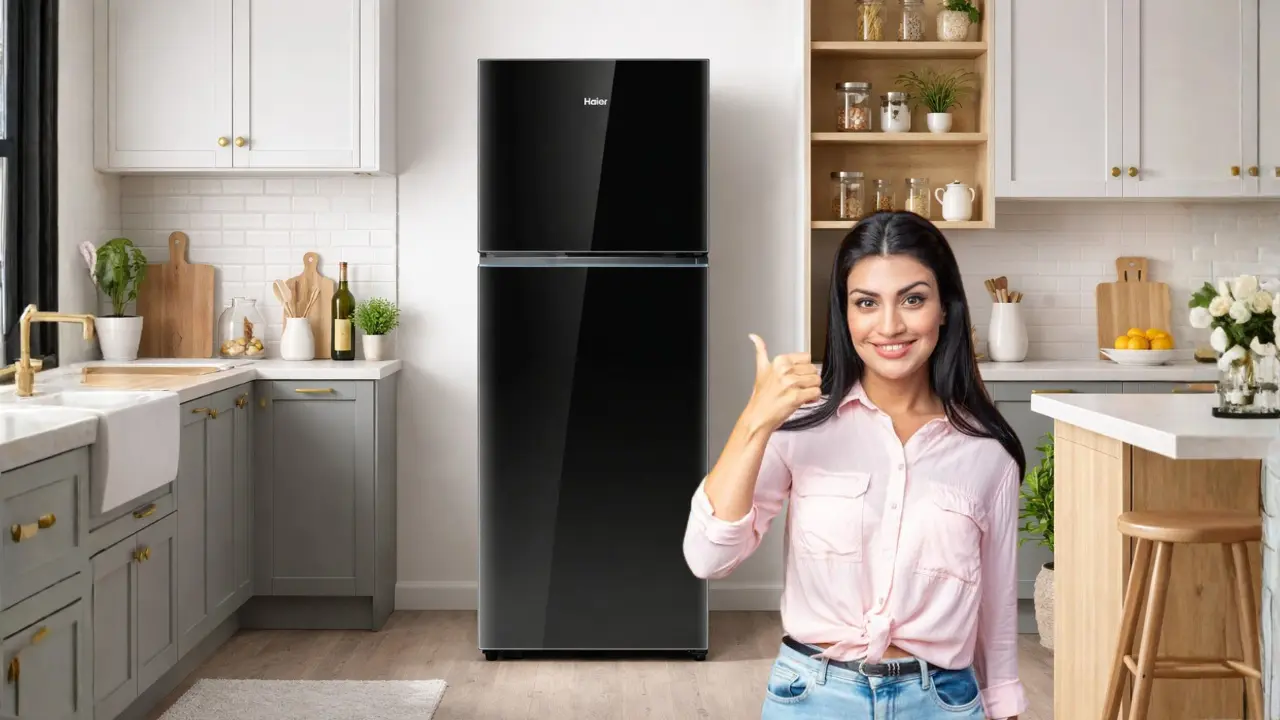
Take the Haier 475L 2 Star Black Glass Double Door Refrigerator (HRF-5252PKG-N).
It is built around systems that reduce energy waste without reducing output.
- Twin Inverter Technology stabilises compressor and fan operation, reducing temperature fluctuations
- 360 Degree Surround Cooling distributes air evenly instead of overworking one zone
- Eco Mode intelligently lowers power consumption during stable usage cycles
- Solar Connect Technology allows operation even during power outages when connected to solar systems
These features work together to keep cooling consistent while avoiding unnecessary power spikes, especially during voltage variations common in many Indian cities .
Performance remains intact.
Energy usage becomes predictable.
Example 2: Air conditioners that stop fighting the room
The most inefficient AC behaviour looks familiar.
Cool aggressively.
Overshoot temperature.
Shut off.
Restart at full load.
This cycle repeats through the night.
Inverter-based ACs break this pattern.
They read room temperature continuously.
They slow down once the desired comfort level is reached.
They maintain balance instead of restarting it.
The room feels calmer.
Sleep improves.
Electricity usage drops naturally.
Efficiency here does not reduce comfort. It improves it.
Example 3: Washing machines that match effort to load
Most laundry loads do not need maximum force.
Yet traditional machines treat every wash the same.
Modern washing machines sense fabric type, load weight, and water levels. They adjust drum motion and motor speed accordingly.
- Light weekday washes consume less power
- Heavy weekend loads get full performance
- Water heating scales only when required
The machine does not overwork.
The clothes do not suffer.
The electricity bill reflects the difference.
What energy efficiency really costs and what it saves
Energy efficiency is often seen as a premium upgrade. In reality, it redistributes cost across time.
What it costs upfront
- Advanced motors and compressors
- Sensors and intelligent controllers
- Better internal components
What it saves long term
- Lower monthly electricity bills
- Reduced mechanical stress
- Fewer repairs caused by repeated power cycling
Over the lifespan of an appliance, efficiency pays quietly. There are no dramatic moments. Just fewer surprises.
The lifestyle benefit people rarely mention
Efficient appliances reduce mental load.
You stop adjusting temperature settings repeatedly.
You stop worrying about power consumption every season.
You stop planning usage around electricity anxiety.
The appliance becomes invisible.
That invisibility is the real luxury.
Why energy efficiency feels personal now
Homes today run like small offices.
Work-from-home setups.
Online classes.
Streaming nights.
All-day appliance usage.
Energy efficiency is no longer about responsibility.
It is about the sustainability of daily life.
When appliances adapt automatically, people do not have to.
A simple framework for choosing better appliances
Before buying, ask three questions.
1. Does the appliance adjust or only react?
Adaptive systems waste less energy.
2. Does it maintain stability or chase it?
Consistency matters more than peak power.
3. Does efficiency show up in daily use, not just labels?
Quieter operation, steady performance, predictable bills.
Star ratings matter.
But intelligent systems matter more.
The bigger picture
Energy efficiency without compromising performance is not about using less.
It is about using right.
Appliances that respect effort do not waste it.
Homes that respect effort feel calmer.
Life feels more sorted when systems work quietly in your favour.
That is what modern living looks like now.
Not louder.
Not harder.
Just thoughtfully designed.
Frequently Asked Questions
I see energy-efficient appliances as expensive upgrades. Am I wrong?
Efficiency doesn’t remove cost, it redistributes it over time. You pay slightly more upfront and far less every month afterward.
What does energy efficiency really save beyond money?
Mental load. You stop micromanaging settings, worrying about bills, or planning usage around power anxiety. The appliance fades into the background.
Why does energy efficiency feel more important than it did a few years ago?
Homes now run like small offices, work, school, entertainment, and cooking all day. Efficiency is about sustaining daily life, not just being responsible.
How should I actually choose better appliances going forward?
Ask three questions:
Does it adjust or only react?
Does it maintain stability or chase extremes?
Does efficiency show up in daily comfort, not just star ratings?