


AC cooling requirement depends on a simple truth: how much heat enters your space versus how quickly it can be removed. Room size, sunlight exposure, insulation, number of people, appliances, and even daily habits all shape how hard your AC needs to work.
Cooling is not about the AC alone.
It is about the technology around it.
The moment every Indian home recognises.
It is a typical May evening.
You walk in. The room feels warmer than outside. The curtains are half open. The TV is on. Someone just finished cooking.
You switch on the AC.
And then begins the waiting.
Five minutes. Ten minutes. Remote clicks. Fan speed changes. Temperature drops.
But the real question is rarely asked.
Was the AC wrong… or was the room asking for more than it could handle?
Cooling problems are rarely about machines.
They are about mismatched expectations.
Cooling is a balance, not a button

An AC does not create a cold. It removes heat.
Which means your cooling requirement depends on how much heat your room collects through the day.
Think of it like filling a bucket with a leak at the bottom.
- The tap is heat entering the room
- The leak is your AC removing it
If the tap runs faster than the leak drains, the bucket fills.
That is exactly how rooms stay hot even with the AC on.
1. Room size defines the starting point
Bigger rooms do not just need bigger ACs. They need smarter planning
A 10×10 bedroom behaves very differently from a 16×18 living room.
Here is a simple way to think about it:
| Room Size | Typical Requirement | Cooling Challenge |
| Small room (up to 120 sq ft) | 1 Ton | Faster cooling, lower load |
| Medium room (120 to 180 sq ft) | 1.5 Ton | Balanced cooling |
| Large room (180+ sq ft) | 2 Ton or more | Heat retention and airflow |
But here is the hidden technology.
Room size is not just area. It is volume.
- High ceilings increase cooling demand
- Open layouts reduce cooling efficiency
- Connected spaces behave like one large thermal zone
So what?
If you treat every room like a simple square box, you will always underestimate cooling needs.
2. Sunlight is the silent heat amplifier
Which direction your room faces matters more than you think
A west-facing room in India can receive up to 30 to 40 percent more heat during peak summer afternoons.
Concrete absorbs it. Walls radiate it. Curtains trap it.
Even after sunset, the room continues to feel warm.
One option is to rely on higher tonnage.
The second option is to reduce heat entry.
The third option is to let the AC adapt dynamically.
Modern technology now uses environmental data to adjust cooling automatically instead of reacting late.
That shift matters.
Because cooling that reacts is always slower than cooling that anticipates.
3. Number of people changes the equation

Every person in the room is a heat source
A single human body emits around 100 watts of heat.
Now imagine:
- A family of four watching TV
- Guests during a festival evening
- Friends gathered for a cricket match
The room heats up without anyone noticing.
This is where traditional AC usage fails.
It assumes a fixed environment.
But real homes are dynamic.
Newer technology can detect human presence and adjust cooling accordingly, reducing unnecessary power when the room is empty and increasing efficiency when occupied.
Comfort is not static. It moves with people.
4. Appliances quietly add to heat load
Your room is not as passive as it looks
Every device contributes.
- Television adds heat
- Laptops generate constant warmth
- Lighting increases ambient temperature
- Refrigerators in open kitchens leak heat into living areas
Now combine that with Indian usage patterns.
Evenings are active.
Cooking. Charging. Streaming. Conversations.
The result?
A room that needs more cooling at 8 PM than at 2 PM.
But most people set the same temperature all day.
That mismatch is where inefficiency begins.
5. Insulation and materials decide how long cooling lasts
Some rooms hold cool air. Others leak it instantly
Two homes. Same AC. Same temperature setting.
Different experiences.
Why?
Because of materials.
- Poor insulation allows heat entry
- Thin walls absorb and release heat quickly
- Old windows leak cool air
- Gaps under doors break thermal control
Think of it like a fridge.
If the door does not seal properly, it works harder but never feels effective.
Cooling efficiency is not about power. It is about retention.
6. Ceiling height and airflow patterns
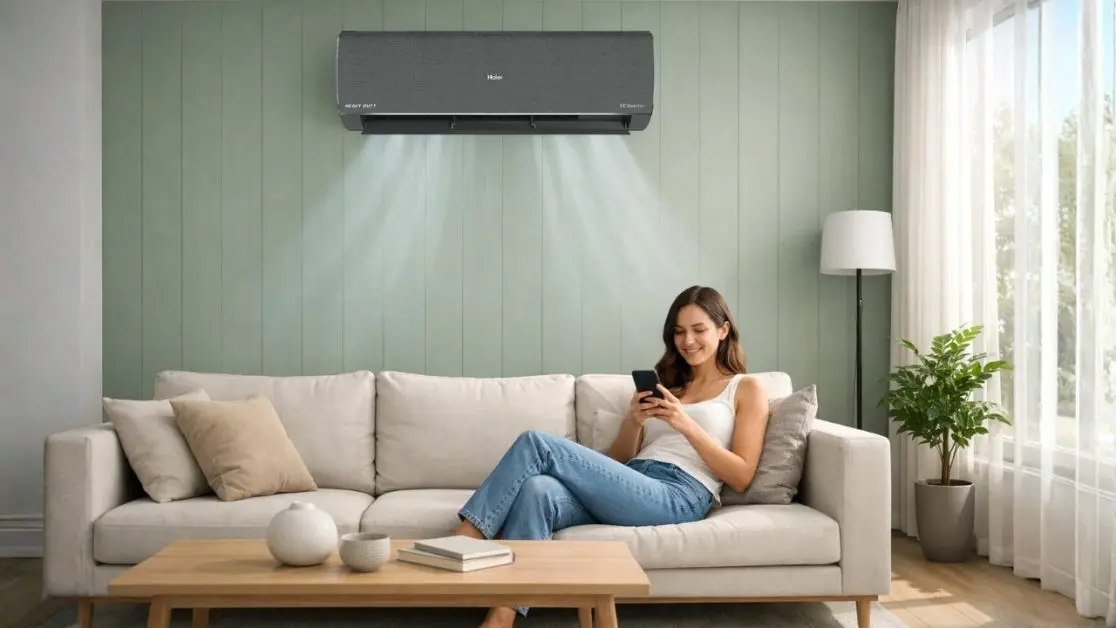
Air behaves differently in every room
Cool air sinks. Warm air rises.
In rooms with higher ceilings:
- Cooling takes longer
- Air circulation becomes uneven
- Comfort feels inconsistent
This is where airflow direction matters.
Modern technology now uses targeted cooling to direct air where it is needed instead of cooling the entire room blindly.
One approach cools the space.
The other cools the experience.
And that difference shows up immediately.
7. Daily habits shape your cooling needs
Your lifestyle is part of the cooling technology
Consider three scenarios:
- Someone working from home all day
- A family that uses the AC mostly at night
- A professional who returns home late evening
Each pattern demands a different cooling strategy.
One option is manual adjustment every time.
The second option is fixed schedules.
The third option is intelligent automation.
AI-powered technology today can learn usage patterns and adjust cooling without constant input.
That changes the equation.
Because comfort becomes proactive instead of reactive.
8. Outdoor temperature and seasonal shifts
Indian summers are not uniform
A 40°C dry heat behaves very differently from humid coastal heat.
Humidity increases discomfort even at lower temperatures.
Which means:
- The same AC setting feels different in different cities
- Seasonal transitions demand flexibility
- Static cooling logic fails in dynamic weather
This is where adaptive climate control technology stands out.
They adjust based on external conditions, not just internal settings.
Because the room is not isolated. It is part of a larger climate technology.
A simple way to understand all factors together
Cooling is a technology of inputs, not a single decision
| Factor | What it affects | Impact on AC |
| Room size | Heat volume | Determines base capacity |
| Sunlight | Heat gain | Increases load |
| People | Internal heat | Dynamic load |
| Appliances | Continuous heat | Hidden load |
| Insulation | Heat retention | Efficiency |
| Ceiling height | Air distribution | Cooling speed |
| Usage habits | Timing | Energy consumption |
| Weather | External pressure | Performance variability |
This table reveals a pattern.
No single factor decides cooling. It is the combination that matters.
So what should you actually do?
Think in technology, not specifications
Most people ask:
“What ton AC should I buy?”
A better question is:
“What kind of room am I trying to cool?”
Three ways to approach this:
1. Static approach
Choose tonnage based on room size
Simple, but ignores real-world variables
2. Reactive approach
Adjust settings constantly
Works, but demands effort
3. Adaptive approach
Use technology that learn and adjust automatically
Efficient, effortless, future-ready
This is where technologies like AI-driven climate control step in.
They observe, learn, and optimize cooling based on environment, usage, and patterns, reducing manual intervention while improving comfort.
The insight most people miss
Cooling is not about lowering temperature.
It is about managing heat flow intelligently.
When you understand that, everything changes.
- You stop overcooling
- You reduce electricity waste
- You choose appliances differently
- You design your space more thoughtfully
And most importantly,
You stop blaming the AC for what the room is doing.
The takeaway
Every room tells a story.
Sunlight, people, devices, materials, habits.
They all shape how cooling behaves.
An AC is not just a machine in that story.
It is the technology that tries to bring balance.
The smarter it becomes, the less you have to think about it.
And that is the real shift happening in modern Indian homes.
Not just better cooling.
But cooling that understands how you live.
Frequently Asked Questions
Why does choosing AC capacity feel harder than it should be?
Because room size is just a starting point. Real comfort depends on heat load, sunlight, people, appliances, and airflow all change how a room behaves.
I followed the tonnage chart exactly, so why does my room still feel warm?
The chart ignores real-life variables like sunlight exposure, ceiling height, and usage patterns.
How do I stop overthinking between 1 ton vs 1.5 ton AC?
Start with room size, then adjust based on conditions. If your room has heat stress (sunlight, top floor), lean toward higher capacity or inverter flexibility.
Do inverter ACs really help if I choose the wrong size?
Yes, to some extent. They adjust power dynamically and reduce the impact of slight sizing errors.
Should I prioritize tonnage or smart features when buying an AC?
Both matter, but smart features (like inverter tech or AI cooling) add flexibility and efficiency.
How do AI-based AC systems improve cooling decisions?
They:
Learn your usage patterns
Adjust cooling automatically
Optimize for comfort + energy savings
Is it okay to rely on “adaptive cooling” instead of perfect sizing?
Yes, but only within limits. Smart systems can correct small mismatches, not major sizing mistakes.