
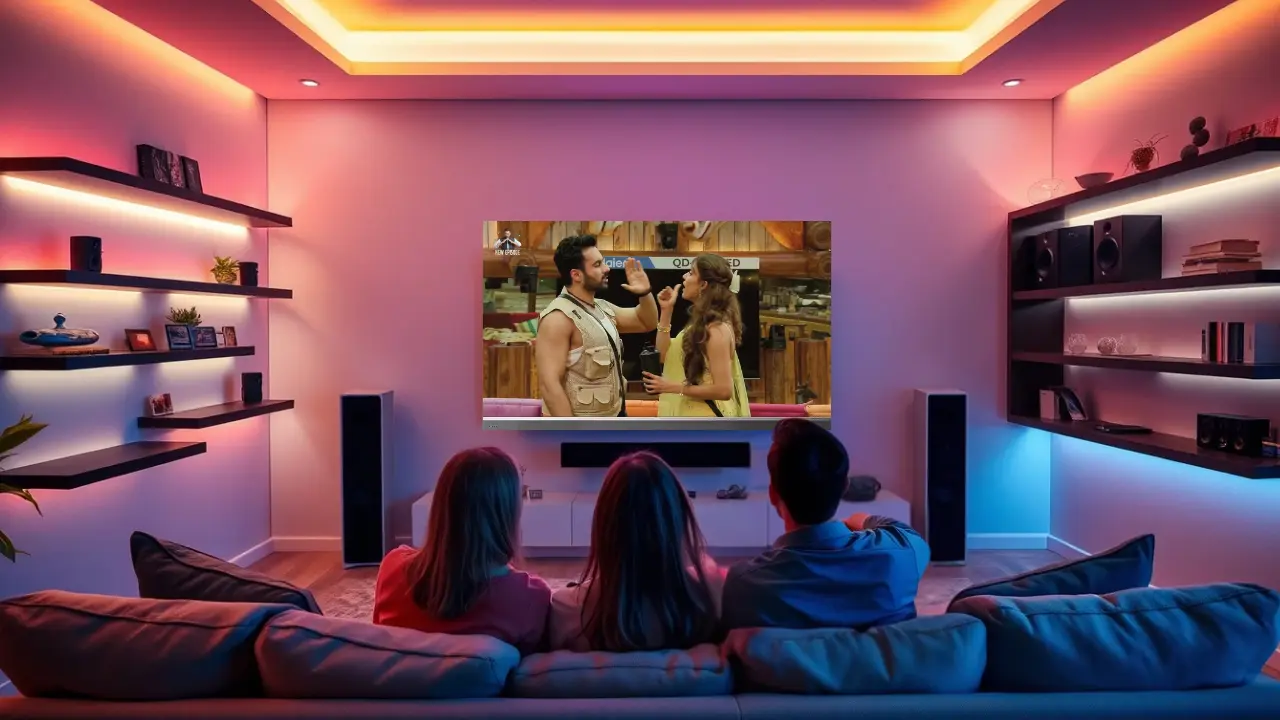

In this season of reality shows and cricket nights, fans aren’t just screenshotting dramatic contestant moments. They’re pausing, zooming, and sharing pictures of the TV itself.
Why? Because the screen looks sharper than the stage, the colors pop harder than the costumes, and the audio feels bigger than the drama.
Why Screenshots of a TV Matter More Than Selfies

Think of the last time you opened Instagram Stories during Bigg Boss or an India-Pakistan match. The feed wasn’t just filled with reactions to players or contestants, it was filled with living rooms. Big screens. Ambient lights. Friends huddled on sofas.
In an age where watching is also about showing, the TV becomes part of the spectacle. It’s no longer background furniture. It’s the foreground.
The New Celebrity Inside the House
Contestants fight for the spotlight. Hosts deliver punchlines. But the one constant presence, season after season, is the TV everyone’s watching on.
The Haier M92 Series QD-Mini LED Google TV has become that silent star. With Dolby Vision IQ and HDR10+ adaptive, the frames look so lifelike that viewers screenshot them not as memes, but as proof: this is how real it felt at home.
Why Fans Keep Pausing the Frame

There are three clear reasons fans are screenshotting this TV:
Clarity that outshines chaos
With 144Hz refresh rate and MEMC motion tech, even messy fight scenes or last-ball cricket finishes look smooth. No blur. No lag. Just precision.
Sound that travels beyond walls
Sound by KEF-tuned speakers with Dolby Atmos 2.1 ch Speaker sound create an audio bubble. Dialogue feels closer. Crowd noise spreads wider. Every cheer has depth.
Screenshots worth posting
Local dimming zones (448 on the 65-inch, 576 on the 75-inch) mean colors stay balanced. A sari’s red doesn’t bleed into the sofa. Stadium greens don’t look neon. It’s Instagram-ready straight off the panel.
The Social Currency of a Living Room
We underestimate how much a TV says about a home. When friends walk in, they notice two things: the sofa and the screen.
Posting a cricket party? People don’t just look at who came over. They look at what you watched it on. In that sense, a TV is no longer just for the household. It’s for the feed.
The Invisible Systems That Make This Possible

Here’s where it gets interesting:
- The AI Ultra Sense Processor constantly scans each scene, tuning contrast and depth so the human eye stays engaged.
- Google TV interface doesn’t just recommend content, it curates it like a playlist making sure the home screen itself is screenshot-worthy.
- The solar remote on the table becomes a conversation starter: “Wait, is that charging from light?” Yes. Sustainability, now part of the story.
Fans Don’t Screenshot Average
Nobody saves a frame that looks ordinary. People pause when something feels cinematic. The M92’s mix of Dolby Atmos audio, QD-Mini LED visuals, and 144Hz speed makes everyday viewing cinematic.
Which is why the screenshots aren’t accidental. They’re deliberate.
What This Means for Indian Homes

- For parents: Festivals on TV now look like the pandal itself, every diya glowing in HDR.
- For couples setting up homes: The TV becomes the centrepiece, a practical showpiece that also future-proofs the living room.
- For working professionals living solo: Cricket nights feel less lonely when the crowd sound is around you, not just at you.
Different households. Same result. The TV becomes the unifying stage.
Parallel Between Contestants and Screens
Contestants in reality shows fight for attention through drama. TVs win attention quietly through consistency.
- Contestants trend for a week.
- A good TV trend in your home for years.
That’s the system shift: what lasts, outshines what screams.
The New Ritual of Entertainment
Cricket nights. Family binges. Weekend gaming. Each of these is a ritual. And rituals need altars.
For this generation, the altar is a large, sharp, immersive screen. The M92 doesn’t just play content. It becomes the canvas on which these rituals unfold.
Implications Beyond Entertainment
Screenshots are more than fandom. They’re signals of aspiration. When people screenshot a TV, they’re saying: This is the standard I want at home.
It’s lifestyle signalling, not just tech appreciation. And Haier, by designing for both performance and aesthetics, makes that signalling effortless.
So What Does This Teach Us?
1. People screenshot what feels aspirational.
That means homes are judged by the tools of experience, not just the people in them.
2. The living room is the new stage.
Contestants may be in the studio, but the audience experience is shaped inside homes.
3. Technology that blends in, stands out.
When a product works so seamlessly that it becomes part of culture (screenshots, parties, posts), it’s no longer just hardware. It’s social currency.
Final Thought
Fans screenshot contestants for drama. They screenshot TVs for quality.
In the end, drama fades. But the memory of watching it clearer, louder, more immersive than expected stays. That’s why more frames of the Haier M92 are saved in galleries than the contestants themselves.
Because in every home, the real star isn’t on stage. It’s on the wall.