
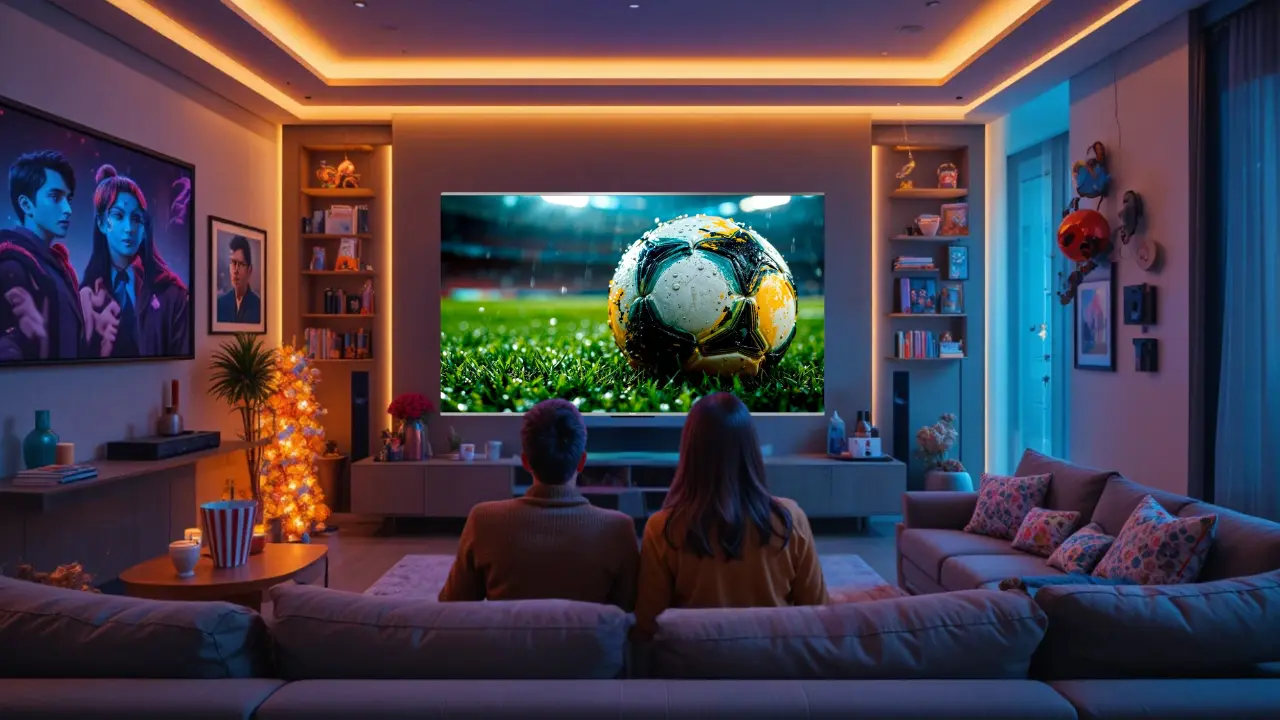

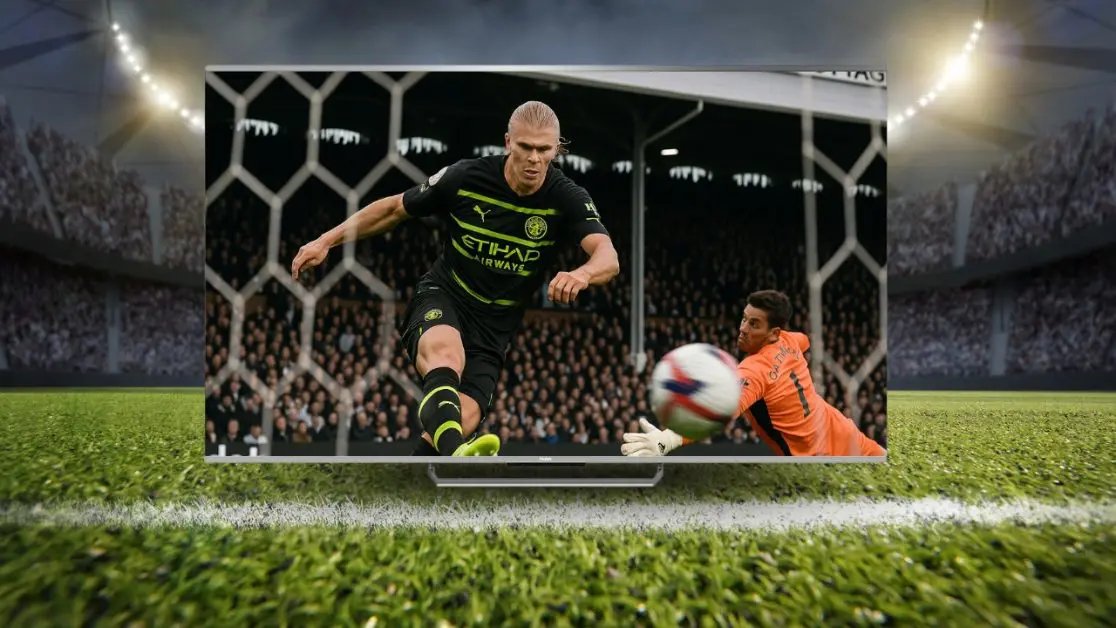
Fast paced Premier League moments look cleaner at a 144 Hz refresh rate because the screen refreshes fast enough to keep up with the speed of modern football.
When the refresh rate rises, motion becomes smoother, edges stay sharper, and quick movements feel continuous instead of fragmented.
That single shift changes how football feels at home.
Premier League Football Moves Faster Than Screens Expect
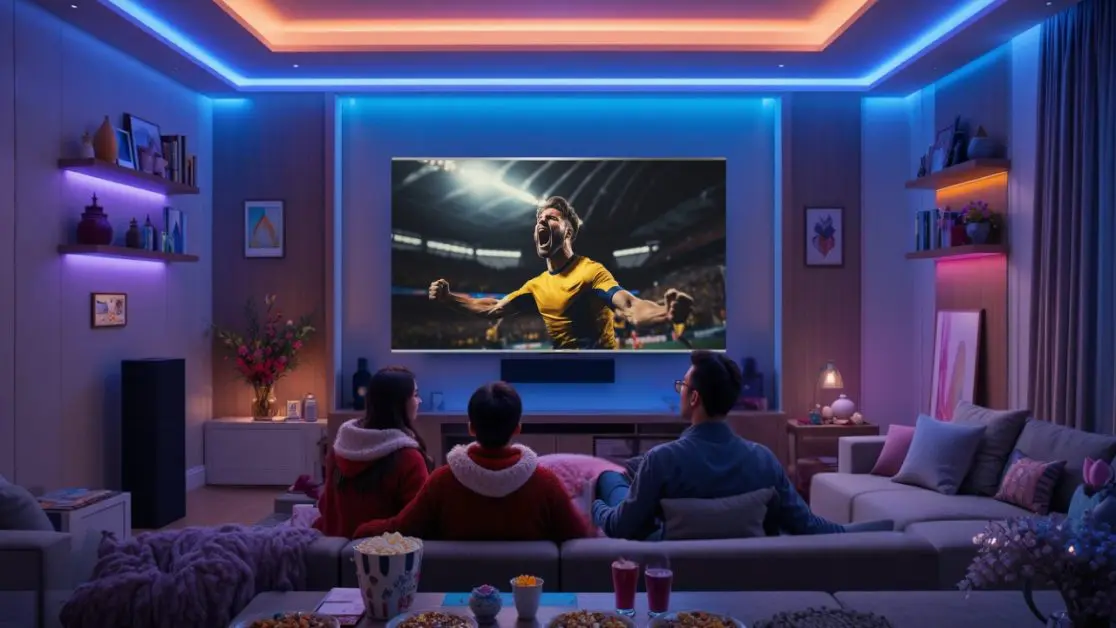
Premier League football is built on speed.
Wingers explode down the touchline.
Midfield transitions happen in seconds.
A counterattack forms, peaks, and finishes before you process the buildup.
Your eyes keep up naturally.
Many TVs do not.
Traditional screens refresh fewer times per second. During rapid play, the image struggles to stay coherent.
The result is subtle blur, soft edges, and a sense that the picture is always a fraction behind the action.
A 144 Hz refresh rate closes that gap.
What 144 Hz Really Means During a Match
Refresh rate sounds technical, but the idea is simple.
It is the number of times your TV redraws the picture every second.
- 60 Hz refreshes the image 60 times
- 120 Hz refreshes it 120 times
- 144 Hz refreshes it 144 times
More refreshes mean smaller visual jumps between frames. Smaller jumps make motion look natural.
In Premier League terms, this means:
- The ball stays crisp during long passes
- Player outlines remain clear while sprinting
- Camera pans across the pitch feel smooth, not shaky
At 144 Hz, motion finally feels uninterrupted.
Why Premier League Broadcasts Expose Weak Screens
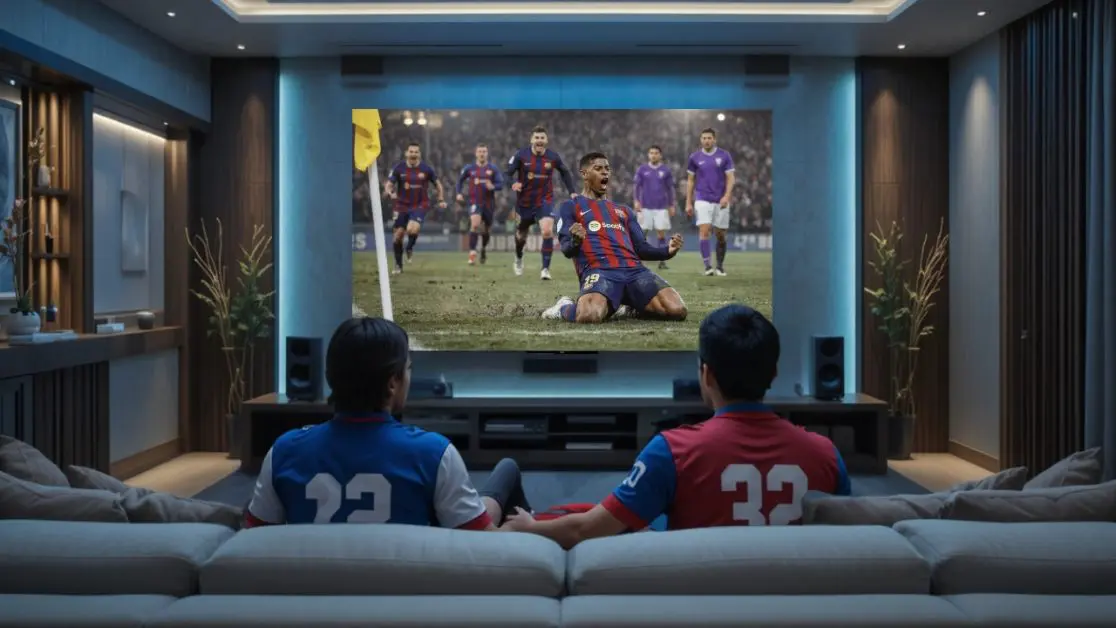
Football is one of the toughest tests for any TV.
Fast camera pans
When play switches from defence to attack, the camera moves instantly. Lower refresh rates often blur the pitch and soften player detail.
Crowded penalty boxes
Corners pack multiple players into tight spaces. Legs, jerseys, and boots overlap. Clear motion becomes critical.
Sudden counterattacks
These are the fastest moments in the game. Two touches can decide a goal. Any blur breaks immersion.
Higher refresh rates reduce motion blur in all these moments, without making the image look artificial.
Why 144 Hz Feels Easier on the Eyes
There is another benefit people notice subconsciously.
Smoother motion reduces visual strain.
When motion stutters, your brain works harder to predict where objects are moving. Over a full ninety minutes, that effort becomes tiring.
With a 144 Hz screen:
- Motion flows continuously
- Your eyes track movement naturally
- Long matches feel less exhausting
This is why higher refresh rates often feel more comfortable, even if viewers cannot explain why.
Slow Motion Replays Show the Difference Clearly
Watch a VAR replay on a standard TV.
Then watch it on a high refresh rate display.
At lower refresh rates, slow motion can look uneven.
At 144 Hz, each micro movement remains intact.
The moment the boot meets the ball.
The exact body position during a tackle.
The ball’s movement as it crosses the line.
Replays feel precise rather than processed.
Why Refresh Rate Matters More for Football Than Movies
Movies are controlled.
They are shot at fixed frame rates. Camera movement is planned. Motion is predictable.
Football is chaotic.
Cameras react to play in real time. Action unfolds without warning. Nothing is choreographed.
This is why refresh rate matters far more for live sport than for cinema. Football demands timing accuracy, not just good colour or brightness.
144 Hz is about keeping up with reality.
Where Features Start to Matter Together
A high refresh rate alone is not enough.
Motion clarity depends on how multiple systems work together.
- Panel response time
- Backlight control
- Motion processing
- Frame handling
When these systems are aligned, motion stays smooth without adding unnatural effects.
This is where TVs like the Haier M90 Mini LED 165cm (55) Google TV 144 Hz stands out. The model combines a 144 Hz refresh rate with Mini LED technology, advanced local dimming, and intelligent picture processing designed specifically for fast moving content like live sports .
The result is motion that feels calm even during chaos.
Why Mini LED Improves Fast Sports Viewing
Mini LEDs play a quiet but important role.
With hundreds of local dimming zones, brightness adjusts precisely across the screen. During night matches, dark areas stay controlled while bright jerseys and floodlights remain vivid.
This matters because motion blur becomes more noticeable when contrast is poor. Better control keeps moving objects clearly defined against the pitch.
On fast Premier League action, that added clarity makes every sprint and tackle easier to follow.
Dolby Vision IQ and HDR10+ in Live Matches
Live sports are not evenly lit.
Day matches, night matches, shadowed stands, and bright pitch lights all change the visual balance.
Technologies like Dolby Vision IQ and HDR10+ adapt brightness and contrast scene by scene. They adjust based on content and ambient light.
In real homes, this means:
- Afternoon matches remain visible in bright rooms
- Night matches retain depth without crushing detail
- Visual balance stays consistent throughout the game
The picture adapts quietly, without drawing attention to itself.
Sound Matters More Than You Expect
Visual clarity pulls you into the game. Sound keeps you there.
A powerful 2.1 channel speaker system with Dolby Atmos support adds depth to crowd noise and commentary. You hear the roar of the stadium, not just the voice of the commentator.
On match nights, this turns the living room into a shared experience rather than background viewing.
How 144 Hz Fits Into Real Indian Homes
Now step away from the specs.
It is a weekend evening.
Dinner is half finished.
Someone walks across the room.
You glance up during a counterattack.
On a lower refresh rate TV, the moment breaks.
On a 144 Hz screen, the action holds together even if you are not watching perfectly.
This is how football is actually watched at home.
Not glued to the screen.
Not in silence.
But in moments.
Smoother motion protects those moments.
Three Viewing Paths Most Homes Take
One option is staying with standard refresh rates
This is familiar and affordable. It works, but fast football reveals its limits.
The second option is upgrading to 120 Hz
Motion improves noticeably. Camera pans feel smoother. Many viewers stop here.
The third option is moving to 144 Hz
This adds extra headroom. Sudden bursts of speed feel more controlled. Motion stops drawing attention to itself.
At this level, the screen disappears and the game takes over.
Football Reveals a Bigger Truth About Technology
Here is the pattern worth remembering.
Good technology does not shout.
It removes friction.
When motion feels right, you stop noticing the screen.
You start noticing decisions, timing, and skill.
That principle applies beyond TVs.
It applies to appliances, tools, and systems we rely on daily.
The best ones fade into the background.
What This Means for the Future of Sports Viewing
Broadcast quality will continue to improve. Frame rates will rise. Cameras will capture more detail.
Screens need to keep pace.
A 144 Hz refresh rate is not about chasing numbers.
It is about matching the speed of real life.
Football simply exposes that need first.
The One Insight That Stays With You
Clarity in fast moments is not about sharper images. It is about better timing.
When your screen matches the rhythm of the game, everything looks cleaner.
Not exaggerated.
Not forced.
Just right.
Once you experience Premier League football that way, it becomes difficult to unsee the difference.