


In humid, post-rain weather when clothes refuse to dry, a front-load washing machine usually offers better spin efficiency, faster moisture removal, and fresher clothes.
But top-loads hold their own with convenience, gentler fabric care, and added heating features in some models.
The choice depends less on “better or worse” and more on your home’s rhythm and needs.
Why the post-rain laundry pile feels never-ending

Every Indian household knows this scene.
You step onto the balcony after a night of drizzle. The air feels heavy, almost sticky. Clothes hung since yesterday still smell faintly damp. Towels take forever to dry. School uniforms and office shirts become hostages to the weather.
This is where the washing machine quietly becomes the hero or the bottleneck. Because if your spin cycle leaves excess moisture, no amount of balcony sun will rescue you.
The real question: Spin or convenience?
The debate between front-load and top-load machines isn’t about prestige. It’s about systems.
- Front-load machines are like marathon runners. They spin at higher speeds (up to 1400 RPM in 9 kg Direct Motion models), wringing out more water, cutting drying time.
- Top-load machines are like sprinters. Quick access, easy loading, less bending, intuitive for busy mornings. 8–9 kg top-loads with Oceanus Wave Drums protect fabrics while still offering thorough cleaning
So in a season when clothes dry slowly, the front-loader’s efficiency shines. But the top-loader may still be the smarter fit for families who prize ease over marginal drying speed.
What science says about moisture removal
Laundry drying is essentially about reducing residual moisture content.
- Studies show that every 200 RPM increase in spin speed can cut drying time by up to 20%.
- Front-loaders like the 11 kg Direct Motion Super Drum series spin at 1400 RPM.
- Most top-loads in the Indian market hover around 700–1000 RPM, meaning more water left behind
In monsoon-soaked cities like Mumbai or Kolkata, that difference translates into hours of drying time.
When top-loaders quietly outperform
Yet, here’s the hidden system people miss: Drying isn’t only about spin.
Top-loads often come with in-built heaters. That means germs, odors, and even the “monsoon smell” get neutralised before clothes hit the drying rack.
Some also feature Ultra Air Fresh, a setting that ensures freshness even if clothes sit inside the drum for hours.
For a bachelor in Bengaluru who forgets to pull clothes out after a wash, this matters more than a few extra RPMs.
The posture and lifestyle test

Think beyond laundry. Think about your body.
- Front-loaders require bending or squatting. Fine in a new apartment with space for a pedestal, harder for older parents with knee issues.
- Top-loaders allow you to simply lift the lid and drop clothes in. Haier even designs them with soft-fall lids to avoid noisy slams
So if your monsoon laundry involves the whole family from kids tossing in socks to grandparents helping fold the ergonomics can outweigh spin speed.
A table for clarity
| Factor | Front-Load Machines | Top-Load Machines |
| Spin Speed | Up to 1400 RPM (faster drying) | 700–1000 RPM (slower drying) |
| Energy Efficiency | Typically 5-Star, uses less water | Good, but often higher water use |
| Fabric Care | Gentle tumbling, steam refresh | Oceanus Wave motion mimics natural wash |
| Convenience | Lower access, more bending | Easy drop-in loading |
| Monsoon Freshness | Steam & refresh modes keep clothes odor-free | Ultra Air Fresh, in-built heaters in some models |
| Price Range (Haier) | ₹37,000–₹60,000 | ₹20,000–₹26,000 |
Cost vs. comfort: where households decide
Indian homes don’t just calculate electricity bills. They calculate time saved, effort spared, and smell avoided.
- A working couple in Gurgaon may see a front-loader as ROI: fewer hours waiting for shirts to dry before office.
- A joint family in Chennai may value a top-loader: multiple washes a day, quick turnaround, everyone from kids to grandparents can operate it easily.
- A student in Pune may lean on affordability: entry-level 8 kg top-load at ~₹20,490 makes more sense than a ₹50,000 front-loader.
The monsoon “hack” no one talks about
Here’s the trick: it doesn’t have to be either/or.
Pairing high spin front-loads with a basic drying rack near a fan or AC can outperform both the balcony and the old iron-press trick.
Meanwhile, top-loads with in-built heaters can sanitise clothes so even if they stay damp longer, they smell fresh and resist mildew.
In other words, technology plus context beats blind preference.
Haier’s quiet edge in this debate
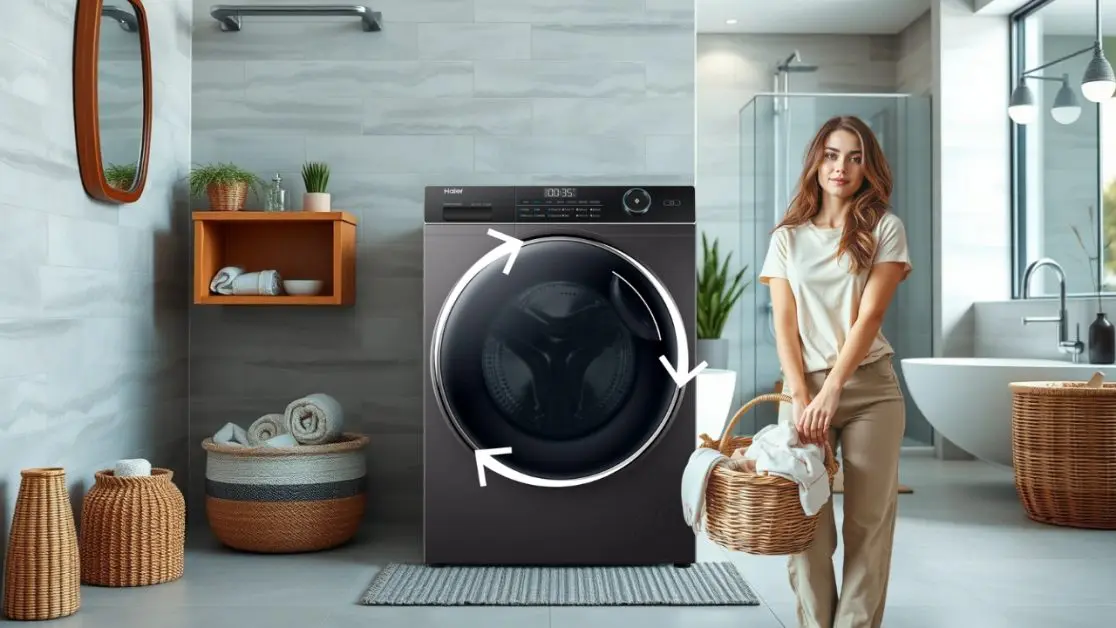
Haier doesn’t sell machines as just hardware. They design them as household systems.
- Direct Motion Motors in front-loads cut noise while running powerful spin cycles. Perfect for small apartments where the washing machine sits next to the living room.
- Oceanus Wave Drums in top-loads handle delicate saris and daily wear alike, reducing the need for hand-washing.
- Warranty coverage of 20 years on front-load motors, 10–12 years on top-load motors makes them future-proof investments.
These aren’t features for a brochure. They’re answers to the Indian monsoon problem.
So, which is “best”?
If you want a verdict:
- Choose front-load if: you live in a high-humidity city, need faster drying, and see laundry as a once-a-day focused task.
- Choose top-load if: your family values quick access, multiple washes, lower cost, and freshness features over spin speed.
Both can work in post-rain India. The “best” is simply the one that reduces your household friction.
Final thought: It’s not the weather, it’s the system
Rain will always slow down drying. That’s the climate’s system.
But how your household responds that’s where choice matters.
Front-loaders accelerate physics.
Top-loaders ease the habits.
Haier designs for both, so the real decision isn’t about rain at all.
It’s about what kind of household rhythm you want to protect when the skies refuse to clear.