


Festivals are meant to be felt, not just seen.
If you’ve ever joined a Ganesh Chaturthi aarti in Mumbai or Pune, you know the sound of dhols isn’t background noise, it’s the heartbeat of the celebration. The shimmer of lights on a pandal isn’t decoration, it’s part of the devotion.
But what happens when distance, traffic, or sheer crowd overwhelm keeps you from being there in person?
That’s where the living room steps in. And not just any living room. A living room powered by a big-screen smart TV that doesn’t just show you the darshan, it makes you feel like you’re standing in front of Bappa himself.
Why do we crave grandeur in our darshan?

Because Ganesh Chaturthi isn’t just about devotion it’s about scale.
- The larger-than-life idols.
- The endless lines of devotees.
- The colours, the chants, the collective energy.
When you watch it on a small screen, say, a phone, you shrink that experience into inches. But when you bring it onto a 98-inch QLED Smart TV, something changes. The idol looks magnificent, the aarti feels cinematic, and the celebration suddenly has room to breathe in your home.
It’s not an exaggeration , it’s a translation. Translating the grandeur of the pandal into the scale of your own space.
From pandal to pixels: how technology redefines tradition
Indian families have always adapted rituals to changing times. From handwritten aarti books to printed pamphlets, from cassettes to YouTube bhajans we’ve always found new mediums to keep the devotion alive.
The smart TV is just the next step.
Today, you can stream live darshans from Siddhivinayak or Lalbaugcha Raja with a clarity that feels almost surreal. Pair that with 4K resolution, Dolby Vision, and 144Hz refresh rate, and suddenly your living room becomes an extension of the pandal.
Technology doesn’t replace faith. It amplifies it.
What does a big-screen darshan look like in practice?

Picture this:
- Morning aarti: You and your family sit cross-legged, modaks on the table, streaming Lalbaugcha Raja live on a 98-inch QLED. The idol towers on the screen the way it does in real life. The saffron flags flutter, the lamps glow, and the sound system fills your space with chants that feel alive.
- Evening visarjan: Instead of scrolling through shaky Instagram videos, you’re watching the immersion procession in UHD, the Ganesh idols moving through Mumbai streets with a detail so sharp you can almost spot the beads of sweat on devotees’ foreheads.
- Family bonding: Parents, kids, grandparents everyone can watch without squinting. No one leans in to see the screen. Everyone leans back, together.
This is what technology at its best does: it dissolves distance, preserves scale, and lets tradition reach every home.
Why a big-screen QLED Smart TV fits this moment
Now, here’s the subtle but important part: not all big screens are created equal.
One option is size without substance, a large screen but flat colours, blurry pixels, and lagging video. That feels less like darshan and more like duty.
The second option is the 98-inch QLED Google TV (98S9QT). Here’s why it matters:
- Picture Brilliance: Colours don’t wash out – they glow, they radiate, they stay true.
- Dolby Vision IQ + HDR10+: Every detail in shadow and highlight is preserved, whether it’s the sparkle of gold ornaments or the texture of clay on the idol.
- 144Hz Refresh Rate: Processions aren’t blurry. Fast camera pans keep up with the rhythm of the dhol.
- Google TV smart ecosystem: One remote, one interface, endless choices whether it’s live darshans on YouTube, devotional films, or even post-aarti movie nights.
- Immersive audio: Dolby Atmos doesn’t just play chants. It surrounds you in them.
So the TV isn’t just a gadget. It becomes part of the ritual.
The subtle shift: from entertainment hub to cultural stage
Most people buy a big-screen TV for cricket or OTT marathons. But festivals reveal a deeper truth:
The television isn’t just for watching. It’s for gathering.
During Ganesh Chaturthi, the TV becomes a stage where rituals unfold, where families participate, and where tradition meets technology. In many ways, it’s no different from the community pandal; it’s just scaled down to your home, yet scaled up in experience.
What about those living away from home?

For the millennial in Bengaluru whose parents are in Nagpur. For the Gen Z student in Delhi who misses Mumbai’s immersion processions. For the family settled abroad who longs for the smell of agarbatti and sound of the aarti.
The big-screen smart TV is a bridge. A way to stay rooted without being physically present. A reminder that devotion isn’t bound by geography it’s only bound by how you choose to experience it.
What does this mean for the way we celebrate?
Three shifts are clear:
- Accessibility over proximity: You don’t need to fight traffic for hours to get darshan. It comes home.
- Collective experience in private spaces: Homes turn into small pandals, bringing together family and neighbours.
- Technology as an enabler of culture: Instead of distracting us from rituals, devices like Haier’s big-screen TVs make them richer, sharper, and more inclusive.
The implication is profound. Festivals are no longer either/or either you’re at the pandal or you’re not. They’re now both/and you can celebrate traditionally and digitally, with no loss of emotion.
Ganesh Chaturthi as a test case for the future of rituals
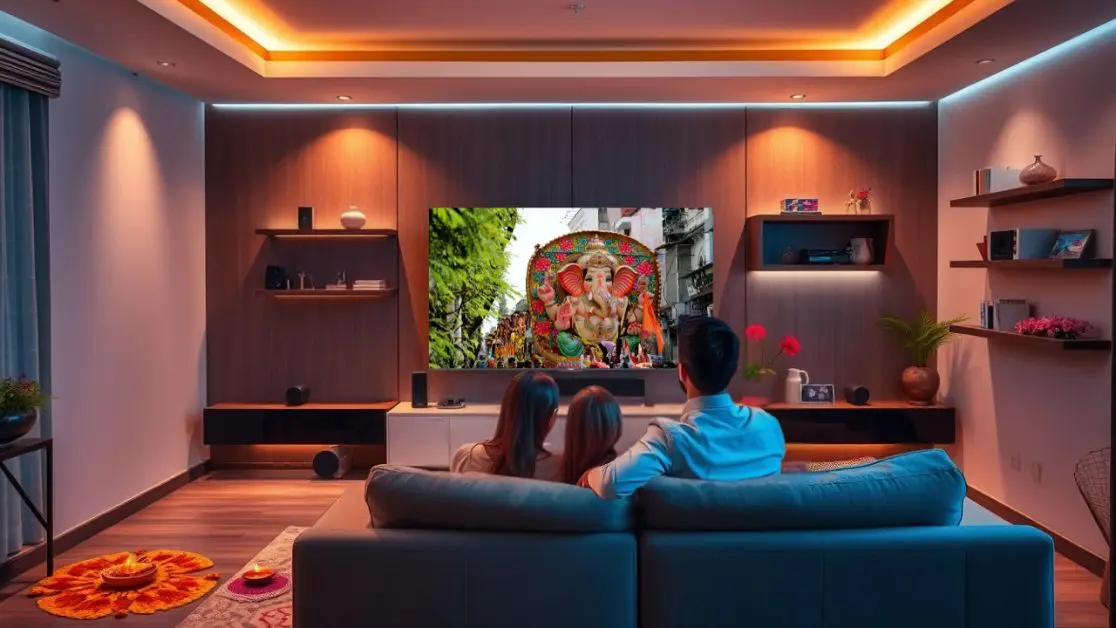
Think about it: If a big-screen TV can make Ganesh darshan feel alive, what happens during:
- Diwali aarti with diyas glowing brighter on screen.
- Navratri garba nights streamed from Gujarat with every twirl visible in detail.
- Live cricket during Holi gatherings because rituals and entertainment coexist in Indian households.
We’re witnessing not the death of tradition, but its upgrade.
The aphorism that stays
When devotion meets definition, faith feels larger than life.
Ganesh Chaturthi reminds us that rituals are about immersion. Not just in water, but in experience. The idol immerses into the sea, but the emotion immerses into us.
A big-screen smart TV doesn’t replace the pandal. It extends it. Into homes, into families, into memories that feel grand, even in a small room.
Closing thought
So this year, as you prepare the modaks, arrange the flowers, and light the incense, think about where you’ll gather for darshan.
Maybe the answer isn’t outside in the crowd. Maybe it’s right in your living room on a screen that turns devotion into spectacle, and spectacle into something intimate.
Because sometimes, the grandest darshan isn’t the one you travel to. It’s the one that comes home to you.