
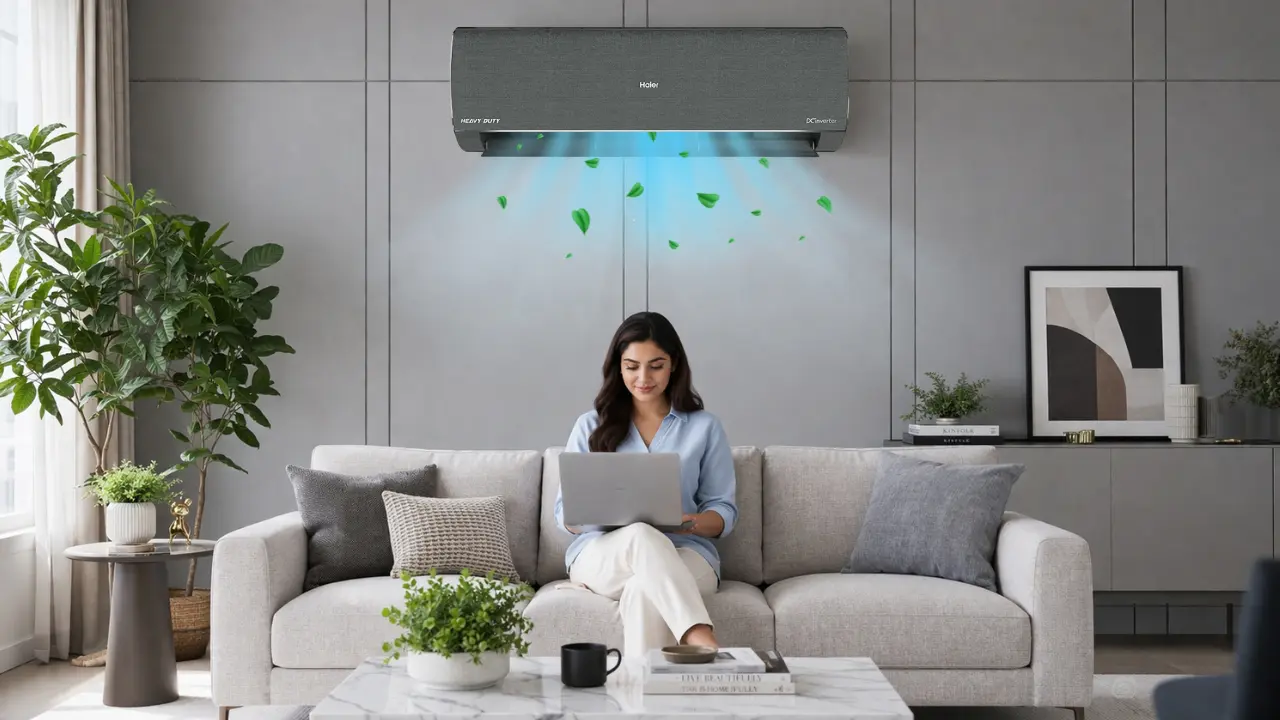

Cooling capacity is not just about how fast an AC cools a room. It is about how intelligently it adapts to space, weather, and human behavior.
While most brands focus on raw tonnage, Haier combines capacity with AI-driven optimization, making cooling faster, more targeted, and more energy-efficient in real Indian conditions.
A familiar Indian summer problem.
It is 2:30 PM in May.
The sun sits right above your building. The walls feel warm. You switch on the AC and wait.
Five minutes. Ten minutes. Still adjusting.
Now imagine something different.
You walk in. The room already feels balanced. Not too cold. Not uneven. Just right.
That difference is not just about cooling power.
It is about how that power is used.
And that is where the comparison between Haier and other brands truly begins.
What does cooling capacity really mean?
Most people think cooling capacity is simple.
More tonnage equals better cooling.
But that is only one part of the story.
Cooling capacity actually depends on three technologies working together:
- Raw cooling output
Measured in tons. Defines how much heat an AC can remove. - Air distribution technology
How evenly cool air spreads across the room. - Intelligence layer
How the AC adapts to changing conditions.
Most brands focus heavily on the first.
Haier builds across all three.
The three ways brands approach cooling capacity
1. The traditional approach: Fixed cooling output
One option is simple.
The AC runs at a set capacity. You adjust the temperature manually.
Cost
- Lower upfront complexity
- Requires frequent manual control
Benefit
- Predictable performance
- Works in stable environments
Limitation
- Overcooling or undercooling happens often
- Energy waste increases
This is still the most common approach across many brands.
2. The inverter approach: Variable speed cooling
The second option improves things.
The compressor adjusts speed based on temperature.
Cost
- Slightly higher upfront investment
Benefit
- Better energy efficiency
- Reduced temperature swings
Limitation
- Still reactive, not Pre-cooling
- Depends on user input
Many brands now operate here.
3. The intelligent approach: Adaptive cooling technology
The third option changes the game.
Cooling becomes a technology that learns, predicts, and responds automatically.
This is where Haier’s AI-powered cooling stands out.
How Haier redefines cooling capacity
Haier does not treat cooling as a number.
It treats it as a living technology.
According to the AI Atmox, the AC continuously analyzes environment, usage patterns, and human behavior to optimize cooling dynamically .
That means cooling capacity is no longer fixed.
It becomes flexible. Context-aware. Precise.
Breaking down Haier’s intelligent cooling technology
AI Climate Control: Cooling that learns
Most ACs wait for you to act.
Haier’s technology is observed first.
- Tracks temperature, humidity, and usage
- Learns patterns over time
- Adjusts cooling automatically
The result is simple.
Comfort without constant intervention.
AI Pre-Cooling: Capacity before you arrive
Traditional ACs start working after you switch them on.
Haier changes that sequence.
- Uses location-based triggers
- Starts cooling before you enter
- Covers up to 100 meters Pre-cooling range
Cost
- Requires initial setup
Benefit
- Eliminates waiting time
- Delivers instant comfort
Cooling capacity here is not just power.
It is timing.
AI Target Cooling: Focused power, not wasted power
Most ACs cool the entire room equally.
Even empty corners.
Haier directs cooling where it is actually needed.
- Uses installation and layout data
- Targets specific zones
- Reduces unnecessary cooling
Cost
- Slight learning curve during setup
Benefit
- Faster perceived cooling
- Lower energy consumption
This is the hidden truth.
Cooling feels faster when it is focused.
AI Eco 2.0 and Power Manager: Capacity meets efficiency
Cooling capacity without control leads to high bills.
Haier balances both.
- Adjusts power levels in real time
- Switches between Eco modes based on temperature gaps
- Tracks electricity usage with detailed insights
For example:
- More than 3°C gap triggers higher cooling mode
- Smaller gaps reduce power automatically
Cost
- None in daily usage
Benefit
- Lower electricity bills
- Optimized long-term performance
Comparison: Haier vs other brands in cooling capacity
| Factor | Traditional Brands | Haier Approach |
| Cooling Start | After manual input | pre-cooling |
| Air Distribution | Uniform, often inefficient | Targeted, layout-based |
| Adaptability | Reactive | Proactive and learning-based |
| Energy Use | Higher due to overcooling | Optimized through AI |
| User Effort | High | Minimal |
| Real Comfort | Inconsistent | Consistent and personalized |
Why cooling feels different, even at the same temperature
Two rooms.
Both set at 24°C.
One feels comfortable.
The other feels harsh.
Why?
Because cooling is not just temperature.
It is:
- Airflow direction
- Humidity balance
- Cooling timing
- Human presence
Haier’s technology accounts for all of this.
Most traditional technologies do not.
The hidden technology most buyers miss
Here is a simple insight.
Cooling capacity is not what the machine can do. It is what you actually feel.
Most buyers compare specs.
Few think about experience.
But experience is shaped by invisible technology:
- When cooling starts
- Where cooling goes
- How cooling adjusts
Haier builds for these invisible layers.
How this plays out in real Indian homes
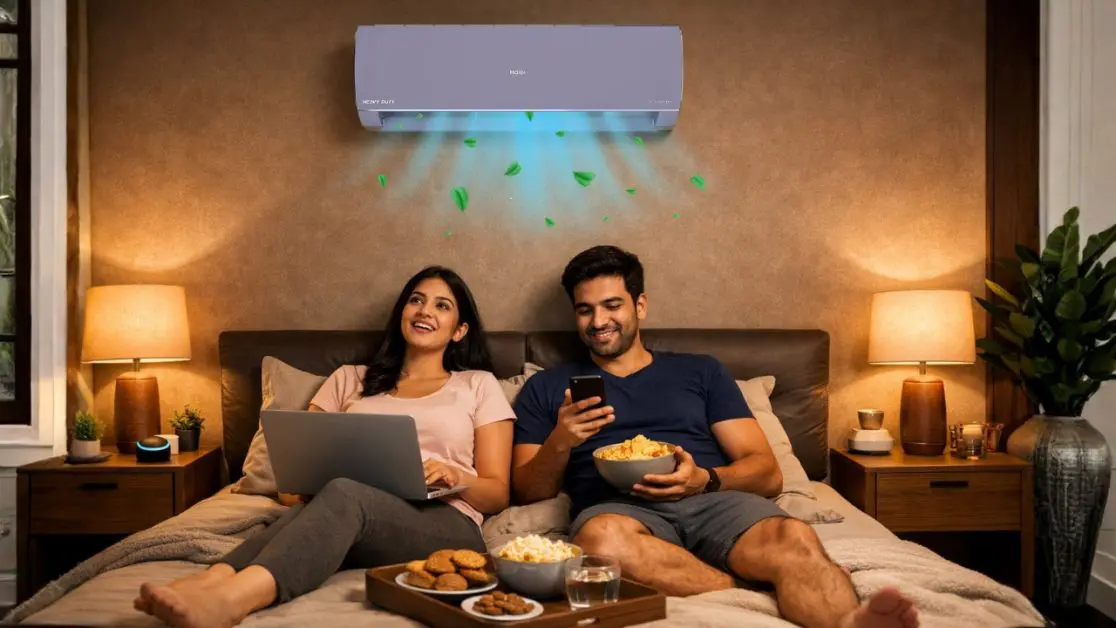
Scenario 1: Working professional returning home
- Traditional AC: Waits 10 minutes to cool
- Haier AC: Room is already comfortable
Scenario 2: Family living room
- Traditional AC: Overcools entire space
- Haier AC: Focuses cooling where people sit
Scenario 3: Nighttime usage
- Traditional AC: Constant manual adjustments
- Haier AC: Automatically maintains balance
The difference is subtle.
But repeated daily, it becomes significant.
The cost of choosing the wrong cooling technology
Choosing based only on tonnage leads to:
- Higher electricity bills
- Uneven cooling
- Frequent adjustments
- Shorter appliance lifespan
Choosing based on technology intelligence leads to:
- Consistent comfort
- Lower energy consumption
- Less mental load
- Better long-term value
One insight that changes how you compare ACs
Most people ask:
“How powerful is this AC?”
The better question is:
“How intelligently does this AC use its power?”
Because power without intelligence creates waste.
Intelligence without power creates inefficiency.
The right technology combines both.
So, which cooling capacity actually matters?
One option is to choose based on tonnage alone.
The second option is to choose inverter-based technology for efficiency.
The third option is to choose technology that combines capacity with intelligence.
That third option is where modern cooling is headed.
The future of cooling is not louder. It is smarter.
Cooling is becoming invisible.
You do not think about it.
You just feel it.
Haier’s approach reflects a larger shift.
From machines that respond
To technology that anticipate
From cooling as a feature
To cooling as an experience
And once you experience that shift, going back feels outdated.
Final thought
The best cooling technology is not the one that works the hardest. It is the one that works the smartest.
Because in the end, comfort is not measured in tons.
It is measured in moments.
Moments where you walk into a room and feel at ease instantly.
Moments where you stop thinking about the machine altogether.
That is the real benchmark.
And that is where the comparison truly ends.
Frequently Asked Questions
I’m confused. Should I just pick higher tonnage for better cooling?
Not necessarily. Higher tonnage only increases raw cooling power. Real comfort depends on how efficiently that power is used. Intelligent systems like Haier’s AI cooling adjust output dynamically, so even lower tonnage can feel more effective.
I keep comparing specs, but how do I know which AC will feel better?
Specs don’t capture airflow direction, humidity control, or timing. ACs with adaptive technologies (like AI-based cooling) tend to feel more comfortable because they optimize these invisible factors.
Is inverter AC enough, or should I go for AI-based cooling?
Inverter ACs are a step forward, they save energy and reduce fluctuations. But they are still reactive. AI-based systems go further by predicting needs, pre-cooling rooms, and adapting continuously.
Is AI in ACs just marketing, or does it really help?
It helps when implemented well. In Haier’s case, AI tracks usage patterns, adjusts cooling automatically, and reduces manual intervention making everyday use easier and more efficient.
What is AI pre-cooling and do I really need it?
AI pre-cooling uses location or usage patterns to start cooling before you arrive. It’s useful if you regularly return home at fixed times or during peak heat.
Will AI cooling reduce my electricity bill?
Yes, because it avoids overcooling, adjusts power levels dynamically, and uses eco modes intelligently.
Does AI cooling require constant setup or monitoring?
Initial setup may take a little time, but after that, it runs automatically and learns your preferences.