
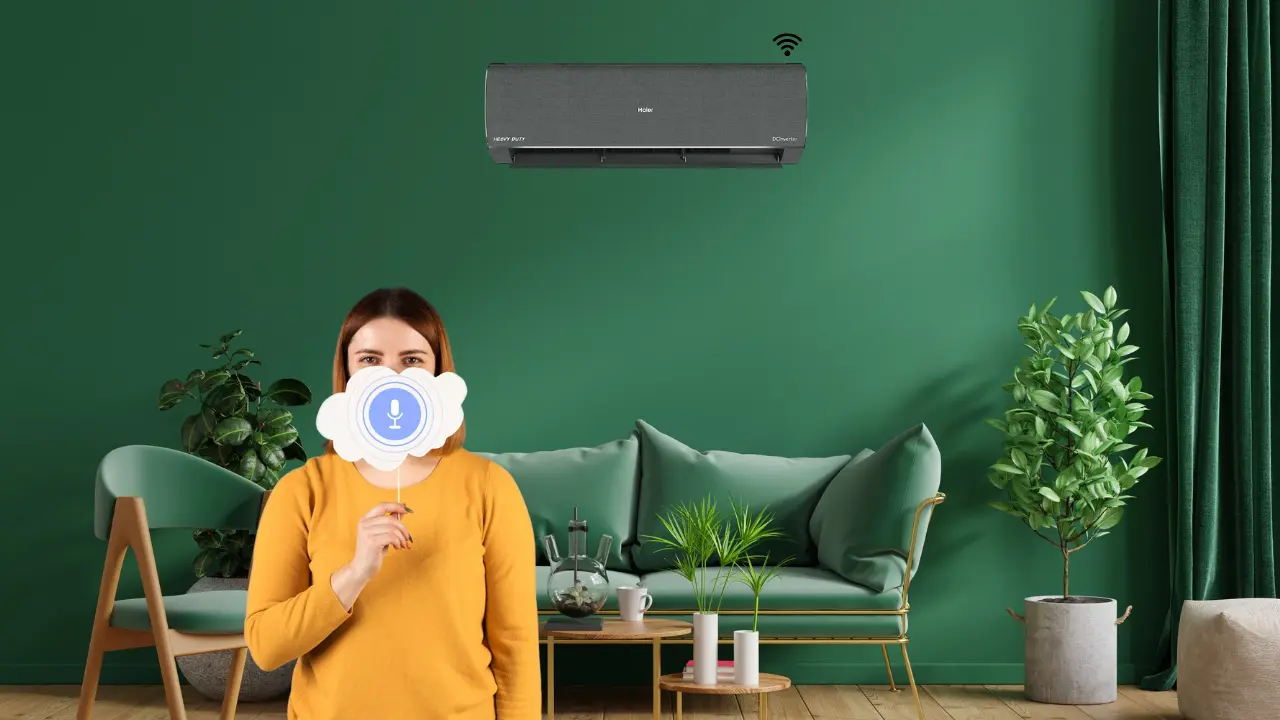

Hands-free cooling lets you control your air conditioner using simple voice commands, without reaching for a remote or app.
In real Indian homes, this means adjusting temperature while cooking, settling kids to sleep, or walking in tired after work. It removes friction from comfort and turns cooling into something that quietly responds, instead of something you constantly manage.
That is the promise.
But the real story is deeper than convenience.
The moment that reveals the problem
It is 7:45 pm.
The stove is on.
One hand is stirring dal.
The other is holding a phone with a recipe video.
The room feels warmer by the minute.
This is the exact moment when traditional AC control breaks down.
You either ignore the heat.
Or you stop everything to find the remote.
Or you open an app, unlock your phone, tap through menus.
Small frictions. Repeated every day.
And this is where hands-free cooling begins to matter.
Why voice control feels like a lifestyle shift, not a feature
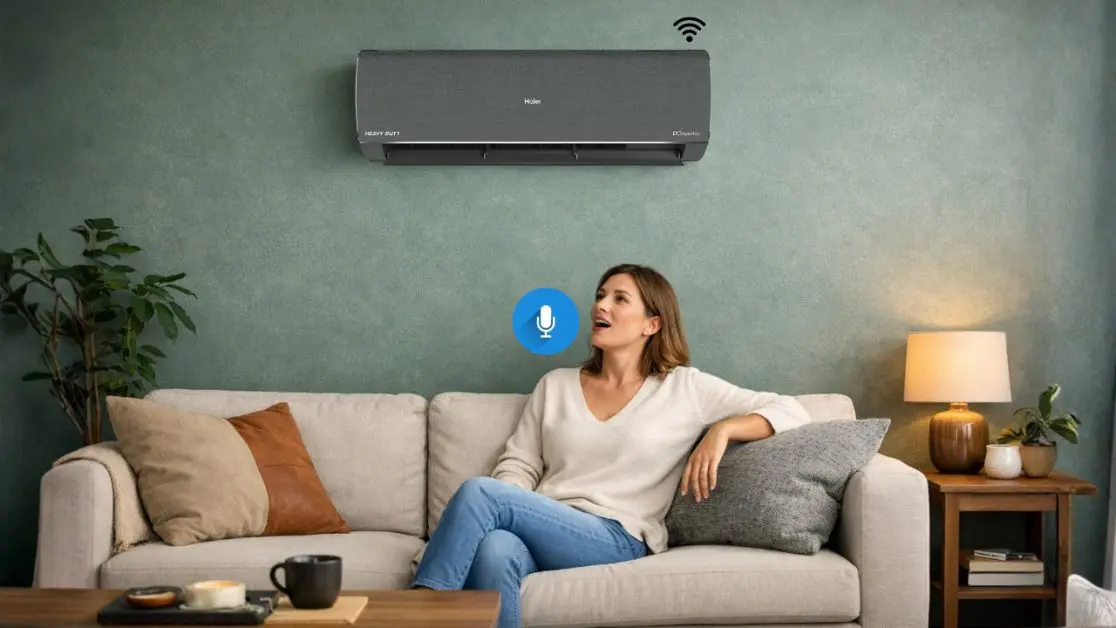
Most people think voice control is about novelty.
Say something.
The machine responds.
Nice trick.
But in practice, voice control changes how cooling fits into your day.
Because the real upgrade is not talking to your AC.
It is not having to think about controlling it at all.
When control disappears, comfort becomes the background.
And background comfort is what modern homes actually need.
How hands-free cooling works in real homes
At its simplest, voice-controlled cooling allows you to say commands like:
- Turn the AC on
- Set temperature to 24 degrees
- Reduce cooling
- Switch to sleep mode
No app.
No remote.
No visual attention required.
According to industry adoption data, voice-enabled smart home devices have seen consistent year-on-year growth in Indian metros, driven largely by ACs, lighting, and entertainment systems. The pattern is clear.
The more hands-busy our lives become, the more voice fills the gap.
But the best systems go beyond basic commands.
When voice control connects to intelligence

Here is where things get interesting.
Voice control alone removes effort.
AI-powered cooling removes decision-making.
Together, they form a system.
Some modern air conditioners combine Direct Voice Control with AI Climate Control, allowing the system to understand context, usage patterns, and environment before responding.
So when you say, “It feels warm,” the system does not just lower the temperature blindly.
It adjusts cooling based on room size, humidity, and recent usage behavior.
This is not magic.
It is pattern recognition at work.
And it matters because overcooling wastes power while undercooling breaks comfort.
The Indian home problem voice control solves best
Indian homes are dynamic.
Rooms are not used the same way all day.
Families move between spaces.
Weather shifts from dry heat to humid evenings.
Fixed schedules struggle here.
Hands-free cooling paired with AI adapts better because it reacts to presence, timing, and real usage instead of assumptions.
One example highlighted in Haier’s AI-powered cooling ecosystem is AI Pre-Cooling, where the system predicts arrival and prepares the room in advance. Combined with voice control, it creates a simple loop.
You arrive.
You speak.
The room responds.
No setup rituals required.
Three everyday scenarios where hands-free cooling shines
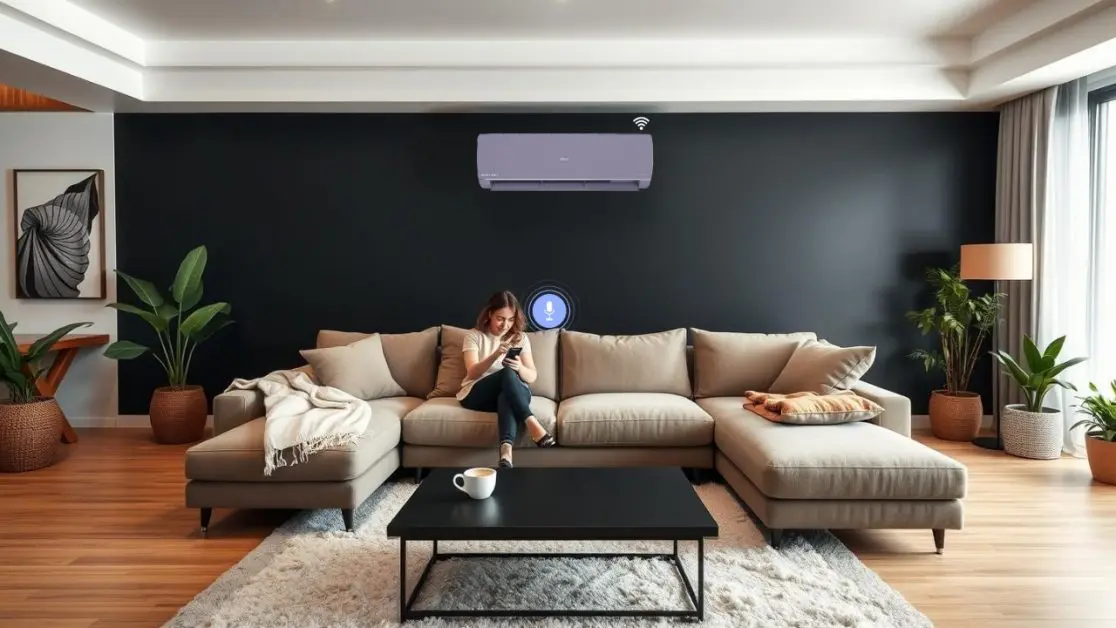
1. Cooking hours
The kitchen spills heat into living spaces.
Hands are wet or occupied.
Remotes are always far away.
Voice commands let you adjust cooling instantly without breaking flow.
Cost: Minimal learning curve
Benefit: Immediate comfort without interruption
2. Bedtime routines
Lights dim.
Children settle.
Nobody wants to move.
A simple voice command can lower temperature or switch to sleep-friendly modes.
This matters because sleep quality is closely tied to consistent, comfortable room temperatures, especially in warm climates.
Cost: Initial setup
Benefit: Fewer disturbances during sleep cycles
3. Solo workdays
You move between calls.
You pace the room.
Your phone stays busy.
Hands-free cooling adapts without adding another task to your mental load.
Cost: Trusting automation
Benefit: Reduced decision fatigue
The hidden system behind voice-based comfort
Here is the insight most people miss.
Voice control is not about control at all.
It is about removing micro-decisions.
Every time you decide whether to adjust the temperature, you pay attention. Over a month, that attention adds up.
Systems that reduce decision-making free cognitive space.
And homes that have free cognitive space feel calmer.
That is why hands-free cooling feels like relief, not luxury.
Energy efficiency and voice commands are connected
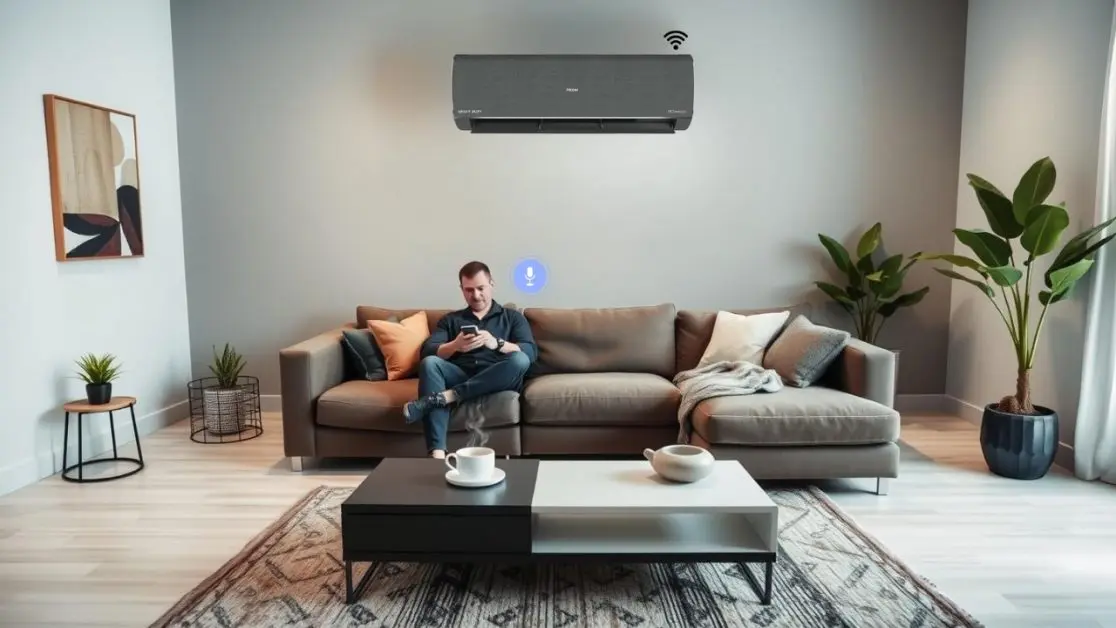
There is a common fear.
“Will I use more electricity if it is so easy to control?”
In practice, the opposite happens.
Voice control encourages small adjustments instead of extreme ones.
Instead of dropping temperature sharply, people tweak settings more often.
When combined with features like AI Eco 2.0 and Electricity Monitoring 2.0, users can see how minor changes affect consumption and learn better habits naturally.
Smart systems make efficiency visible.
Visibility shapes behavior.
This is where technology quietly teaches without lectures.
What makes voice control reliable, not gimmicky
For hands-free cooling to work, three things must be true:
1. Offline capability
Systems should respond even without Wi-Fi in select conditions.
2. Clear recognition
Commands must work across accents and background noise.
3. Context awareness
The system should understand what adjustment makes sense.
Haier’s Direct Voice Control is designed around these principles, integrating with its broader AI-AtmoX ecosystem to ensure voice is not an isolated feature but part of a larger intelligence loop.
Why this matters for future homes
Homes are becoming quieter.
Not in sound.
In friction.
The future of appliances is not about adding buttons or screens.
It is about removing them.
Voice is just the bridge.
Eventually, systems will anticipate more and ask less.
Hands-free cooling is an early signal of that shift.
The bigger pattern worth noticing
Every major lifestyle upgrade follows the same arc.
First, it feels optional.
Then, it feels convenient.
Finally, it feels essential.
Think about automatic transmissions.
Or streaming instead of scheduled TV.
Or contactless payments.
Hands-free cooling is moving along the same curve.
Once people experience comfort without interruption, going back feels strange.
Where Haier fits into this story
Haier’s approach focuses on quiet intelligence.
Not shouting features.
Not forcing behavior.
But blending AI Climate Control, Direct Voice Control, energy monitoring, and self-cleaning systems into a single experience that adapts over time.
The result is not just cooler air.
It is a home that responds instead of reacts.
And that difference shows up in everyday moments, not spec sheets.
The insight to carry forward
The best technology disappears.
Not because it stops existing.
But because it stops demanding attention.
Hands-free cooling is not about talking to machines.
It is about letting machines listen, learn, and act so you do not have to.
That is how comfort becomes effortless.
And that is how modern Indian homes quietly move forward.