
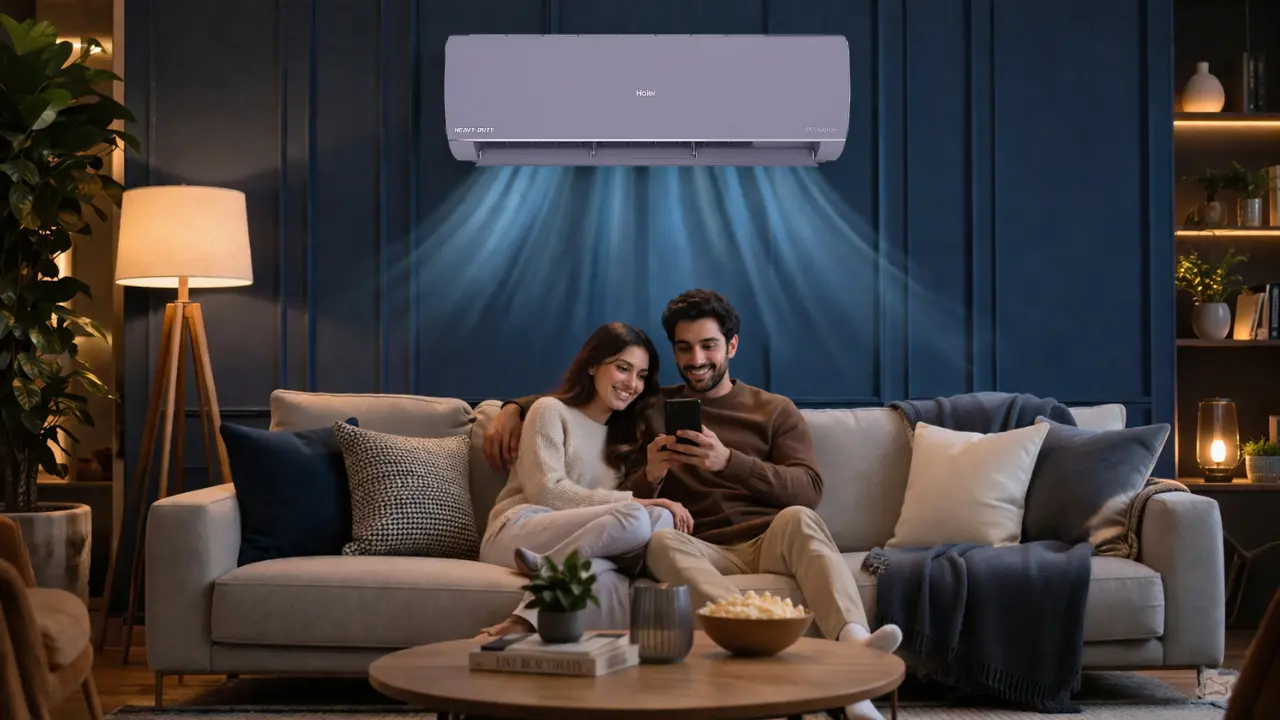

Human detection in ACs uses sensors and AI to identify presence, movement, and location of people in a room, then adjusts cooling automatically.
It tracks occupancy in real time, reduces cooling when no one is around, and directs airflow where people actually are. The result is simple. Less wasted energy. More precise comfort.
The moment that reveals the problem.
It is 7:15 pm in an Indian home.
Someone walks into the bedroom. Switches on the AC. Leave the room for dinner. The AC keeps running.
No one notices.
Thirty minutes later, the room is empty. The machine is still working.
That is not a technology problem.
That is a visibility problem.
Appliances do not know what is happening around them.
Human detection changes that.
Why traditional ACs always get it slightly wrong
Traditional air conditioners follow a simple rule.
Turn on. Cool everything. Keep running.
They assume:
- The room is always occupied
- Cooling demand stays constant
- People sit in one place
None of this is true in real homes.
In Indian households, movement is constant.
- Someone walks between rooms
- Kids run in and out
- A work call shifts from bedroom to living room
- Dinner pulls everyone to the dining area
Cooling systems miss this pattern.
And what systems miss, they waste.
What is human detection technology in ACs, really?
At its core, human detection is about awareness.
Not just temperature awareness.
But presence awareness.
Modern ACs use a combination of:
- AI pattern learning
- Occupancy mapping
In Haier’s AI-driven systems like AI Atmox, this goes a step further. The system combines human perception with environmental data to optimize cooling automatically .
The AC does not just react.
It observes. Learn. Adjusts.
How human detection actually works step by step
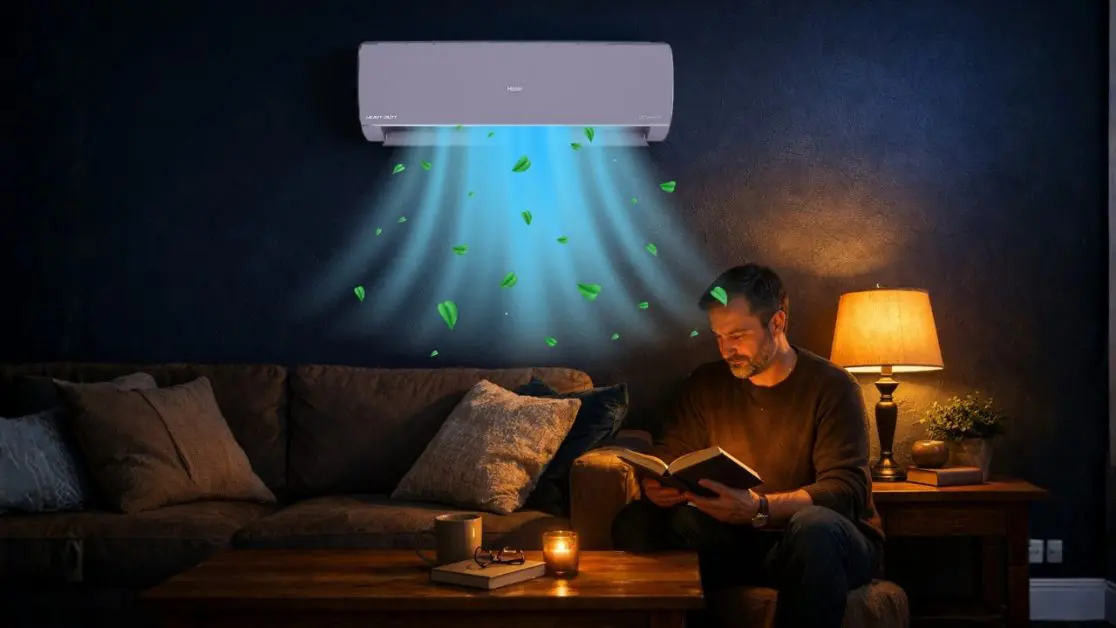
Step 1: Detecting presence
Sensors scan the room continuously.
Most systems use:
- Infrared sensors to detect body heat
- Motion sensors to track movement
- Range detection up to 10 to 12 metres in modern ACs
The AC now knows one thing.
Someone is here.
Step 2: Understanding activity
Detection is not enough.
The system needs context.
Is the person:
- Sitting still
- Walking around
- Leaving the room
AI models analyze movement patterns over time.
This is where systems start becoming intelligent.
Step 3: Mapping the cooling need
Once presence is confirmed, the AC decides:
- Where to direct airflow
- How much cooling is needed
- Whether to maintain or reduce power
For example, AI Target Cooling focuses airflow exactly where a person is sitting instead of cooling the entire room .
Comfort becomes directional, not general.
Step 4: Detecting absence
This is where real savings happen.
When no activity is detected:
- Cooling reduces automatically
- Energy-saving mode activates
- System may switch off after a set time
Some systems shift to low power in 15 minutes and shut down in 30 minutes of inactivity .
No reminders needed.
No manual effort required.
Step 5: Learning behavior over time
This is the quiet upgrade most people miss.
The system starts learning:
- When you usually enter the room
- How long you stay
- Preferred temperature patterns
Over time, the AC builds a personalized cooling model.
Not for “a user”.
For your life.
The three modes of human-aware cooling
Human detection is not a single feature.
It operates through layered decisions.
One option: Passive detection
- Detects presence or absence
- Turns AC on or off accordingly
- Basic energy saving
Cost: Lower intelligence
Benefit: Immediate energy savings
Second option: Adaptive cooling
- Adjusts temperature based on activity
- Reduces overcooling
- Maintains comfort stability
Cost: Slightly higher processing
Benefit: Balanced comfort and efficiency
Third option: Pre-cooling intelligence
- Learns routines
- Prepares cooling in advance
- Combines occupancy with environment data
Cost: Requires AI integration
Benefit: Seamless, invisible comfort
This is where systems like AI Atmox stand out.
They do not just respond.
They anticipate.
What changes inside your home when ACs start “seeing” people
The shift is subtle.
But powerful.
1. Cooling becomes personal
Not the whole room.
Just where you are.
Like a spotlight in a theatre.
Focused. Intentional. Efficient.
2. Energy savings become automatic
Most Indian households waste 20 to 30 percent energy on idle cooling.
Human detection reduces this quietly.
No habit change required.
3. Comfort becomes consistent
No sudden overcooling.
No temperature swings.
The system maintains balance.
Comfort stops being reactive.
A simple comparison that explains everything
| Feature | Traditional AC | Human Detection AC |
| Awareness | None | Detects presence |
| Cooling pattern | Entire room | Targeted cooling |
| Energy usage | Constant | Dynamic |
| Response to empty room | None | Reduces or shuts off |
| Learning ability | No | Yes |
Old systems cool spaces.
New systems understand behavior.
Why this matters more in Indian homes
Because Indian homes are dynamic systems.
Not static boxes.
- Multi-room movement
- Joint families and varied schedules
- Work-from-home shifts
- Frequent entry and exit
A static cooling system cannot keep up.
A responsive one can.
The hidden system most people miss
Every appliance follows one of two models.
- Reactive systems wait for instructions
- Intelligent systems reduce the need for instructions
Human detection belongs to the second category.
It removes decisions.
And removing decisions is the real luxury.
How it connects to the future of smart living
AI Human detection is not just about ACs.
It is a pattern.
The same principle applies to:
- Lighting that switches off automatically
- Refrigerators that adjust cooling based on usage
- Washing machines that optimize cycles
All moving toward one idea.
Homes that respond, not homes that wait.
So what should you take away from this?
Do not think of human detection as a feature.
Think of it as a shift in how appliances behave.
From tools to systems.
From commands to context.
From control to intelligence.
The one insight that stays
The best technology does not ask for attention. It removes the need for it.
Human detection in ACs does exactly that.
It notices when you are there.
It adapts when you are not.
And somewhere in between, it makes life feel just a little more effortless.
Frequently Asked Questions
Do I really need an AC with human detection, or is it just a fancy add-on?
Human detection isn’t just a “nice-to-have.” It addresses a real inefficiency of cooling empty rooms. In homes with regular movement (which is common in most Indian households), this feature can significantly reduce unnecessary power usage without requiring any effort from you.
Will this actually lower my electricity bill, or is that just marketing?
It can genuinely lower your bill. If you often leave the AC running unintentionally, human detection helps cut down idle cooling which can account for roughly 20–30% of wasted energy.
Is AI-based cooling like Haier’s AI Atmox worth the extra cost?
If you prefer automation and consistent comfort, then yes. Systems like Haier AI Atmox don’t just detect presence they learn your usage patterns and adjust cooling proactively for better efficiency.
I already have an inverter AC. How is this different?
Inverter ACs regulate power based on temperature. Human detection adds another layer by adjusting cooling based on whether someone is actually in the room, not just how hot it is.
I turned on my AC and left the room. Will it keep running all night?
With a traditional AC, yes. With human detection, it will automatically reduce cooling or even shut off after a period of inactivity.
If I fall asleep without moving, will the AC think I’ve left?
No. These systems rely on infrared heat sensing, not just motion detection, so they can still recognize your presence even if you’re completely still.
My kids keep running in and out. Will the AC keep adjusting constantly?
It will adjust, but intelligently. These systems analyze patterns rather than reacting instantly to every movement, preventing unnecessary fluctuations.
I sometimes forget to turn off the AC before leaving home. Can this fix that habit?
It doesn’t fix the habit, it removes the need for it. That’s the real advantage.