
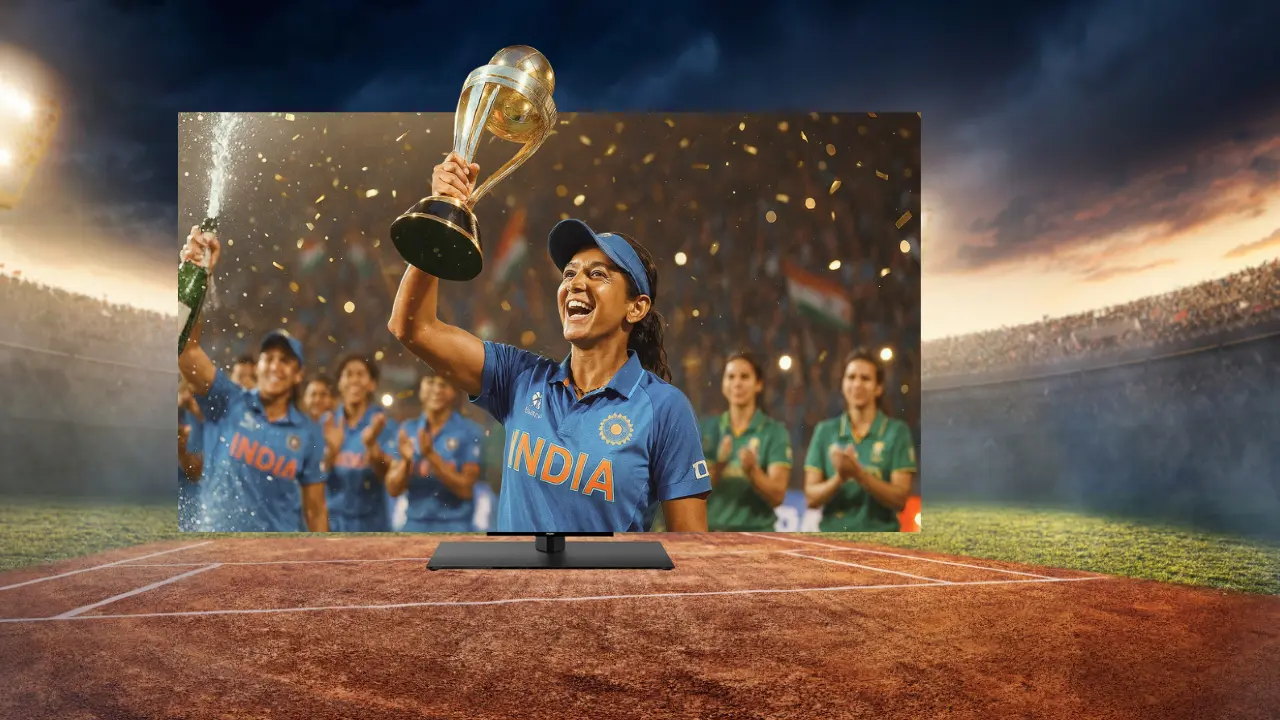

When India’s women lifted their first-ever World Cup trophy, it wasn’t just a match, it was a moment that lit up living rooms across the country.
A night when 4K screens turned walls into history books, and every cheer echoed like a heartbeat.
A win decades in the making

298 runs on the board.
Seven wickets down.
Fifty overs of grit.
And then, silence the kind that grips you right before history changes its course.
When Deepti Sharma’s fifth wicket sealed the match, and India beat South Africa by 52 runs at DY Patil Stadium, the roar that followed wasn’t limited to Navi Mumbai. It came from every home where families had gathered some on balconies, some sprawled across sofas, some clutching remote controls like lucky charms.
This was more than sport.
It was recognition long overdue for a team that had quietly built something monumental.
When a living room became a stadium
There’s something about live sport that defies words.
The goosebumps when Harmanpreet Kaur raised her arms.
The silence before the final ball.
The laughter that spills over when neighbours shout, “What a catch!”
At that moment, home and stadium blur. The crowd is on your couch, the floodlights shine from your TV, and your heart is beating in sync with eleven women chasing destiny.
That’s what the Women’s World Cup final felt like a collective heartbeat broadcast across a million screens.
And this time, it wasn’t watched in pixels. It was felt in 4K clarity, in Dolby Atmos sound, in living-room surround energy.
The screen that made history feel closer
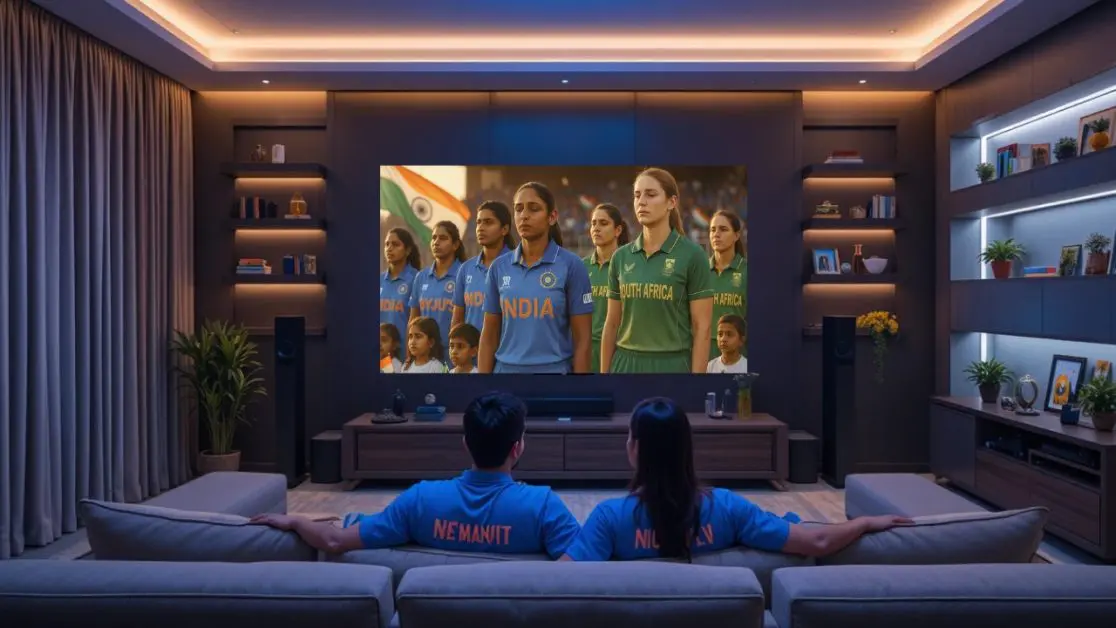
Technology didn’t create emotion. It simply removed the distance.
On a Haier C90 OLED 194cm (77) Google TV, colours didn’t just appear; they breathed. The green of the pitch shimmered under stadium lights, the tricolour waved with lifelike brilliance, and when the camera cut to the Indian dressing room you could almost hear the pulse of a nation.
That’s what Dolby Vision IQ does, it adjusts brightness and contrast based on your room’s light, so the game looks as vivid at midnight as it does under the afternoon sun.
And with 120Hz MEMC motion clarity, every fast delivery, every diving catch, every teardrop of victory plays out smoother than memory itself.
Sound matters too.
With Dolby Atmos 2.1 channel speakers, you don’t just hear the crowd you’re surrounded by. Each boundary reverberates, every chant rises like a wave. For one night, every home became a theatre of national pride.
Every home, one story
In Delhi, a father called his daughter “Turn up the volume, beta, this is the one.”
In Pune, a group of college friends live-streamed the match on their shared big screen, screaming like they were at DY Patil.
In Chennai, a grandmother who’d never missed a men’s match in her life said quietly, “This feels bigger.”
Moments like these remind us: the living room isn’t just furniture and walls. It’s where we come together, sometimes to argue, often to celebrate, always to feel something real.
The evolution of watching
A decade ago, we squinted at grainy highlights.
Today, our TVs anticipate what we want to watch next.
From app-controlled fridges to AI-powered air conditioners, Indian homes have evolved into living ecosystems of comfort and connection. The TV, once a passive screen, is now a shared canvas, a portal for family rituals, streaming marathons, and spontaneous national celebrations.
That’s what modern innovation looks like when it’s designed for emotion, not just entertainment.
The pride behind the pixels
What made this night special wasn’t just the 52-run win. It was the feeling that every household from high-rise apartments to small-town verandas was part of the same story. A shared rhythm of pride.
And for many, that story unfolded on a Haier screen with Dolby Vision IQ painting every colour true, 120Hz refresh rate making every moment fluid, and AI voice control letting you celebrate hands-free.
It wasn’t just television. It was a presence. The kind that makes history feel like it’s happening right in front of you.
When pride meets picture perfection
India’s first-ever Women’s World Cup victory didn’t just change the record books. It changed what home watching could mean.
Because when technology gets out of the way, what’s left is pure emotion.
A family huddled together.
A nation in sync.
And a screen big enough to hold it all.
As the confetti fell in Navi Mumbai, somewhere a young girl watched and whispered, “Someday, that’ll be me.”
Maybe she’ll train harder because she saw every shot in perfect detail.
Maybe she’ll dream bigger because she heard every chant surround her like wind.
And maybe that’s how history will repeat itself not on the field first, but in the living rooms that believe.