
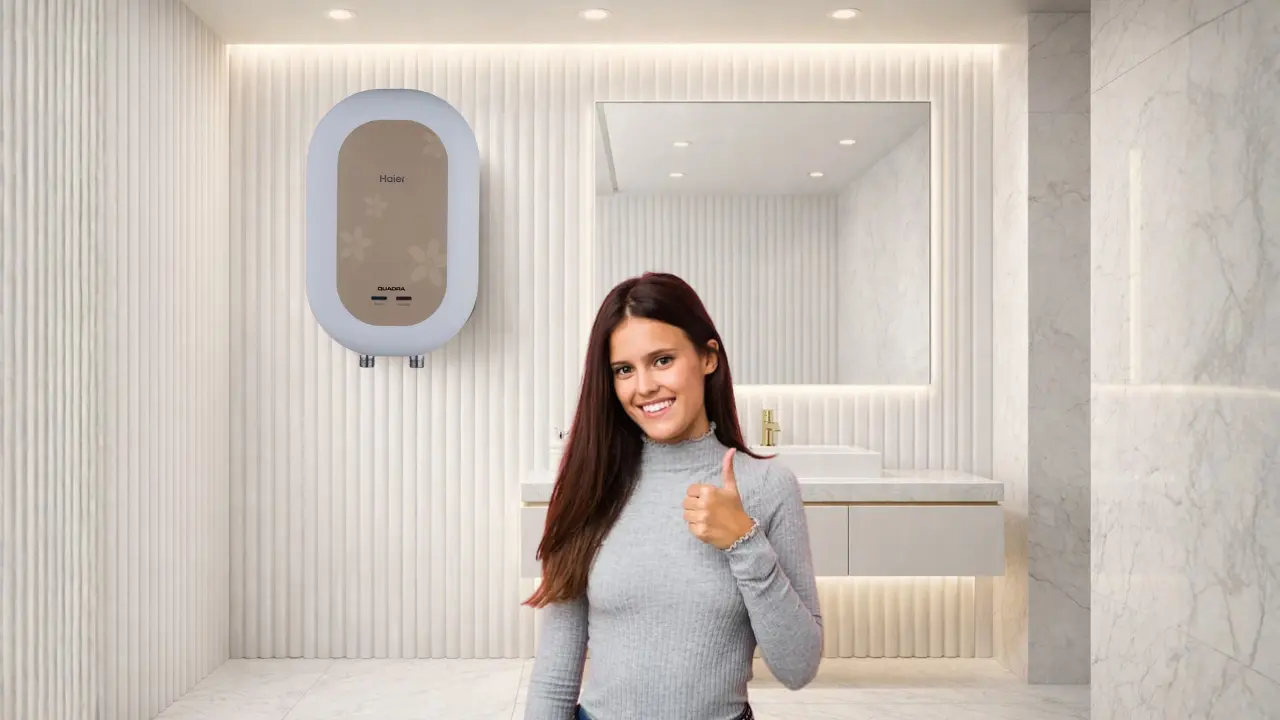

Faster hot water delivery means reducing the wait between turning on the tap and getting comfortable hot water.
Modern instant water heaters achieve this by heating smaller volumes of water quickly using high-power heating elements, efficient circulation systems, and compact tanks. The result is quicker showers, smoother routines, and less waiting in busy homes.
In practical terms, it removes one of the quiet frustrations of everyday life.
Cold water running while someone waits.
And in most Indian homes, mornings cannot afford that delay.
The morning rush reveals the real problem.
Picture a weekday morning in a typical apartment.
Someone turns on the geyser switch.
Someone else waits outside the bathroom.
Someone checks the time again.
“Hot water ready?”
That one question carries the tension of the entire morning schedule.
Tea is boiling.
Children are getting ready for school.
Office calls are waiting.
When hot water arrives slowly, everything behind it slows too.
A delayed shower pushes breakfast later.
A delayed breakfast pushes the commute later.
Small delays create large consequences.
That is why faster hot water delivery matters.
Not because it is fancy technology.
Because it protects the rhythm of everyday life.
Why Traditional Water Heating Feels Slow
Most traditional water heaters follow a simple system.
Heat a full tank of water.
Store it.
Use it later.
That approach works. But it introduces time delays.
Where the waiting happens
| Stage | What Happens | Time Impact |
| Tank filling | Cold water fills storage tank | Low delay |
| Heating cycle | Entire tank heated to set temperature | Major delay |
| Temperature stabilization | Thermostat maintains heat | Moderate delay |
Heating a large tank simply takes time.
Even powerful heating elements must raise the temperature of many litres of water.
In winter, the problem becomes more visible because incoming water is colder.
Cold water takes longer to heat.
Physics does not negotiate.
The Hidden Physics Behind Faster Hot Water
Hot water systems follow three basic variables.
Change them, and speed changes.
The three drivers of faster hot water
- Heating power
- Tank size
- Water circulation design
Think about boiling water in a kitchen.
A large pot takes time.
A small kettle heats quickly.
Water heaters behave the same way.
Compact tanks with strong heating elements reach usable temperatures faster.
Instant water heaters like the Haier 3L Instant Water Heater EI3V-C1(W)-P use high power heating elements of up to 3 kW, enabling rapid heating and continuous hot water flow.
Less water.
More power.
The result is speed.
Three Practical Approaches to Faster Hot Water
Homes solve the hot water problem in different ways.
Each approach balances speed, storage, and convenience.
Option 1: Larger Storage Tanks
Some households prefer bigger storage heaters.
They heat a large quantity of water at once and store it.
Benefits
- Enough hot water for multiple users
- Stable temperature during long showers
- Suitable for larger families
Costs
- Longer heating time
- Higher electricity use
- Larger wall space required
Large tanks solve capacity problems but not speed problems.
Option 2: Instant Water Heating
Instant water heaters focus on heating water quickly in smaller quantities.
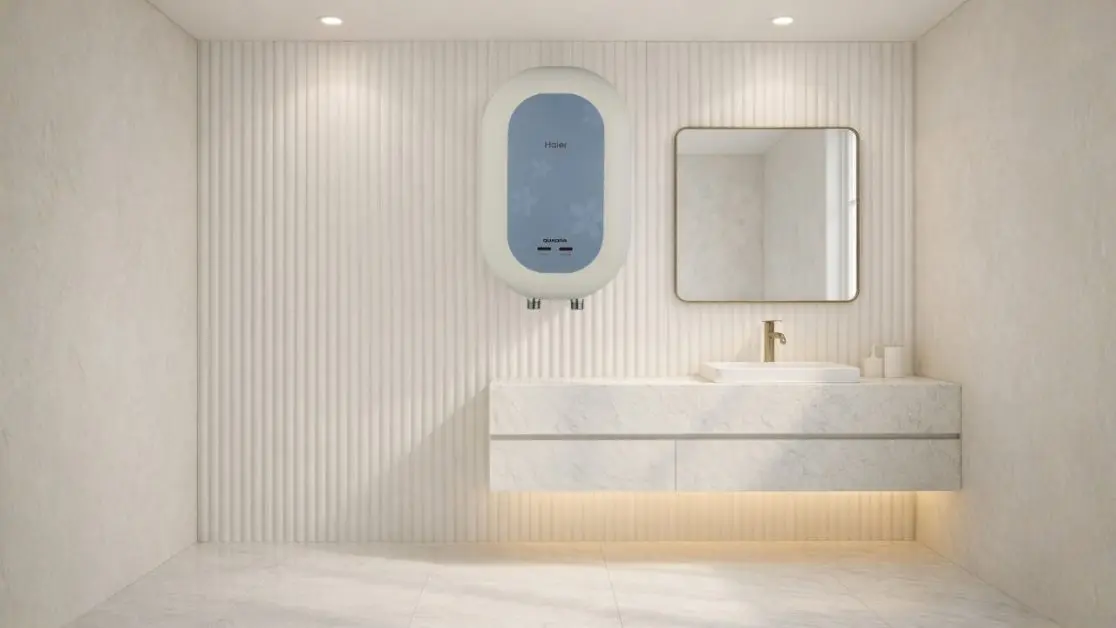
Units like the Haier 3L IPX4 Ivory Instant Water Heater ES3V-C1(I)-P use compact tanks and high power heating elements to reduce waiting time.
Benefits
- Rapid heat-up time
- Smaller wall footprint
- Energy efficient operation
Costs
- Ideal for one bathroom at a time
- Requires stable electrical supply
For modern apartments, this design works extremely well.
Because speed matters more than volume.
Option 3: Smart Water Flow Systems
Some heaters improve speed by improving internal water circulation.
Technologies like RSC U-turn flow circulation keep water moving inside the tank so heat spreads evenly and stagnant water does not collect.
Water that moves heats faster.
Water that sits still heats slowly.
Small design details create meaningful speed improvements.
Technologies That Make Instant Heating Possible
Several engineering improvements combine to create faster hot water delivery.
Individually they look minor.
Together they reshape everyday convenience.
Key technologies inside modern instant water heaters
- High-efficiency heating elements
Stainless steel Incoloy heating elements heat water quickly and last longer under high temperatures. - Dual thermal safety protection
Dual thermostat systems stop heating if temperatures exceed safe levels, preventing overheating. - Anti-bacterial heating modes
Some heaters heat water up to 80°C periodically to inhibit bacterial growth inside the tank. - Corrosion resistant tanks
Glass-lined tanks improve durability and protect against rust in long term use.
Each feature removes one small risk.
Together they build a system that feels faster, safer, and more reliable.
Indian Homes Use Hot Water Differently
Design assumptions often come from Western homes.
Indian households behave differently.
Our kitchens are busier.
Our bathrooms see faster turnover.
Our families often share routines.
Hot water appears in many small moments.
Common hot water moments in Indian homes
- Early morning showers before work
- Children preparing for school
- Washing dishes after family dinners
- Winter hand washes and quick baths
- Festival cooking and cleaning
Because these moments happen repeatedly, waiting repeatedly becomes frustrating.
Speed becomes comfort.
Why High-Rise Buildings Need Better Water Heater Design
Urban India is growing vertically.
Twenty storey towers are now common in cities like Mumbai, Bengaluru, and Gurgaon.
That changes plumbing conditions dramatically.
Water pressure increases.
Heaters must withstand stronger pressure systems.
Some instant heaters, including models like the Haier 3L Instant Water Heater EI3V-C1(I)-P, are designed to handle 8 bar pressure, making them suitable for high-rise apartments.
That extra durability protects both the appliance and the plumbing system.
Safety Systems Matter as Much as Speed
Speed without safety is a poor system.
Modern instant water heaters include multiple safety layers.
Typical protection features
- Multi-usage pressure safety valves
- Anti-vacuum plumbing protection
- Non-return water valves
- Overheat cut-off systems
For example, Dual Thermal Proof safety systems shut off heating at high temperatures, ensuring safe operation during heavy usage.
The idea is simple.
Comfort must never compromise safety.
What Faster Hot Water Actually Changes
At first glance, faster hot water feels like a small upgrade.
But systems thinking reveals something deeper.
It removes waiting.
And removing waiting changes behaviour.
Compare two routines
Routine A
Turn on the heater.
Wait ten minutes.
Shower.
Routine B
Turn tap.
Hot water arrives quickly.
Routine continues.
Eight minutes saved every day equals nearly 48 hours saved in a year.
Two full days of time returned.
Technology rarely gives time back.
But efficient systems sometimes do.
Choosing the Right Water Heater for Your Home
Every household runs differently.
The right water heater depends on daily usage patterns.
Quick guide for Indian homes
| Household Type | Recommended Solution |
| Single professional apartment | Instant water heater |
| Small nuclear family | Medium storage heater |
| Large joint family | High capacity storage heater |
There is no universal answer.
Only the system that matches how people live.
The Appliance Nobody Talks About
Water heaters rarely get attention.
No one invites guests to admire them.
Yet they quietly shape daily comfort.
Warm winter showers.
Clean dishes after dinner.
Relaxed mornings before work.
These moments depend on invisible systems working well.
Appliances like the Haier 3L Instant Water Heater EI3V-C1(W)-P or Haier 3L IPX4 Ivory Instant Water Heater ES3V-C1(I)-P simply remove the waiting.
And when waiting disappears, everyday life feels smoother.
That is the real story of faster hot water delivery.
Not flashy innovation.
Just better mornings.
Frequently Asked Questions
Why does my geyser take so long to heat water in the morning?
Most traditional geysers heat an entire storage tank before you can use the water. If the tank holds 15–25 litres, the heating element must warm all of it before the thermostat allows usage. In colder months, the incoming water temperature is lower, so heating takes even longer.
Why does hot water delay disrupt my entire morning routine?
Hot water delays often become the first bottleneck in the day. A delayed shower can push breakfast later, which pushes school preparation or office departure later. Small delays compound into bigger scheduling problems.
Is it normal to wait 10–15 minutes for hot water from a storage heater?
Yes. Many storage geysers require 10–20 minutes to heat a full tank depending on tank size and heater power.
Why does my family keep asking if the hot water is ready?
Because traditional heaters require manual waiting. Without instant heating, households must time their routines around the heating cycle.
I left my hot water heater unused for a few days. Is the water still hygienic?
Most modern water heaters include antibacterial heating modes that periodically raise water temperature to around 80°C to inhibit bacterial growth.
Does hot water stored in a tank become unsafe over time?
If the heater remains unused for long periods, stagnant water can become less hygienic. Many modern heaters address this with anti-bacterial heating cycles.