


What happens when a TV stops being just a screen and starts talking back?
It used to be simple.
TV time was about the show. The cartoon. The action sequence. The big reveal.
But in many Indian homes today especially those with young kids something unexpected is stealing the spotlight.
Not the superhero.
Not the animal rescue.
Not even the music video on loop.
It’s the mic button.
The voice command feature.
And for a generation growing up surrounded by Alexa, Siri, and Hey Google, pressing that mic button isn’t a novelty. It’s second nature.
Voice isn’t just a feature it’s a playground

A 5-year-old in Pune figured out how to switch from Peppa Pig to Bheem using nothing but voice.
A 9-year-old in Delhi races her brother to see who can say “play Doremon in Hindi” faster.
A 7-year-old in Bangalore asks the TV to play her mom’s wedding song. Every Sunday. Without fail.
These aren’t isolated moments.
They’re rituals. Habits. Little acts of agency.
Because when a kid says something and the TV listens, they’re not just watching. They’re directing.
Why does this matter?
Because it tells us something deeper about how families interact with tech now.
It’s not just about entertainment. It’s about empowerment.
- For a child who can’t spell yet, voice bridges the literacy gap.
- For a grandparent who finds remotes confusing, voice offers ease.
- For a busy parent juggling kitchen and homework, voice saves time.
It’s democratic. Inclusive. Humans.
And in that, it’s deeply Indian.
The living room has become a command centre
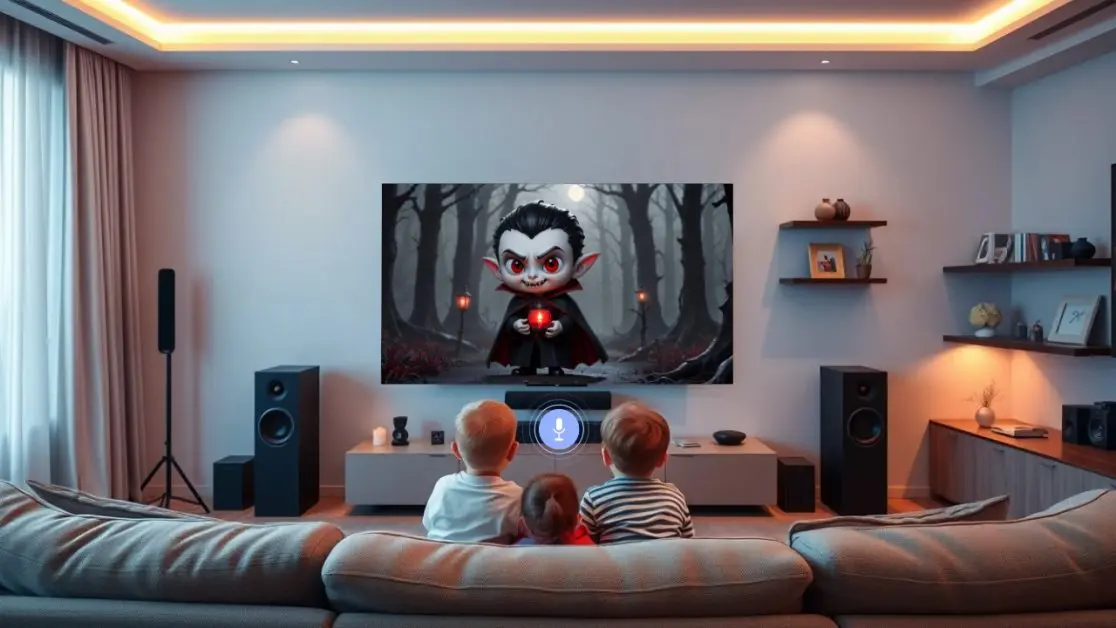
We used to fight for the remote.
Now we negotiate airspace for voice commands.
And TVs, especially smart OLEDs like the ones from Haier, are rising to meet this shift.
Take OLED series with Google TV and Hands-Free Voice Control. You don’t even need to hold the remote to speak. Just say it.
Want to pause the cartoon while you answer the door?
Say it.
Want to rewind that joke your daughter laughed too hard at?
Say it.
Want to switch from Disney+ to YouTube without digging through menus?
Say it.
There’s something magical and slightly surreal about a child under ten telling the TV to “fast forward to the part where the dragon flies.”
And watching it happen.
So what are the real benefits here?
Let’s break it down.
1. Ease of use for all ages
From toddlers to grandparents, voice eliminates the complexity of navigation.
2. Encourages curiosity
Kids experiment. They try weird combinations. Sometimes it works. Sometimes it doesn’t. But they learn by doing.
3. Builds digital confidence early
When children see tech responding to their voice, it instills a sense of control and clarity. They become less passive and more participatory.
4. Reduces dependency on parents
They no longer need you to type “Chhota Bheem episode with train” for the tenth time. They ask themselves.
5. Brings accessibility into the mainstream
It’s not a “special” feature anymore. It’s just how TVs should work.
But wait, what about the content?
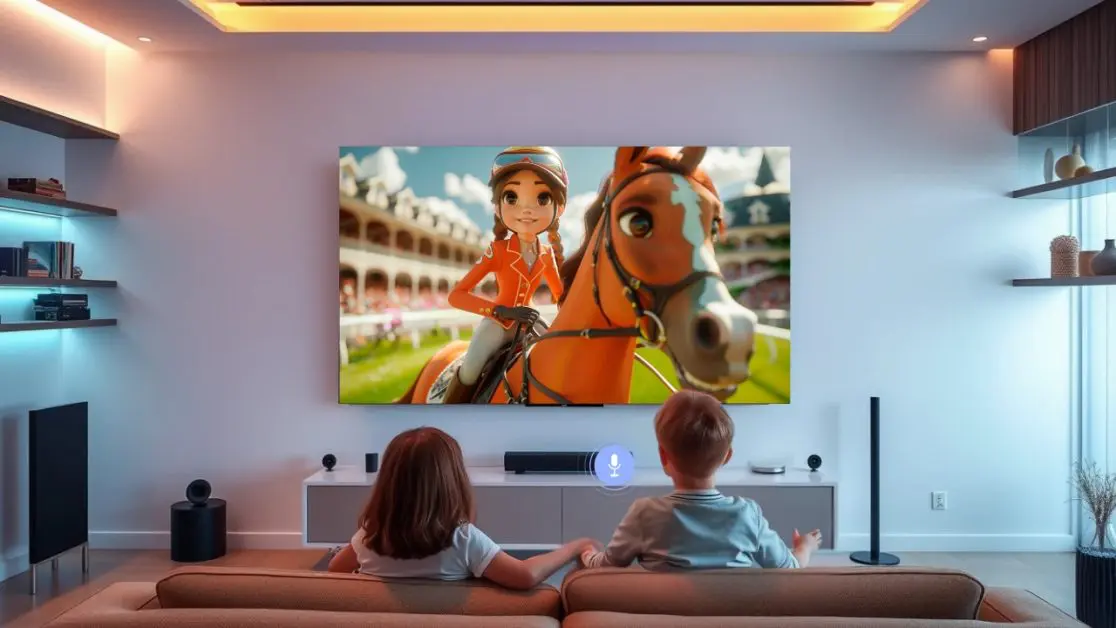
Of course, shows still matter.
But for kids, the content is increasingly on-demand. They expect to ask and receive.
It’s not about “what’s coming on next.”
It’s “what do I want to watch now?”
And that subtle shift from linear to instant is rewiring how they think.
They’re learning that systems respond to clear instructions.
That communication is key.
That their voice matters.
Imagine growing up in a home where the TV doesn’t ignore you.
It listens. And responds. Instantly.
What this reveals about modern parenting
Parents aren’t just buying TVs anymore.
They’re investing in tools for autonomy.
A TV with voice command is one less thing to explain.
One less button to press.
One more moment of independence for the child.
It’s a silent support system especially in dual-income households where multitasking is the norm.
While the dal simmers and the call runs long, your kid still gets their song.
Not by crying. But by asking.
That’s not just convenient.
It’s growth.
Where Haier fits into this evolution
Let’s be honest, plenty of brands offer smart TVs.
But the OLED lineup, especially models like the H55C90EUX, H65C90EUX, and H77C90UEX, bring something deeper to the table.
They don’t just have voice commands.
They make it invisible. Effortless. Fun.
Hands-Free Voice Control, Google TV interface, 2.1 Channel 50W Woofer Sound, and MEMC 120Hz smoothness make every interaction seamless.
And for kids, that seamlessness matters.
If there’s a lag, they notice.
If the system mishears, they frown.
But when it works like magic, they light up.
Haier gets that.
And builds TVs that don’t just entertain but empower.
This isn’t just a tech feature. It’s a cultural moment
We’re watching a shift in how Indian families relate to devices.
- TV isn’t the hero anymore. It’s the stage.
- The voice isn’t noisy. It’s input.
- The child isn’t passive. They’re a participant.
That’s a profound reordering of dynamics.
And it’s happening in living rooms across Delhi, Chennai, Indore, and Kochi not with big announcements, but with tiny commands like:
“Play Baby Shark.”
“Pause.”
“Switch to Hindi.”
“Volume down.”
So what should this change in how we think?
A few takeaways for any home today:
- Buy devices that listen. Because your family needs flexibility.
- Let kids explore safely. Voice command gives freedom within boundaries.
- Redefine ‘watch time’ as ‘engagement time’. It’s not just about screens it’s about agency.
The kids might come for the cartoons.
But they’re staying in control.
Because in 2025, power doesn’t sit in the remote. It lives in the voice.
And that’s what makes all the difference.