
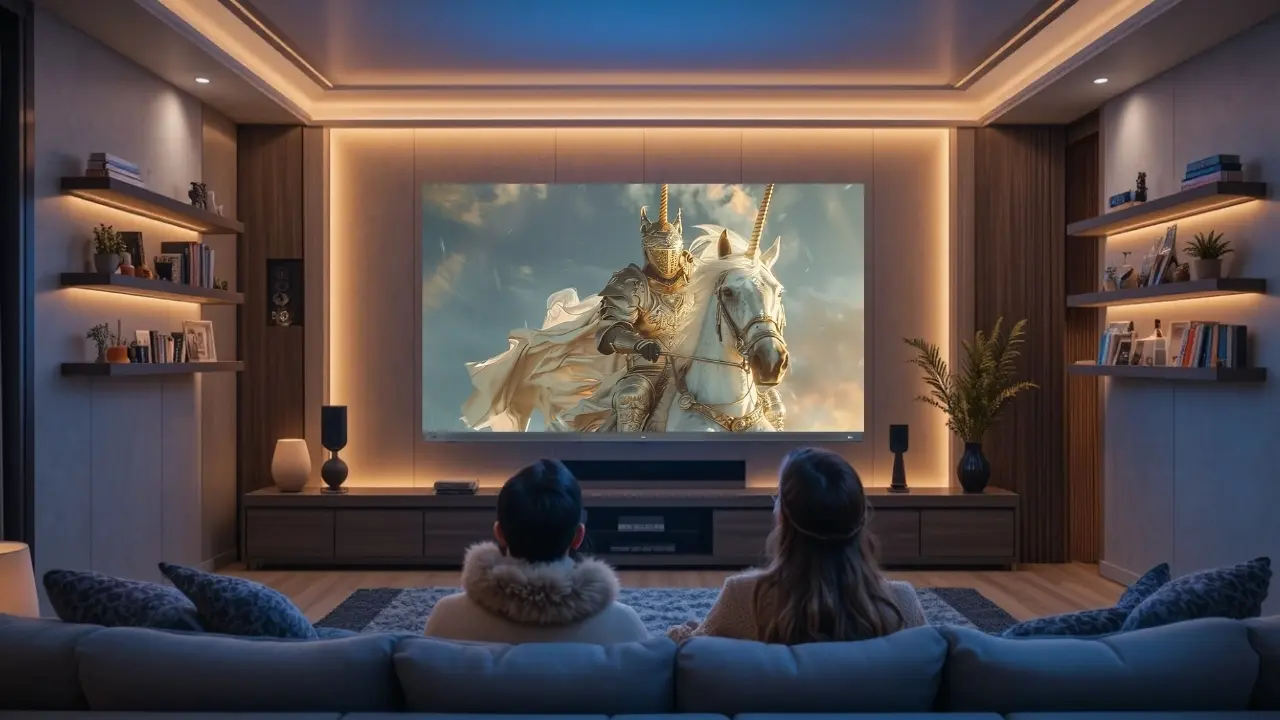

A big screen does not just make content look larger. It reshapes how a living room is used, how people gather, and how attention flows at home.
In modern Indian households, large-screen TVs transform everyday spaces into flexible home theatres that support cricket nights, family films, gaming, and quiet personal downtime with equal ease.
The moment the TV stops being background,
It usually happens on an ordinary evening.
Dinner plates are still on the table.
Someone is scrolling on their phone.
A match moves under floodlights or a movie scene slows down.
And suddenly, people look up.
That is the shift.
The TV stops being background noise and starts becoming the centre of the room.
Big screens do that. Not because they are flashy, but because they command attention without asking for it.
Why big screens feel different before you even press play
Scale changes perception.
A larger screen fills more of your visual field, which triggers three quiet changes:
- Distractions reduce because the screen dominates peripheral vision
- Emotions feel stronger because faces and movement appear life-sized
- Shared focus becomes easier because everyone can see comfortably
This is why cinema screens work. And why big screens now work so well at home.
From watching to experiencing: what actually changes
1. Attention stretches
Small screens encourage grazing. Big screens reward staying.
Scenes breathe longer. Action feels continuous. You stop checking your phone because the experience holds you.
2. Choices become intentional
Instead of endless channel hopping, families choose one thing and commit.
A match.
A movie.
One episode together.
Big screens turn content into an event.
3. The living room becomes flexible
A large TV supports multiple daily roles:
- Morning news without eye strain
- Afternoon cartoons visible from anywhere
- Evening films that feel cinematic
- Late-night gaming with smooth motion
One room. Many moods.
Indian homes have changed. Screens are catching up
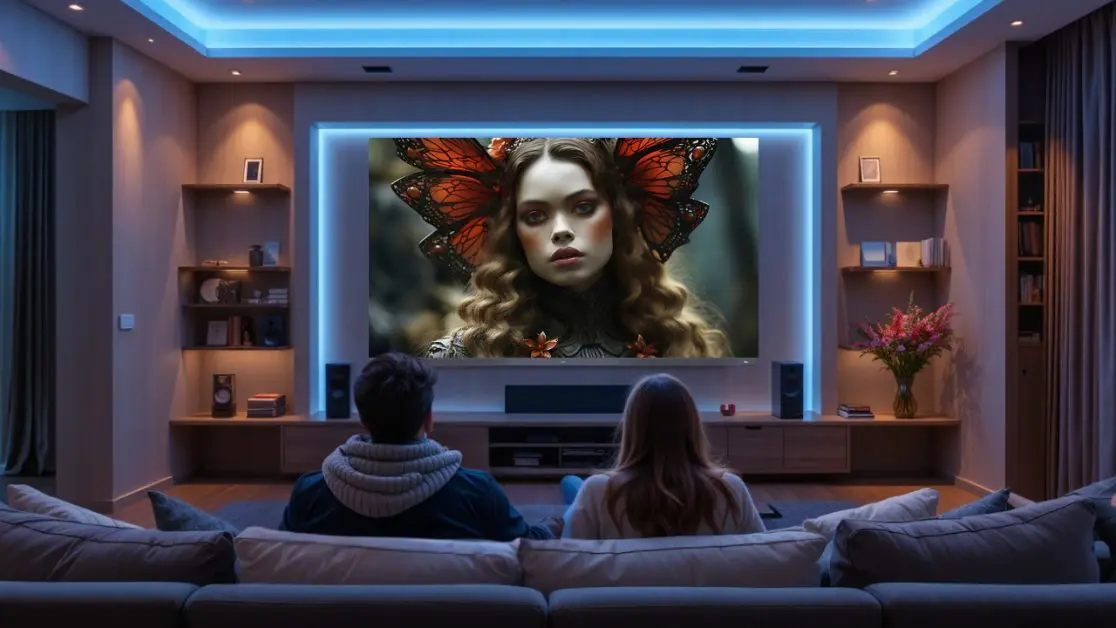
Today’s Indian living rooms are not single-purpose spaces.
They host work calls, festival gatherings, study sessions, casual meals, and weekend rest.
Big screens fit this reality because they do not demand perfect seating or dark rooms. They adapt to movement, light, and distance. That matters in real homes.
The hidden system behind the big-screen shift
Big screens did not grow popular because people wanted luxury.
They grew because constraints changed.
- Homes became more compact
- Entertainment quality improved dramatically
- Families spent more time indoors
- Screens became central to social time
When constraints change, systems evolve.
Big screens are not indulgence. They are a response.
Why size alone is not enough
A large screen magnifies everything, including flaws.
That is why modern big-screen TVs rely on intelligent systems working together.
System one: AI-driven picture intelligence
Large displays need smart processing to avoid fatigue.
Features like AI scene recognition, adaptive brightness, local dimming, and colour optimisation ensure that fast sports, dark films, and bright animations all look natural on a big canvas.
System two: Room-filling sound
Immersion comes from balance, not loudness.
Multi-channel speakers, tuned audio profiles, and Dolby Atmos support allow sound to move around the room instead of blasting from one direction.
System three: Effortless control
The bigger the screen, the more people use it.
Voice control, personalised profiles, and smart content recommendations remove friction and keep the experience smooth.
Where Haier fits into this story

Haier approaches big screens as lifestyle systems, not display panels.
A clear example is the Haier M96 Series 254cm 100 QD Mini LED AI Smart Google TV (H100M96FUX).
This model is built around how Indian living rooms actually behave.
Features that matter on a big screen
- QD Mini LED display with 2160 local dimming zones for precise contrast and deep blacks
- AI Ultra Sense Processor, co-developed with MediaTek, that recognises scenes and adjusts colour, motion, and depth in real time
- 144Hz refresh rate, expandable for gaming modes, keeping sports and action scenes smooth
- Dolby Vision IQ and HDR10+, which adjust picture quality based on room lighting
- Sound by KEF with a powerful multi-channel speaker system, designed to fill large spaces evenly
- Dolby Atmos and Total Sonics for immersive, layered audio
- Google TV with hands-free voice control, making navigation easy for everyone
These features exist because big screens amplify both strengths and weaknesses. Intelligent systems keep the experience comfortable over long viewing hours..
The real upgrade is social, not technical
Here is what people often miss.
Big screens change behaviour.
Parents watch more content with their children.
Couples plan movie nights instead of separate scrolling.
Guests stay longer after dinner.
The screen becomes a shared anchor.
In a world of fragmented attention, anything that pulls people into the same moment has value beyond entertainment.
How to think about choosing a big screen
One option is chasing specifications.
The second option is copying a cinema setup.
The third option is matching the screen to your real habits.
The third option lasts.
Ask practical questions:
- How far do people naturally sit?
- Is the room bright during the day?
- Is the screen used more for sports, films, or gaming?
- Does sound need to travel across rooms?
Big screens reward honesty about lifestyle.
Why big screens are becoming the new default
This is not a trend. It is a correction.
Smaller screens worked when content was casual and attention was split. Today, content is richer and time feels limited.
When time is scarce, experiences need to feel worth it.
Big screens make staying in feel intentional.
They turn ordinary nights into shared rituals.
They allow living rooms to adapt instead of dictate.
The bigger picture
Homes today do more than house us.
They help us unwind, connect, focus, and recover.
Big screens are not about excess. They are about alignment.
When technology fits the rhythm of real life, it disappears into the background.
And that is when a living room quietly becomes a home theatre.