
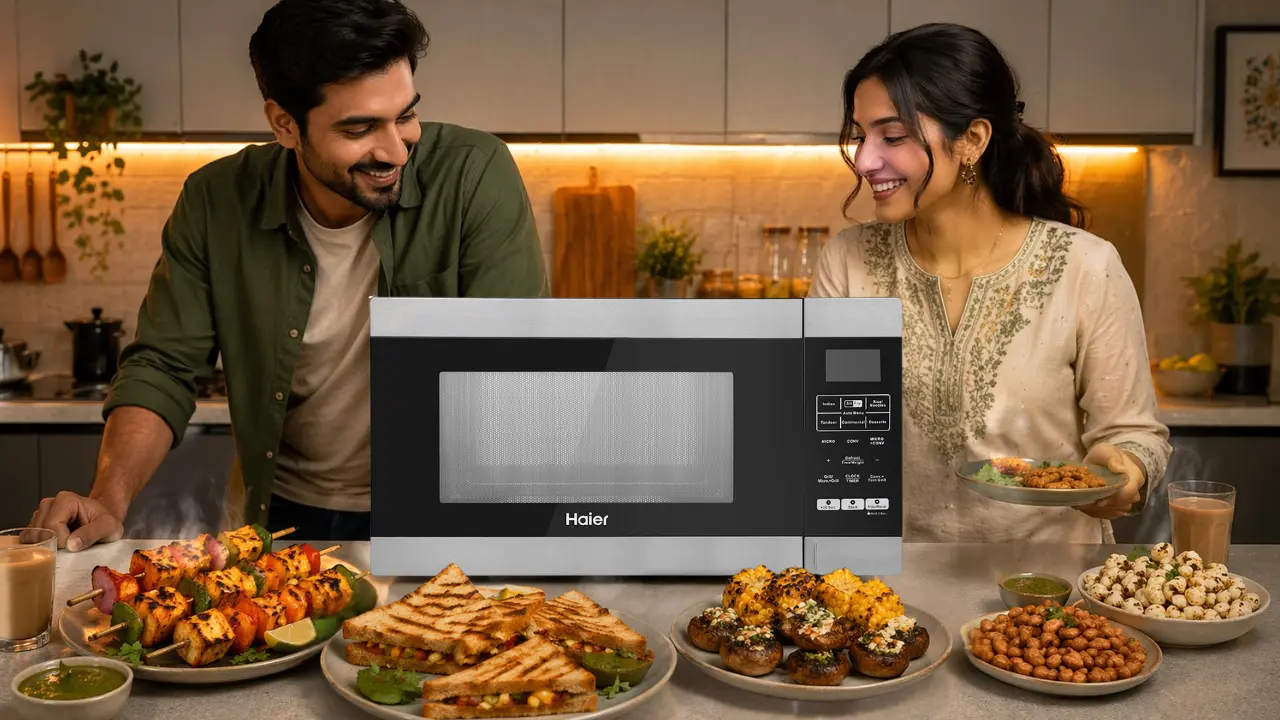

Haier microwave performance in Indian kitchens comes down to one simple shift: it turns cooking from a manual, time-heavy task into a guided, predictable system.
With features like multi-stage cooking, auto menus, and combination modes, it adapts to Indian cooking styles while saving time, reducing effort, and improving consistency across everyday meals.
The 8:15 PM kitchen reality most homes recognize.
Dinner is not one dish.
It is dal reheating.
Rotis waiting.
Sabzi cools too fast.
Someone asked, “Is the rice hot?”
Indian kitchens do not cook in isolation. They operate in layers.
And that is where most appliances fail.
They assume cooking is linear.
But Indian cooking is parallel.
Performance is not about speed alone. It is about handling complexity.
What Does “Microwave Performance” Really Mean in Indian Kitchens?
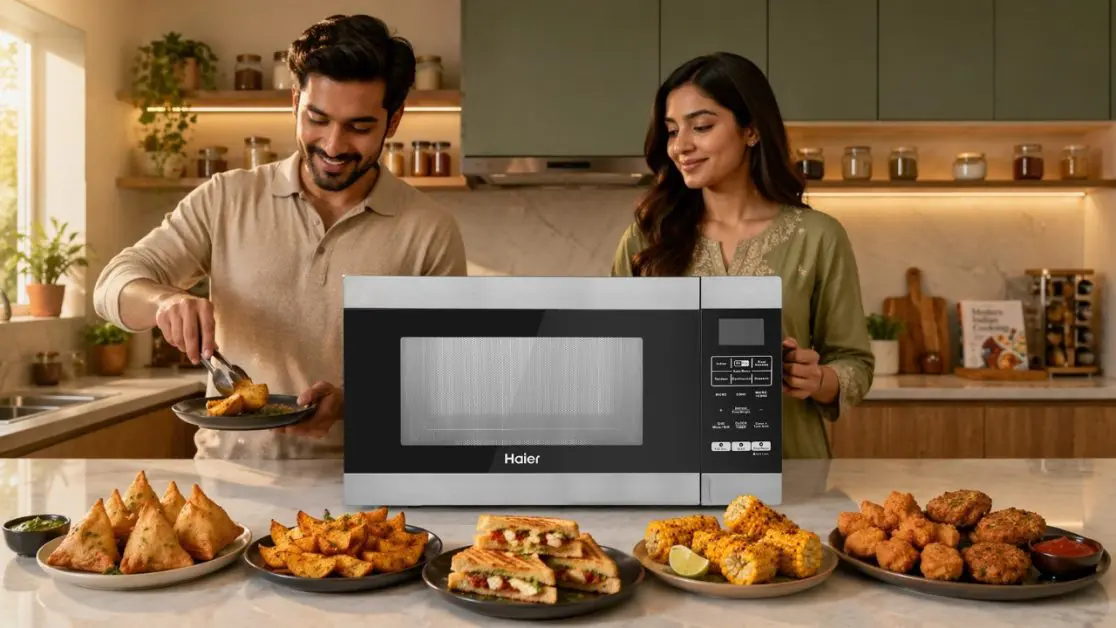
Performance is often misunderstood.
It is not just wattage.
Not just capacity.
Not just how fast it heats.
In an Indian home, performance means three things:
- Can it handle diverse dishes in one cycle
- Can it reduce constant supervision
- Can it maintain taste, not just temperature
Because heating food is easy.
Heating it correctly is the real job.
The Hidden System Behind Haier Microwave Performance
A good microwave does not just heat food.
It manages variables.
Temperature.
Time.
Moisture.
Cooking stages.
Take something as simple as paneer tikka.
It needs:
- Initial heating
- Controlled grilling
- Browning without drying
That is not one step. It is a sequence.
Haier microwaves approach this with multi-stage cooking, where different modes combine automatically to deliver consistent results without manual intervention
When machines handle sequencing, humans stop guessing.
Why Indian Cooking Demands Multi-Mode Performance
Indian meals are not built for single-mode cooking.
Think about it:
- Tandoori items need grilling
- Cakes need convection baking
- Leftovers need reheating
- Snacks need crisping
One appliance. Four different expectations.
This is where combination cooking becomes critical.
How combination cooking changes outcomes
- Microwave mode heats internally
- Grill mode adds texture
- Convection ensures even baking
Used together, cooking time can reduce by up to 30 percent while improving texture
That is not convenient.
That is efficiency engineered into the system.
The Real Cost of Traditional Cooking Methods
Let’s look at the hidden costs.
Option 1: Gas stove cooking
- Requires constant attention
- Slower for reheating
- Uneven heating for leftovers
Option 2: OTG usage
- Great for baking
- Time-consuming preheating
- Limited versatility
Option 3: Basic microwave
- Fast heating
- Limited cooking flexibility
- Poor texture control
Option 4: Convection microwave systems like Haier
- Combines all functions
- Reduces cooking steps
- Improves consistency
The real upgrade is not speed. It is controlled.
Auto Cook Menus: Why They Matter More Than You Think
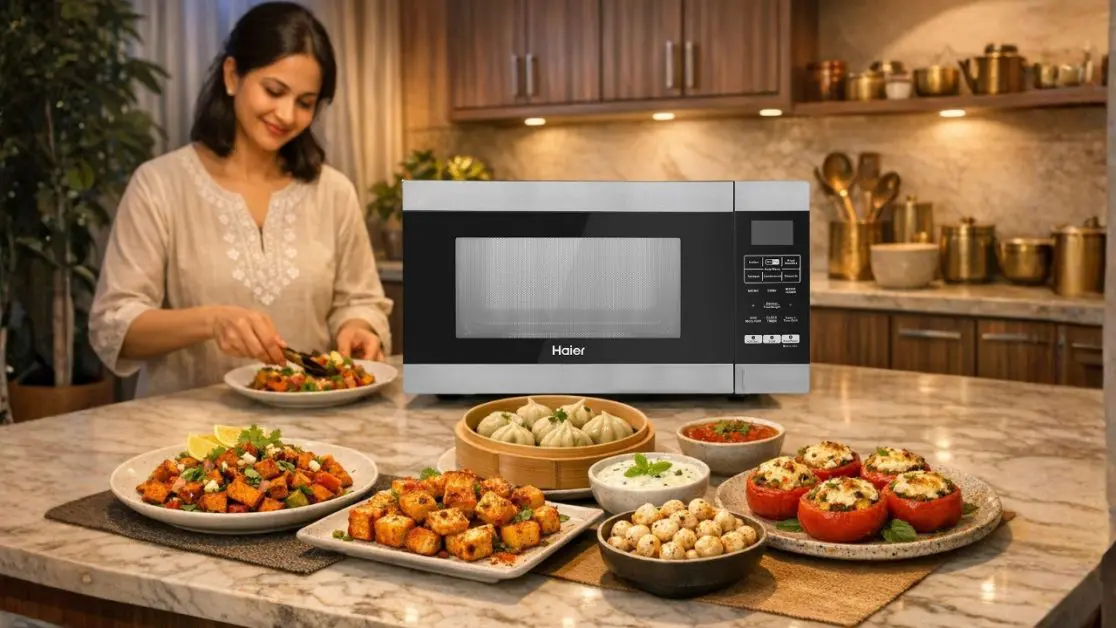
Auto menus sound like a convenience feature.
They are not.
They are encoded cooking knowledge.
For example, Haier models offer up to 305 auto cook menus designed to handle different cuisines and cooking styles
What does that mean in real life?
- You stop estimating time
- You stop adjusting power manually
- You reduce trial and error
This is especially important in Indian cooking where:
- Ingredients vary
- Recipes are flexible
- Timing is often instinct-based
Auto menus turn instinct into repeatable results.
Performance Is Also About Health, Not Just Taste
The shift in Indian kitchens is clear.
Less oil.
More control.
Health without compromise.
Haier microwaves support oil-free or low-oil cooking, reducing dependence on deep frying while maintaining taste
Now consider the impact:
- Lower oil consumption
- Reduced kitchen mess
- Healthier daily meals
This is not a feature.
It is a lifestyle shift.
The Role of Capacity in Indian Households
Capacity is often overlooked.
Until guests arrive.
What different capacities actually mean
| Capacity | Ideal Use Case |
| 20L | Singles, small families, reheating and basic cooking |
| 25L | Medium families, daily cooking plus baking |
| 30L | Large families, festive cooking, batch preparation |
For example:
- A 20L model handles everyday reheating efficiently with compact space usage
- A 25L convection microwave supports multi-dish cooking with features like bread basket modes for Indian flatbreads
- A 30L model with air fryer and rotisserie expands into full-scale cooking versatility
Capacity is not about size. It is about lifestyle fit.
The Shift From Appliances to Systems
Older appliances perform tasks.
Modern appliances manage outcomes.
Take the Haier 30L convection microwave with an in-built air fryer.
It combines:
- Microwave heating
- Convection baking
- Grill cooking
- Air frying
- Rotisserie grilling
That is five systems in one.
What does that replace?
- A microwave
- An OTG
- An air fryer
- A grill
Fewer appliances. More capability.
Performance Is Also About Time You Get Back
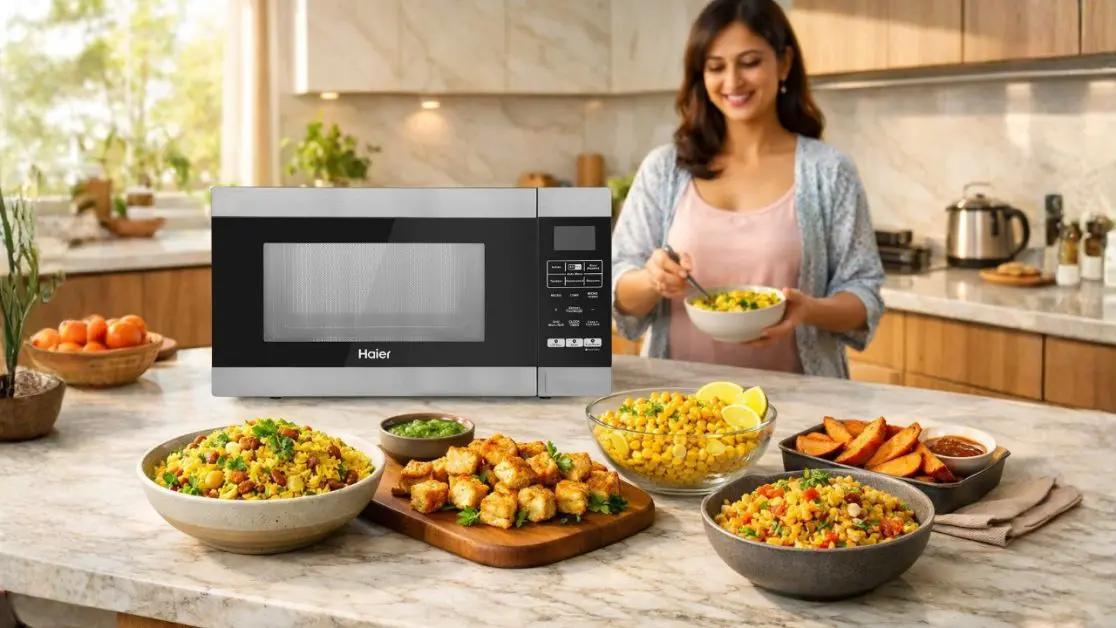
Time is the most invisible cost in Indian kitchens.
Waiting for preheating.
Standing near the stove.
Checking if food is done.
Now compare.
Traditional cooking flow
- Prepare
- Cook
- Monitor
- Adjust
Smart microwave cooking flow
- Prepare
- Select
- Done
That difference compounds daily.
Performance is measured in minutes saved, not watts used.
Why Even Heating Is a Bigger Deal Than You Realize
Uneven heating ruins food.
Cold spots.
Overcooked edges.
Dry textures.
Haier microwaves use features like stainless steel cavities and optimized heat distribution to ensure even cooking
This matters because:
- Indian dishes often have mixed textures
- Gravies need uniform heating
- Snacks require consistent crispness
Consistency builds trust. And trust defines performance.
The Design Layer Most People Ignore
Performance is not just internal.
It is also how easily you interact with the appliance.
Modern microwave design choices include:
- Digital touch controls for precision
- Mirror glass finishes for visibility and aesthetics
- Larger turntables for full plates
For example, a 255 mm turntable allows standard Indian plates to fit easily without repositioning
Small detail. Big impact.
What Most Buyers Get Wrong About Microwave Performance
They focus on specs.
They ignore usage patterns.
Here is the real framework:
Ask these three questions instead
- What do you cook most often?
Daily reheating or full meals - How many people are you cooking for?
Single plates or batch cooking - Do you want speed or versatility?
Quick heating or complete cooking
The answers define the right choice.
Not the price tag.
The Bigger Shift Happening in Indian Kitchens
Kitchens are becoming systems.
Less manual.
More predictive.
More efficient.
Microwaves are no longer backup appliances.
They are becoming primary cooking systems.
And performance is no longer judged by how fast something heats.
It is judged by:
- How little effort it needs
- How consistent the results are
- How seamlessly it fits into daily life
The One Insight That Changes Everything
A high-performing microwave does not cook faster. It removes decisions.
No guessing time.
No adjusting settings.
No second-guessing outcomes.
And in a kitchen where ten things happen at once, that clarity is everything.
So What Does This Mean for Modern Indian Homes?
It means this:
The future of cooking is not about doing more.
It is about thinking less while achieving more.
And appliances that understand this shift will quietly become essential.
Not because they are advanced.
But because they make life feel simpler.
And in the end, that is what performance really looks like.
Frequently Asked Questions
I’m confused between OTG, gas, and a convection microwave. What should I actually buy for my kitchen?
If your cooking involves reheating, baking, grilling, and multitasking (typical Indian kitchens), a convection microwave like Haier combines all functions into one system, reducing both appliance clutter and decision fatigue.
Do I really need a convection microwave or is a basic one enough for my daily use?
A basic microwave works for reheating, but if you cook full meals, bake, or want better texture (like crispy snacks), convection mode becomes essential.
I only cook for 2–3 people. Should I still consider a larger capacity microwave?
A 20–25L model is ideal for small families. Go larger only if you host often or batch cook.
Why do I feel overwhelmed comparing microwave specs like wattage, modes, and capacity?
Specs don’t reflect real usage. Focus instead on: what you cook, how often, and how many people you cook for.
Are auto cook menus actually useful, or just marketing gimmicks?
They encode cooking logic removing guesswork around time, power, and sequence, especially useful for Indian dishes.
I don’t follow exact recipes. Will auto menus still work for me?
Yes, they standardize outcomes even when ingredients vary slightly, reducing trial-and-error.
What is multi-stage cooking, and do I really need it?
It automates cooking steps (e.g., heat → grill → bake). You don’t need to manually switch modes mid-cooking.
Can a microwave really replace multiple appliances in my kitchen?
Advanced models combine microwave, grill, convection, air fryer, and rotisserie effectively replacing several devices.