
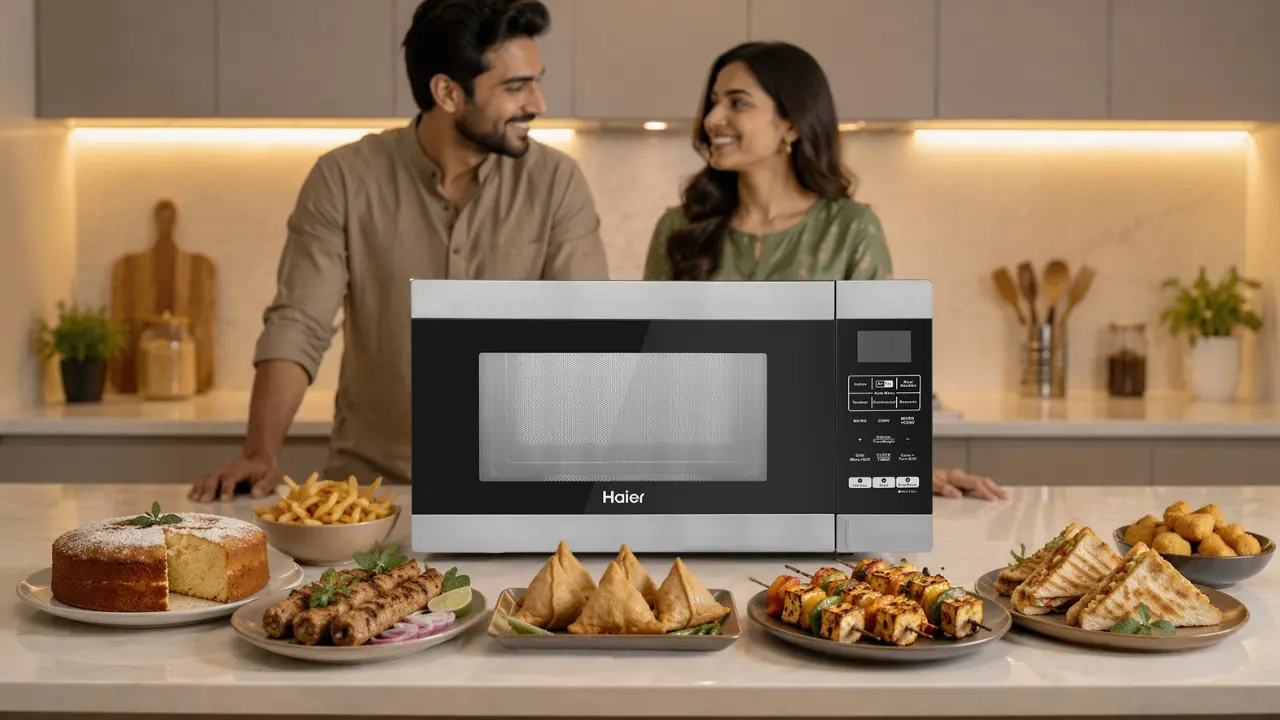

A single modern microwave can replace an OTG, air fryer, grill, toaster, and even parts of your gas stove by combining multiple cooking technologies into one compact system.
It cooks, bakes, grills, reheats, and even air-fries.
Not as a compromise. But as a system designed to simplify how Indian kitchens actually work today.
And that changes everything.
The real problem is not cooking. It is kitchen clutter.
Walk into a typical urban Indian kitchen.
A gas stove.
An OTG tucked in a corner.
A mixer that rarely moves.
Maybe an air fryer bought during a sale.
Each appliance solves one problem.
Together, they create another.
Space.
Time.
Decision fatigue.
The kitchen becomes a collection of tools. Not a system.
Modern microwaves flip that equation.
They don’t add one more appliance.
They replace five.
What makes a microwave “modern” today?
A microwave is no longer just for reheating leftovers.
It is a multi-mode cooking system.
Think of it like this:
- Microwave mode heats food quickly using electromagnetic waves
- Grill mode gives crisp, golden textures
- Convection mode acts like an oven for baking and roasting
- Air fryer mode enables low-oil cooking
- Combination mode blends all of these for faster results
That’s not a feature list.
That’s a shift in how cooking works.
For example, combination cooking can reduce cooking time by up to 30 percent by using multiple modes together
Speed is no longer a trade-off against quality.
You get both.
One appliance. Five roles. What actually gets replaced?
1. The OTG (Oven Toaster Grill)
You want to bake a cake or toast garlic bread.
Earlier:
- Preheat the OTG
- Monitor temperature manually
- Wait
Now:
- Convection mode handles baking automatically
- Pre-set menus guide temperature and timing
Modern Haier convection microwaves come with up to 305 auto cook menus, simplifying complex recipes into one-touch operations
What changes?
Skill becomes optional. Consistency becomes default.
2. The Air Fryer
The promise was simple.
Crispy food with less oil.
But now, it is built in.
For instance, models like the Haier 30L convection microwave integrate in-built air fryer functionality with dedicated menus
That means:
- Fries without deep frying
- Samosas without excess oil
- Snacks without the mess
What changes?
Healthy cooking stops feeling like extra effort.
3. The Grill
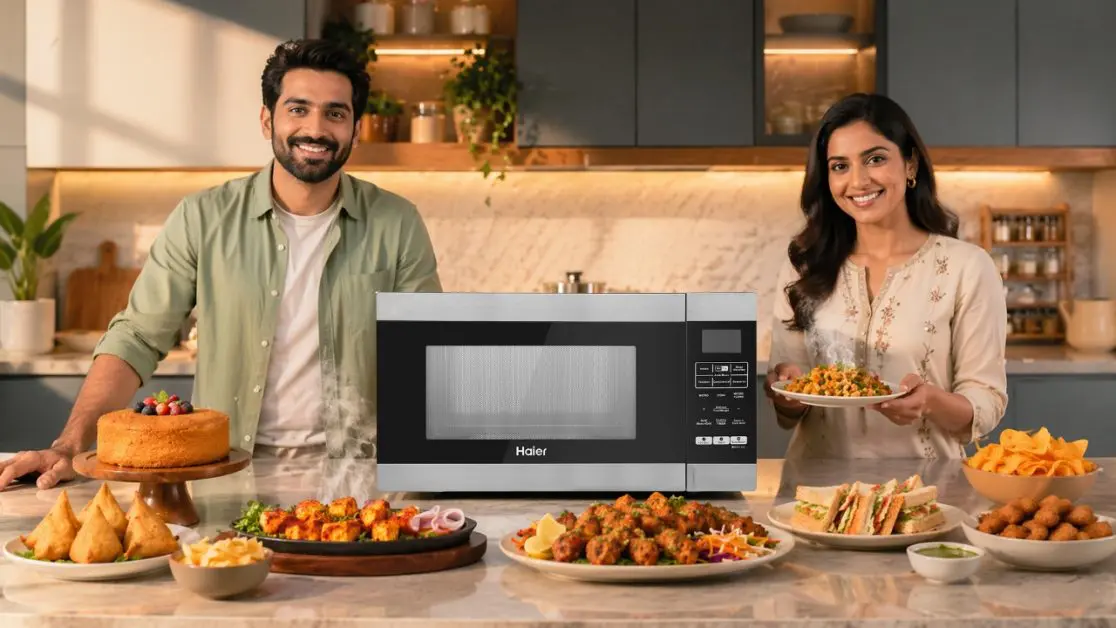
Weekend paneer tikka.
Mid-week corn.
Late-night sandwiches.
Earlier:
- Separate grill setup
- Manual turning
Now:
- Quartz grilling and rotisserie systems ensure even cooking
- Automated rotation improves consistency
Modern systems even include rotisserie for uniform grilling at home
What changes?
Restaurant-style results become routine.
4. The Gas Stove (partially)
Not entirely replaced. But significantly reduced.
Think about:
- Boiling rice
- Making omelettes
- Cooking halwa
All possible inside a microwave.
In fact, microwaves can preserve up to 7x more nutrients compared to boiling or steaming
What changes?
Daily cooking shifts from stovetop dependency to flexible, faster options.
5. The Toaster and Reheater
This is where microwaves quietly dominate.
- Reheat food evenly
- Toast nuts, bread, and snacks
- Melt chocolate, butter, cheese
All within minutes.
No additional appliance needed.
What changes?
Small tasks stop requiring separate tools.
Why this shift matters more in Indian homes
Because Indian kitchens are not static.
They are:
- Small in metro cities
- Multi-functional in joint families
- Time-constrained in working households
A modern microwave fits into this reality.
Let’s break it down.
The cost-benefit shift
| Factor | Traditional Setup | Modern Microwave |
| Space | Multiple appliances | Single compact unit |
| Cost | Separate purchases | One-time investment |
| Time | Manual processes | Automated cooking |
| Effort | High monitoring | Low intervention |
| Flexibility | Limited | Multi-cuisine, multi-mode |
Insight:
Efficiency is not about doing more. It is about needing less.
The hidden system: Automation replaces decision-making
Cooking is not just physical work.
It is mental work.
What temperature?
How long?
When to flip?
Modern microwaves remove this layer.
For example:
- Multi-stage cooking adjusts power levels automatically
- Memory functions save frequently used settings
- Auto menus eliminate guesswork
Some Haier models even include multi-stage cooking that automatically adjusts cooking stages for perfect results
What changes?
Cooking becomes predictable.
And predictability reduces stress.
Three ways people actually use modern microwaves today
One option is efficiency-first cooking
Busy professionals.
Late dinners.
Quick meals.
- Reheat food in minutes
- Cook basic meals without prep complexity
Cost: Limited experimentation
Benefit: Maximum time saved
The second option is lifestyle cooking
Young couples.
Fitness-focused routines.
- Air fry instead of deep fry
- Bake instead of order
Cost: Learning new modes
Benefit: Healthier habits without friction
The third option is creative cooking
Home chefs.
Weekend experimenters.
- Bake cakes
- Grill kebabs
- Try global recipes
Cost: Slight learning curve
Benefit: Endless variety from one appliance
Why fewer appliances lead to better kitchens
There is a pattern here.
The best systems are not the ones with more parts.
They are the ones with better integration.
A microwave that combines:
- Heating
- Baking
- Grilling
- Air frying
is not just convenient.
It is structurally efficient.
A kitchen improves when decisions are reduced.
Where Haier fits into this shift
Not as a brand pushing products.
But as a brand aligning with how homes are changing.
Take the .
It is not just a microwave.
It offers:
- 305 auto cook menus for Indian and global dishes
- Bread basket functionality for naan, roti, kulcha
- Oil-free cooking for healthier meals
- Stainless steel cavity for hygiene and durability
Or the .
It goes further:
- Built-in air fryer with dedicated menus
- Rotisserie for grilling
- Multi-power levels for precision cooking
These are not features.
They are responses to real kitchen behavior.
So what does this mean for how we design our kitchens?
It changes one simple assumption.
Earlier, kitchens were built around tasks.
Now, they are built around systems.
Instead of asking:
“What appliances do I need?
The better question becomes:
“What system reduces effort, space, and decisions?
The final insight: Convenience is not the goal. Control is.
People don’t want more appliances.
They want:
- Less clutter
- Less effort
- More control over time
Modern microwaves deliver that quietly.
They don’t shout innovation.
They remove friction.
And that is why they replace everything.
Not because they can.
But because they make everything else feel unnecessary.
Frequently Asked Questions
Why does my kitchen feel more stressful even though I have more appliances?
Because each appliance solves a single task but adds a decision. Over time, choosing which appliance to use becomes mental clutter.
A modern microwave reduces that by consolidating multiple cooking methods into one system.
Do I really need an OTG, air fryer, and grill separately?
Not anymore. A convection microwave with grill and air fryer modes can handle baking, roasting, grilling, and crisping eliminating the need for separate appliances in most cases.
Is microwave cooking actually healthy for everyday Indian meals?
Yes. Microwave cooking often preserves more nutrients compared to boiling because it uses less water and shorter cooking times. It’s especially effective for vegetables, dals, and reheating without overcooking.
Can I cook real meals like rice, sabzi, or halwa in a microwave?
Absolutely. Modern microwaves support full meal prep from rice and curries to desserts using auto menus and controlled heating.
Does faster cooking in a microwave reduce food quality?
Not in modern systems. Combination cooking (microwave + convection + grill) ensures food cooks quickly and develops proper texture, color, and flavor.
Why does microwave food sometimes turn soggy?
That happens in basic microwave mode. Using grill or convection modes restores crispness and texture.
Do I need cooking skills to use a modern microwave?
Not really. Features like auto-cook menus, pre-set temperatures, and multi-stage cooking remove the need for manual adjustments.
What are auto cook menus and do they actually work?
Auto cook menus are pre-programmed settings for specific dishes. They automatically adjust time, temperature, and mode making cooking consistent and beginner-friendly.
How does multi-stage cooking help me?
It allows the microwave to switch modes automatically (e.g., microwave → grill → convection), ensuring even cooking without manual intervention.