
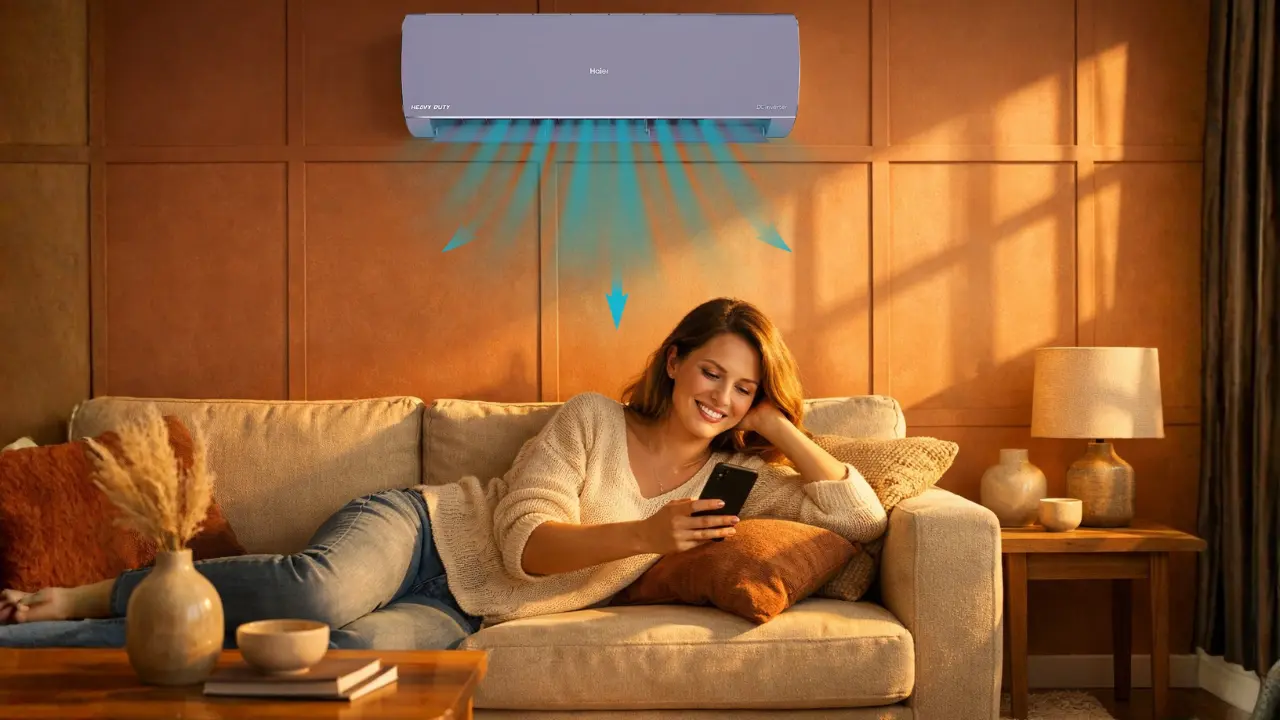

Modern ACs learn your comfort by tracking your habits, reading the room, and adjusting automatically in real time.
They analyse temperature gaps, detect human presence, observe usage patterns, and even predict your arrival.
Then they fine tune cooling, airflow, and power consumption without waiting for manual input. The result is simple: consistent comfort with lower effort and smarter energy use.
That is the short answer.
The real story is more interesting.
Why do we still adjust the remote ten times a day?
Picture a regular weekday in May.
The sun hits your balcony at 2 pm. The living room heats up. You lower the temperature to 20°C.
By 9 pm, the room feels too cold. You raise it to 24°C.
At midnight, you wake up and switch the AC off.
This pattern repeats across Indian homes. According to the Bureau of Energy Efficiency, air conditioners can account for nearly 40 percent* peak residential electricity load during summer. Yet most cooling decisions still depend on guesswork and remote buttons.
The friction is small.
But daily.
And daily friction adds up.
Comfort should not require supervision.
What Does It Mean When an AC “Learns” You?
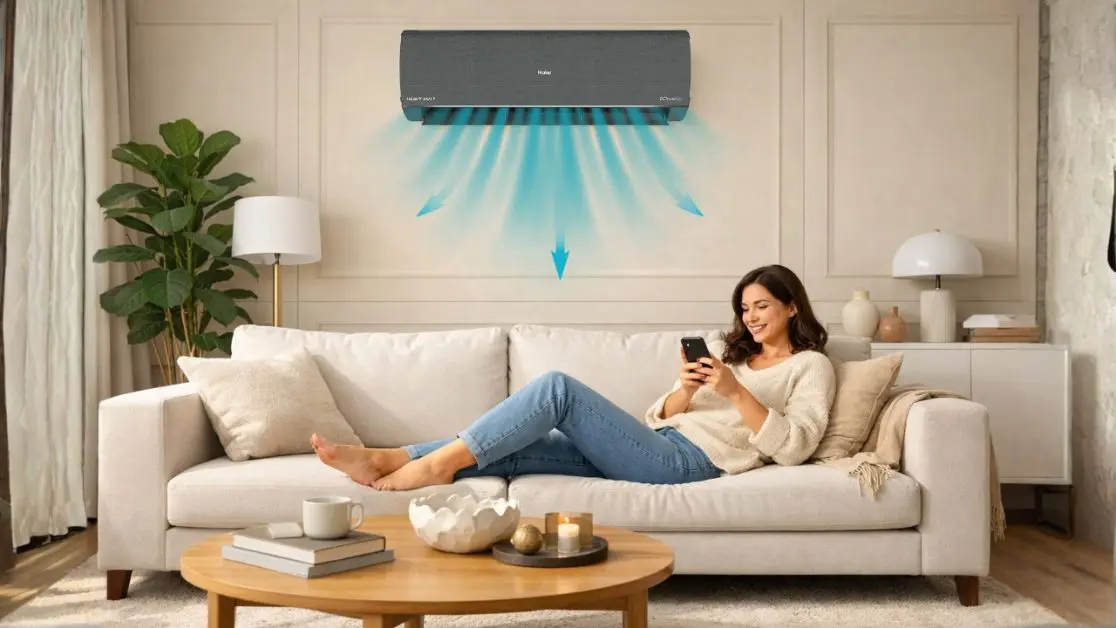
Learning in modern ACs is not a buzzword. It is pattern recognition.
1. It Tracks Usage Behaviour
Smart AC technology record:
- Preferred temperature settings
- Time of operation
- Mode changes between Cool, Eco, or Turbo
- Duration of continuous use
Over weeks, this builds a behavioural map.
In AI powered platforms like Haier AI Atmox, the system develops a personalized consumption model using machine learning and environmental data.
The benefit is practical.
Instead of resetting preferences daily, the AC anticipates them.
2. It Reads Environmental Conditions
Traditional ACs respond only to indoor temperature.
Modern AI technology go further:
- They monitor outdoor heat levels
- They analyse humidity patterns
- They compare room temperature gaps
If the difference between set temperature and actual temperature exceeds 3°C, AI Eco 2.0 modes automatically shift performance levels for efficiency.
This dynamic adjustment prevents overcooling.
Energy saved without sacrificing comfort.
3. It Detects Human Presence
Some advanced technology include AI human detection sensors.
They detect movement within 12 metres and shift to energy saving modes if the room is empty.
The logic is simple:
- No movement for 15 minutes: shift to lower power mode
- No activity for 30 minutes: power off
This is not automation for novelty.
It is waste prevention.
From Reactive Cooling to Predictive Cooling
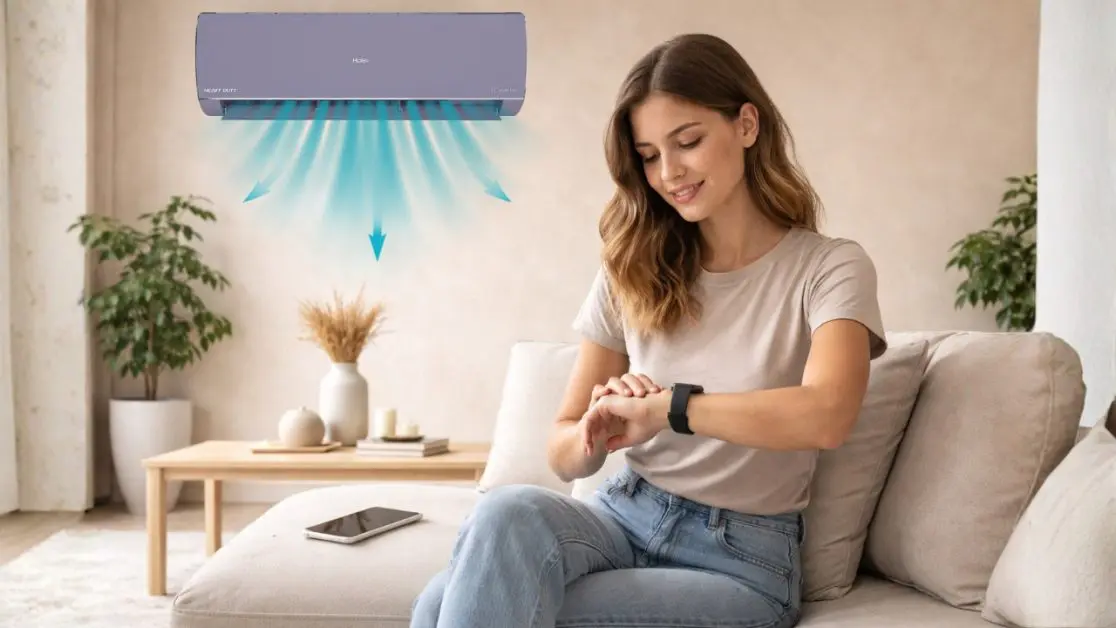
Here is where things change.
Most appliances react.
Modern ACs predict.
AI Pre Cooling: Cooling Before You Enter
Imagine leaving the office in Gurgaon at 6 pm.
By the time you enter your apartment, the room is already cool.
That is AI pre-cooling.
Using geofencing within 100 metres, the AC predicts arrival and starts cooling automatically.
No timers. No reminders.
Just readiness.
Comfort that arrives before you do.
AI Target Cooling: Cooling Where It Matters
Traditional ACs cool the entire room uniformly.
AI target cooling directs airflow toward the occupied zone based on installation position data and cloud intelligence.
Benefit comparison:
| Traditional Cooling | AI Target Cooling |
| Cools entire room | Focuses on occupied area |
| Higher energy usage | Reduced power waste |
| Slower perceived comfort | Faster direct cooling |
It is not about lowering the temperature.
It is about directing experience.
How AI Eco 2.0 Balances Comfort and Cost
Energy efficiency is not only about star ratings.
It is about dynamic adjustment.
AI Eco 2.0 operates across levels:
- L1 Mode when temperature gap exceeds 3°C
- L2 Mode when gap is 1 to 3°C
- L3 Mode when gap is less than 1°C
Instead of running at full compressor speed continuously, the system calibrates output in real time.
According to the International Energy Agency, efficient air conditioning could reduce electricity demand growth by nearly half globally by 2050 if smart technology scales effectively.
The implication is clear.
Learning technology is not a luxury.
They are infrastructure.
Electricity Monitoring Turns Guesswork Into Data
Most households only see the monthly electricity bill.
By then, behaviour cannot change.
Modern AC platforms integrate electricity monitoring dashboards:
- Graphical daily usage
- Calendar view tracking
- Mode comparison between Normal and Eco
- Cost display in currency
This creates visibility.
And visibility changes behaviour.
When you see cost per hour, comfort decisions become informed.
Clean technology Learn Better
Learning does not stop at cooling.
Efficiency declines when dust accumulates.
AI powered auto clean technology like IDU Frost Self Clean and ODU Cyclone Clean automatically reverse airflow and frost wash indoor components after 240 hours of operation.
Cleaner coils mean:
- Faster cooling
- Lower energy consumption
- Longer compressor life
Maintenance shifts from reactive service calls to automated care.
Intelligence is incomplete without self care.
Three Types of Cooling Philosophies
Every buyer today faces three options.
One: Manual Control
- Lower upfront cost
- Constant remote adjustment
- Higher long term power consumption
Two: Timer Based Automation
- Pre set schedules
- Limited flexibility
- Inefficient during unpredictable routines
Three: AI Learning technology
- Predictive adjustments
- Dynamic energy optimisation
- Minimal manual intervention
The cost benefit equation favours intelligence.
Not because it is new.
Because it reduces friction.
Why This Matters in Indian Homes
Indian living rooms are not static.
Morning sunlight floods east facing windows.
Evening gatherings add body heat.
Power supply fluctuates in many regions during peak hours.
Smart technology like AI Climate Control adapts to these variables continuously.
And in larger households, comfort expectations differ:
- Parents prefer moderate cooling
- Children want lower temperatures
- Guests expect instant comfort
Learning technology average patterns.
Then personalise.
Direct Voice Control and Reduced Effort
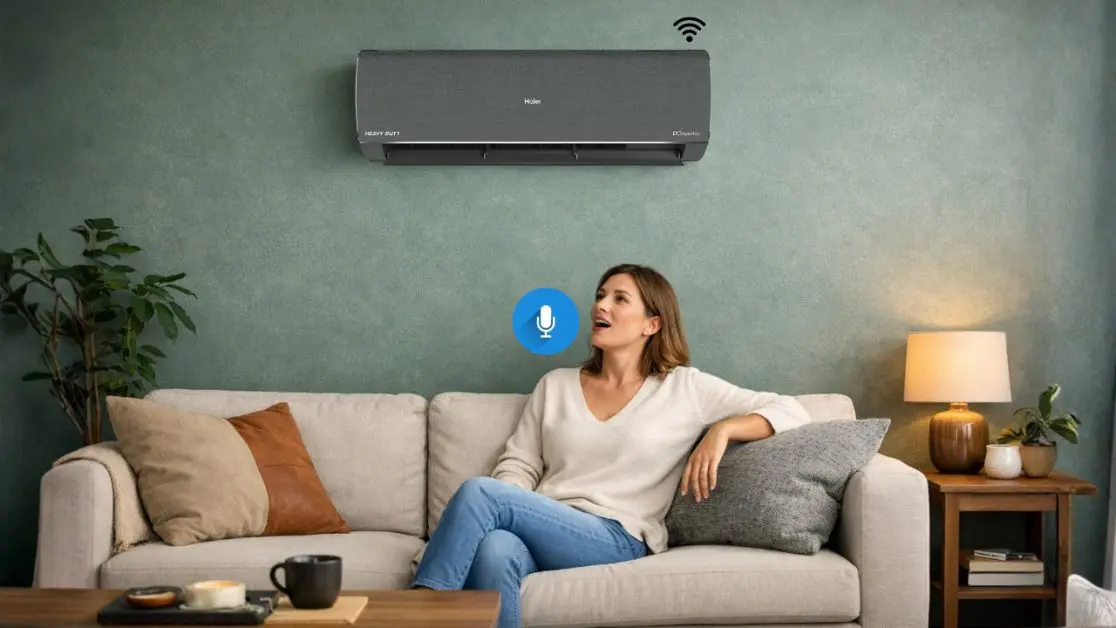
Some advanced models offer voice control without WiFi dependency.
The implication is subtle.
When control becomes frictionless, usage patterns stabilize.
Less fiddling. More consistency.
Consistency improves energy efficiency.
The Hidden System Behind Effortless Comfort
Every intelligent AC runs on three invisible loops:
- Data Collection
Temperature, humidity, occupancy, usage duration. - Pattern Analysis
Learning preferences and environmental cycles. - Dynamic Response
Adjusting compressor speed, airflow direction, and Eco levels.
This closed loop replaces manual guesswork.
And guesswork is expensive.
What This Teaches Us About the Future of Appliances
Learning technology represents a shift in philosophy.
Appliances no longer wait for commands.
They anticipate context.
This mirrors how organisations evolve.
Reactive technology survives.
Predictive technology lead.
When cooling becomes predictive, living becomes smoother.
So What Should You Look For?
When choosing a modern AC that learns your comfort, evaluate:
- Does it track usage patterns?
- Does it detect occupancy automatically?
- Does it offer predictive pre-cooling?
- Does it provide real time electricity monitoring?
- Does it maintain internal cleanliness autonomously?
Features alone do not matter.
Integration does.
Comfort Is Not a Temperature. It Is a System
We often think comfort means 24°C.
It does not.
Comfort means:
- The room feels right when you enter.
- The AC does not overcool at night.
- Electricity bills stay predictable.
- Maintenance feels effortless.
Modern AI technology such as Haier AI Atmox show how layered intelligence turns cooling into a background process rather than a daily task.
That is the shift.
From adjustment to anticipation.
From reaction to learning.
And in homes where routines change every day, that quiet intelligence feels less like technology and more like understanding.
Because the best comfort technology does not wait to be told.
They observe.
They adapt.
They are cool.
Frequently Asked Questions
Why do I keep changing my AC temperature throughout the day?
Because your room conditions change sunlight, humidity, body heat, and outdoor temperature all fluctuate. Traditional ACs react only to the set temperature, not the context.
Modern systems like Haier AI Atmox learn your adjustment patterns over time and automatically adapt cooling levels to match your typical daily routine.
Is AI in ACs just marketing or does it actually learn something?
It learns patterns, not personalities.
Modern ACs use:
Usage data
Indoor–outdoor temperature gaps
Humidity trends
Occupancy signals
Pattern recognition enables predictive cooling rather than reactive cooling.
Why does my AC feel weaker after a few months?
Dust accumulation on coils reduces heat exchange efficiency. That means:
Slower cooling
Higher electricity consumption
Compressor strain
Advanced models include auto-clean technologies like IDU Frost Self Clean and ODU Cyclone Clean that reverse airflow and frost-wash coils after ~240 hours of use.
If I leave my AC running overnight, is that bad?
Not necessarily but overcooling wastes energy.
AI Eco systems automatically reduce compressor speed when the temperature gap narrows, preventing unnecessary power use during sleep hours.
What is AI Eco 2.0 and how is it different from normal Eco mode?
AI Eco 2.0 dynamically adjusts compressor intensity based on temperature gap:
L1 Mode: Gap > 3°C
L2 Mode: Gap 1–3°C
L3 Mode: Gap < 1°C
Instead of running at full speed constantly, it fine-tunes output in real time balancing comfort and cost.
Is cooling the entire room necessary?
Not always.
AI Target Cooling directs airflow toward occupied zones instead of uniformly cooling empty space reducing power waste while improving comfort perception.
What is AI Pre-Cooling and does it really work?
AI Pre-Cooling uses geofencing (within ~100 meters of home) to start cooling before you arrive.
Example:
You leave work in Gurgaon → AC detects proximity → Starts cooling → Room is ready when you enter.
No manual timer required.