

The MUV valve shields the tank, pipes, and heating system of a water heater from sudden winter pressure spikes caused by cold inflow water.
It prevents internal stress, leaks, and long term structural damage so the appliance lasts longer and stays safe.
Why winter suddenly feels like a stress test for your water heater
Walk into any northern Indian home right now and you will notice the same winter pattern.
Colder nights. Higher usage. Longer showers.
And beneath all of it, a silent physics problem waiting to happen.
Cold water enters a water heater with higher density. Once it heats up, it expands rapidly. Pressure inside the tank rises. Some houses see this pressure jump within minutes, especially in regions facing early cold waves like Delhi, Rajasthan, Haryana, and Madhya Pradesh.
This is where protection stops being a feature and becomes a survival system.
Every winter, plumbers say the same thing.
“Tanks don’t fail because of heat. They fail because of pressure.”
And that one insight explains why the MUV valve matters.
The hidden system behind pressure surges
Pressure surges inside water heaters follow a simple pattern.
Cold in. Heat up. Expand. Push outward.
Winter is not an exception.
Winter is when the system is most vulnerable.
The MUV valve is designed for that exact vulnerability
The MUV (Multi Use Valve) is placed at the inlet of many modern heaters. It acts as a safety gateway. When pressure rises beyond safe limits, the valve releases the excess to keep the tank balanced.
Think of it as a seatbelt for your water heater.
You rarely notice it, but it protects you every day.
Many Haier instant water heaters across the catalogue include strong structural protection like stainless steel tanks, copper heating elements, and ISI-grade safety systems.
These models are built to handle winter surges better.
The MUV valve joins this framework as a small part with a large job.
What exactly does the MUV valve protect?
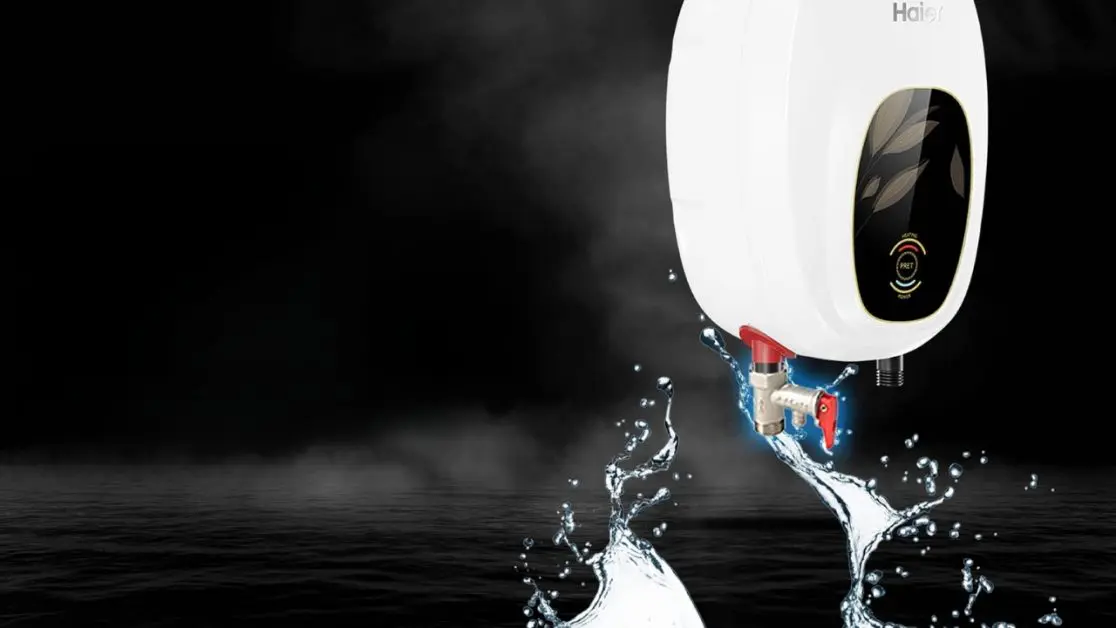
1. It protects the tank from internal stress
A heated tank under pressure behaves like a balloon.
More pressure means more tension on the metal.
Left unchecked, this stress weakens welds, joints, and internal linings.
The MUV valve releases extra pressure before it reaches the danger zone.
The benefit is structural health.
The cost of not having it is long term damage.
2. It protects inlet and outlet pipes from bursting
Pipes in winter behave differently. The colder the surroundings, the stiffer the pipes.
Pressure surges hit them harder.
The MUV valve distributes the pressure safely so the pipes don’t bear the shock.
This single function reduces the risk of cracked pipes, leaks, and sudden failures.
3. It protects heating elements from overload
When pressure rises inside the tank, the heating element is forced to work under unstable conditions. Copper elements are strong but not invincible.
Extra pressure impacts three things.
- Heat dispersion
- Temperature regulation
- Power draw
A stable pressure environment keeps the element running efficiently.
4. It protects the thermostat from misreading temperature
Thermostats regulate heating cycles. If pressure rises, water layers inside the tank mix unevenly and confuse the sensor.
A MUV valve ensures:
- Better thermal layering
- Better sensor accuracy
- Better control over heating time
The result is consistent hot water without overheating.
5. It protects your home from safety risks
Pressure plus heat equals risk.
This is why every global water heater standard mentions a pressure release system.
A functioning MUV valve prevents:
- Valve blowouts
- Hot water backflow
- Sudden leaks
- Tank deformation
A small part avoids a major problem.
Why winter pressure surges increase sharply
Pressure inside water heaters depends on one equation.
Cold input water + temperature rise = expansion.
In winter, this rise is higher because:
1. The starting temperature is lower
More temperature difference means more expansion inside the tank.
2. Families use more hot water in shorter intervals
Morning rush. Evening wind-down. Festival season cooking.
All of these increase load on the heater.
3. Municipal supply pressure changes during the season
Cities adjust supply patterns in winter.
Lower availability in some regions increases inlet pressure.
4. Closed bathrooms trap heat and moisture
This creates micro pressure zones that impact heaters installed indoors.
Pressure is a system.
Winter simply exposes its dynamics.
A table that breaks down how pressure behaves in winter
| Factor | Winter Impact | Result |
| Cold inlet water | Higher density | Faster pressure buildup |
| Thermal expansion | Increased volume change | More stress on tank |
| User demand | Higher cluster usage | Rapid heating cycles |
| Municipal pressure | Variable supply | Surges during peak |
| Closed installation spaces | Lower ventilation | Heat pressure trap |
Pressure has patterns. The MUV valve interrupts the dangerous ones.
Why modern heaters depend on multi layered protection
A dependable winter water heater is not built on one safety feature.
It is built on a system of protections that work together.
One option is a stainless steel tank.
The second is a copper heating element.
The third is an ISI backed thermostat and cut off system.
The fourth is an MUV valve that balances internal pressure.
Modern Haier instant water heaters are a good example of this layered design. Stainless steel tanks, copper elements, and safety features ensure reliable hot water even during extreme winter dips.
The implication is simple.
A winter ready heater is not a product.
It is an ecosystem.
What people misunderstand about pressure protection
People usually think summer is harder on heaters.
The truth is the opposite.
Winter creates pressure.
Summer creates usage.
Winter is about physics.
And physics wins every time.
Another assumption is that small heaters do not need pressure protection.
Instant heaters face the fastest pressure rise because heating is rapid.
The MUV valve plays a critical role by stabilising this faster cycle.
A real home example that explains everything
Picture a family in Jaipur.
Morning routine.
Three back to back showers.
Outdoor temperature around 9 degrees.
Every time cold water enters the heater, the heater works harder to heat it.
The temperature difference between input and output water is huge.
Pressure rises sharply.
Without a pressure balancing system, this cycle repeats daily.
Small stress.
Daily load.
Cumulative impact.
The heater does not fail instantly.
It wears out quietly.
The MUV valve is what keeps the system from wearing out.
So what does this mean for households preparing for winter?

It means three things.
1. A heater without pressure protection is taking a risk
The tank may survive.
The pipes may not.
2. Winter households benefit most from an MUV valve
Regions like North India, Central India, and the Himalayan belt see strong pressure swings.
3. The safest heaters are the ones designed as systems
Tank quality.
Heating element.
Thermostat.
MUV valve.
All working together.
You do not buy a feature.
You buy long term peace.
The bigger picture: Smart homes rely on quiet protectors
The modern Indian home is evolving.
Better kitchens. Faster appliances. Smarter living rooms.
Yet the devices that make life comfortable rely on small protective parts that most people never notice.
The MUV valve is one of those protectors.
It does not get headlines.
It does not get attention.
But it prevents the kind of winter problems that disrupt mornings, routines, and comfort.
Good design is not loud.
It is reliable.
And that is what makes winter living feel effortless.