
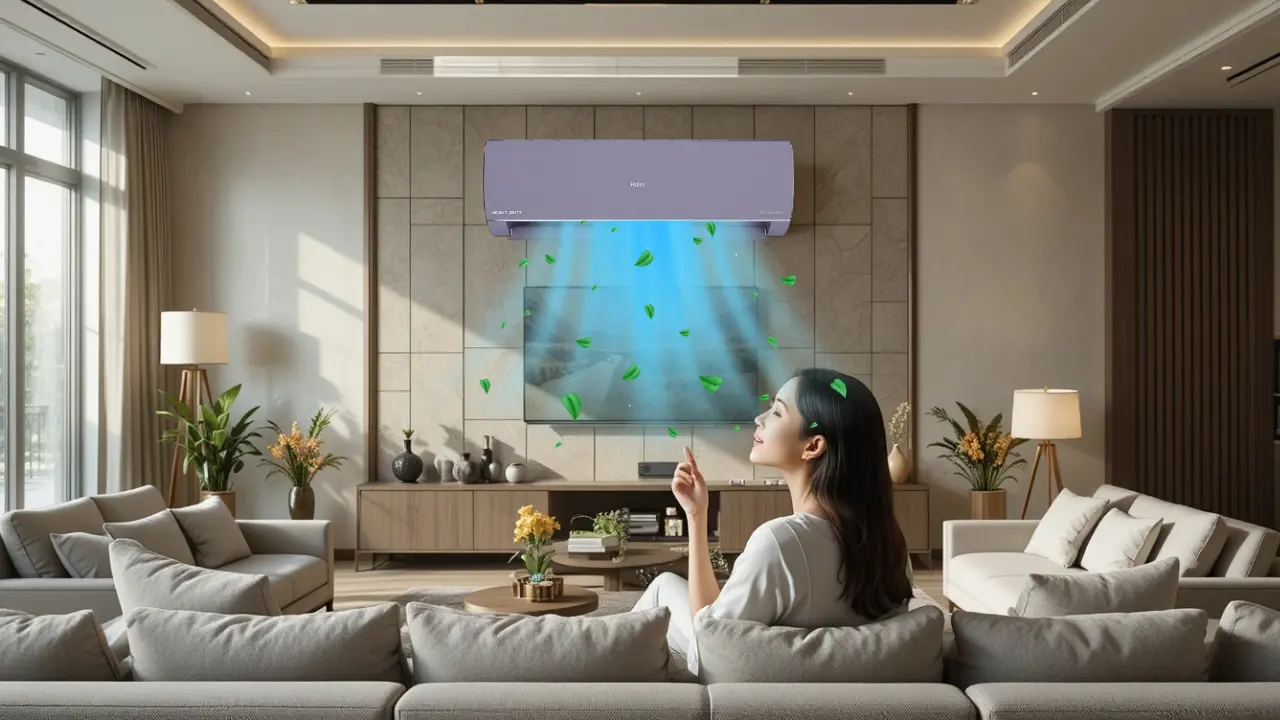

AI climate control removes temperature guesswork by learning how you live, reading your environment in real time, and adjusting cooling automatically.
Instead of constant remote tweaks, smart systems balance comfort, energy use, and timing on their own. The result is steadier comfort, lower power waste, and fewer daily decisions in Indian homes.
That is the promise.
But the real story lives inside everyday moments.
Why temperature guessing became a daily habit
Every Indian home knows this scene.
It is 10 pm.
One person feels cold.
Another feels warm.
Someone reaches for the remote.
Temperature settings move from 22 to 24. Then back again.
The problem is not indecision.
It is information.
Traditional ACs ask humans to do what machines are better at.
Reading humidity.
Tracking heat load.
Understanding occupancy.
Balancing comfort with energy use.
Humans guess.
Machines calculate.
And in most homes today, the guessing never stops.
The hidden cost of manual cooling
Manual temperature control looks simple.
It is not.
Every adjustment carries invisible costs.
- Overcooling increases power consumption without improving comfort
- Frequent compressor cycling stresses the system
- Fixed temperatures ignore changing weather, time of day, and room usage
According to the Bureau of Energy Efficiency, air conditioners can account for up to 40 percent of household electricity use during peak summers. Small inefficiencies add up quickly.
Comfort becomes expensive.
Silently.
What AI climate control actually changes
AI climate control flips the system.
Instead of asking you to decide, observe first.
It reads multiple inputs together.
- Room temperature and humidity
- Outdoor weather conditions
- Time of day and seasonal patterns
- Occupancy and usage habits
Then it adjusts cooling dynamically.
Not aggressively.
Not constantly.
Precisely.
This is not about colder air.
It is about appropriate air.
Learning beats guessing
The biggest difference between a smart system and a regular one is memory.
AI systems learn.
They notice patterns like:
- When the room is usually occupied
- How quickly the space heats up in afternoons
- When cooling can be reduced without discomfort
Over time, the system stops reacting and starts anticipating.
Comfort becomes predictable.
Effort disappears.
This learning-based approach is a core principle behind Haier’s AI-powered climate technologies, including its AI Atmox platform, which focuses on automated temperature monitoring and optimisation .
Three everyday scenarios where AI climate control shines
1. Coming home after work
Traditional setup
You enter a warm room.
You wait.
Cooling catches up.
AI-driven setup
The system anticipates arrival.
The room is already comfortable.
No waiting. No manual scheduling.
This is not luxury.
It is time to recuperate.
2. Sleeping through changing nights
Night temperatures fluctuate.
Humidity rises.
The body cools naturally.
Fixed temperature systems ignore all of this.
AI climate control adapts gradually, maintaining comfort without sudden chills or unnecessary cooling. Sleep improves not because the room is colder, but because it is stable.
3. Empty rooms and forgotten switches
We forget.
Everyone does.
AI-powered occupancy sensing reduces cooling when rooms are empty, then restores it when someone returns. Power is saved without discipline or reminders.
Automation replaces guilt.
How AI saves energy without sacrificing comfort
Energy saving usually sounds like a compromise.
AI changes that equation.
Here is how the balance works.
- Cooling intensity reduces once the target comfort is achieved
- Power usage adapts to real-time conditions instead of fixed modes
- Systems avoid running at full load unnecessarily
This dynamic control improves efficiency while keeping comfort intact.
The system optimises continuously.
Humans do not have to.
From control to coordination
Think of cooling like traffic.
Manual systems are traffic signals.
They switch on and off at fixed intervals.
AI systems are traffic controllers.
They see the whole flow.
They coordinate cooling with weather, usage, and timing.
They smooth peaks instead of reacting to them.
This coordination is what makes modern AI climate control feel calm instead of aggressive.
Why this matters for modern Indian homes
Homes today multitask.
They are offices by day.
Living rooms by evening.
Sleeping spaces by night.
A single temperature cannot serve all roles.
AI climate control adapts as the purpose of the room changes.
- Focused cooling during work hours
- Balanced comfort during family time
- Gentle adjustments overnight
The room responds to life, not the other way around.
The quiet shift from settings to systems
Earlier, buying an AC meant choosing tonnage and star ratings.
Today, the real difference lies deeper.
It is about systems that think.
AI climate control represents a shift from settings to systems.
From manual inputs to intelligent defaults.
From constant correction to steady balance.
Once experienced, it is hard to go back.
A simple way to think about it
Manual cooling is like adjusting a fan speed every few minutes.
AI cooling is like cruise control.
You still choose where you want to go.
The system handles the rest.
That is the real upgrade.
What to look for when choosing an AI-powered AC
Not all smart features are equal.
When evaluating AI climate control, focus on:
- Learning ability
Does the system adapt over time or just follow rules? - Environmental awareness
Does it respond to humidity, weather, and occupancy? - Energy visibility
Can you understand and track power usage patterns? - Automation depth
Does it reduce manual effort meaningfully or just add controls?
The best systems fade into the background.
Why less interaction often means better technology
Good technology does not demand attention.
It removes friction.
When you stop thinking about temperature,
When comfort feels consistent,
When bills stay predictable,
That is success.
AI climate control works best when you forget it is there.
The bigger implication
Temperature control was never really about degrees.
It was about control.
And control creates work.
AI shifts control back to living.
As Indian homes become smarter, the role of appliances quietly changes. They stop being tools that need management and start becoming systems that support daily rhythms.
No more temperature guesswork is not just a feature promise.
It is a mindset shift.
From managing comfort to simply enjoying it.
Frequently Asked Questions
Why does fast cooling sometimes feel harsh or drying?
Rapid, full-power cooling ignores how the body adapts. AI climate control cools progressively, avoiding sudden chills and overdying especially important during sleep.
Does AI cooling mean the room is colder?
No. It means the room is appropriate. Comfort improves because temperature stays stable instead of swinging between extremes.
Why do I wake up cold at 3 am even though the AC setting never changed?
Your body temperature drops at night, and humidity often rises. Fixed ACs don’t adapt. AI climate control adjusts gently through the night, improving sleep quality without manual changes.
Can AI climate control really improve sleep?
Yes not by lowering temperature, but by maintaining consistency. Stable conditions reduce micro-disturbances that cause restless sleep.
I forget to turn off my AC when I leave the room. Is that a big problem?
Yes but it’s also human. AI-powered occupancy sensing reduces cooling automatically when rooms are empty and restores it when someone returns. No reminders. No guilt.
How much electricity does an AC actually use in Indian summers?
According to the Bureau of Energy Efficiency, air conditioners can consume up to 40% of household electricity during peak summer months. Small inefficiencies compound quickly.