
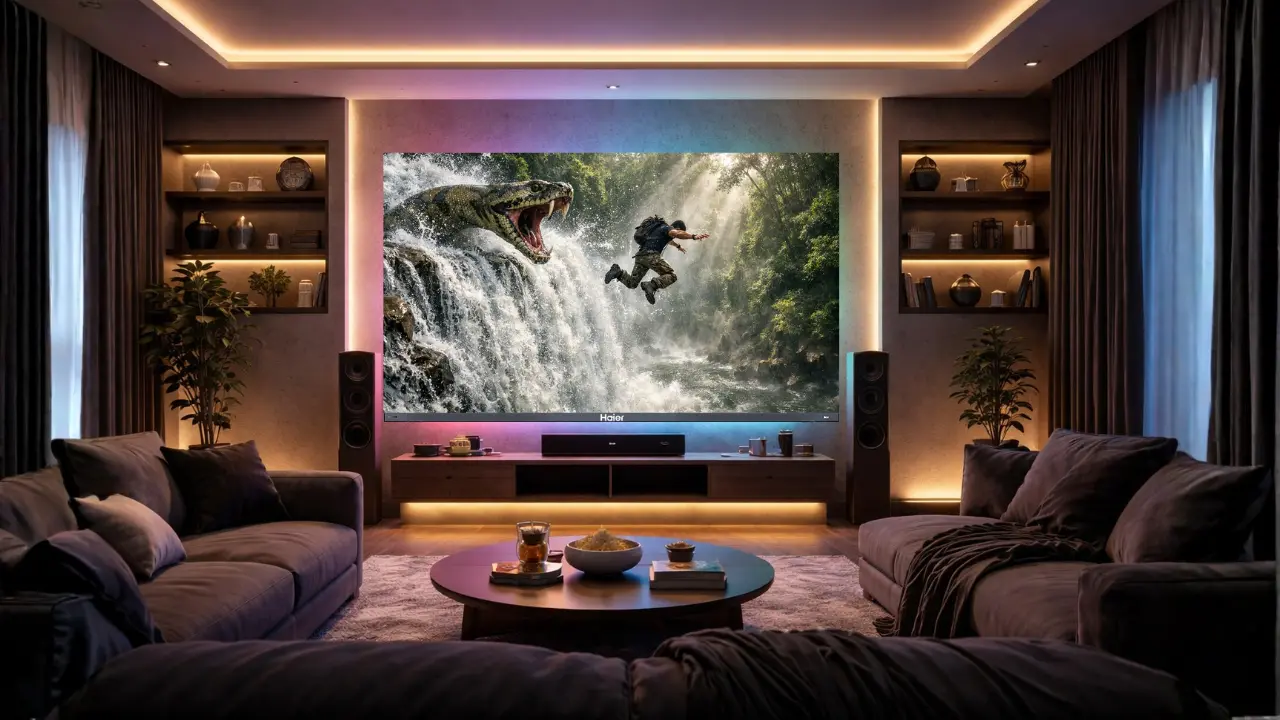

Haier TVs powered by KEF Audio deliver immersive, room-filling sound through built-in 2.1 channel and advanced multi-channel speaker systems, tuned by one of the world’s most respected audio brands.
With 50W output on the M80F series and up to 90W on the M96 series, plus Dolby Atmos support, the experience feels cinematic without adding a separate soundbar.
That is the practical truth.
The deeper story is about friction. And how removing one extra device changes the way a living room feels.
The Hidden Cost of “Just Add a Soundbar”.
Walk into a modern Indian home on a Saturday night.
Cricket on the screen. Snacks on the table. Ceiling fan spinning. Someone in the kitchen asking what happened to the last over.
The dialogue dips. The crowd noise flattens. A goal feels smaller than it should.
So someone says, “We need a soundbar.”
It sounds logical.
But pause for a second.
A soundbar means:
- Extra cables
- Extra power sockets
- Extra remote pairing
- Extra furniture planning
- Extra spending
According to industry data, over 40 percent of mid-range TV buyers in India purchase external audio within a year. Not because they love complexity. Because they expected more.
That expectation gap is what KEF Audio inside Haier TVs quietly closes.
When sound is engineered into the TV from the start, not added later, the system behaves differently.
Integrated systems are cohesive systems.
And cohesive systems reduce friction.
What Does KEF Audio Actually Change?
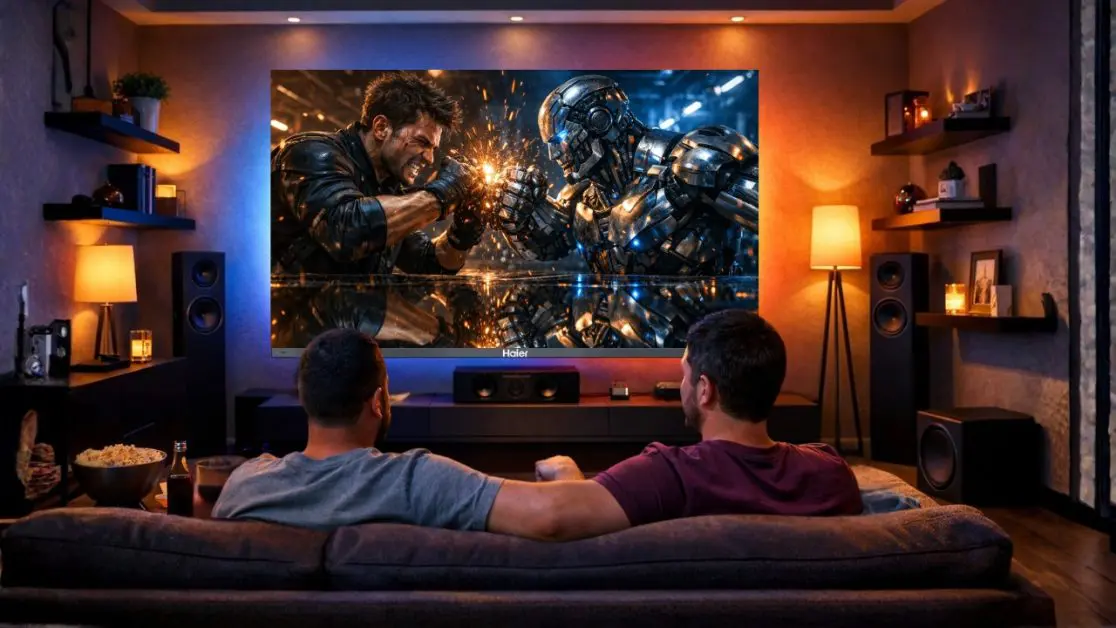
KEF is not a random badge on a box. It is a British audio brand with over 60 years of speaker engineering expertise. That matters.
Speaker design is physics. Placement. Tuning. Material choice. Crossover calibration.
On the Haier M80F Mini LED 165cm model H65M80FUX, for example, you get:
- 2.1 channel stereo speakers
- 50W audio power output
- Dolby Atmos integration
- HDMI 2.1 eARC support
This is not standard TV audio.
It includes a dedicated woofer that delivers deeper bass than flat-panel speakers typically allow.
Now compare that to adding a mid-range soundbar. You are often getting similar wattage. But with separate calibration. Separate acoustics. Separate design philosophy.
When audio and display are built together, timing improves. Dialogue sync improves. Sound staging improves.
The system breathes as one.
From Living Room to Concert Hall: The 100-Inch Perspective
Let’s zoom out.
The Haier New M96 Series 254cm QD-Mini LED AI Smart Google TV model H100M96FUX features:
- Sound by KEF
- 6.2.2 channel speaker system
- 90W audio power output
- Dolby Atmos
- 144Hz refresh rate
A 6.2.2 channel system means horizontal, vertical, and bass layers working together.
This is an architectural sound.
Add to that Dolby Atmos, which places audio in a three-dimensional field, and you begin to understand something important.
This is not “TV sound.”
This is spatial design.
And spatial design changes how rooms feel.
Why Integrated Audio Works Better in Real Homes
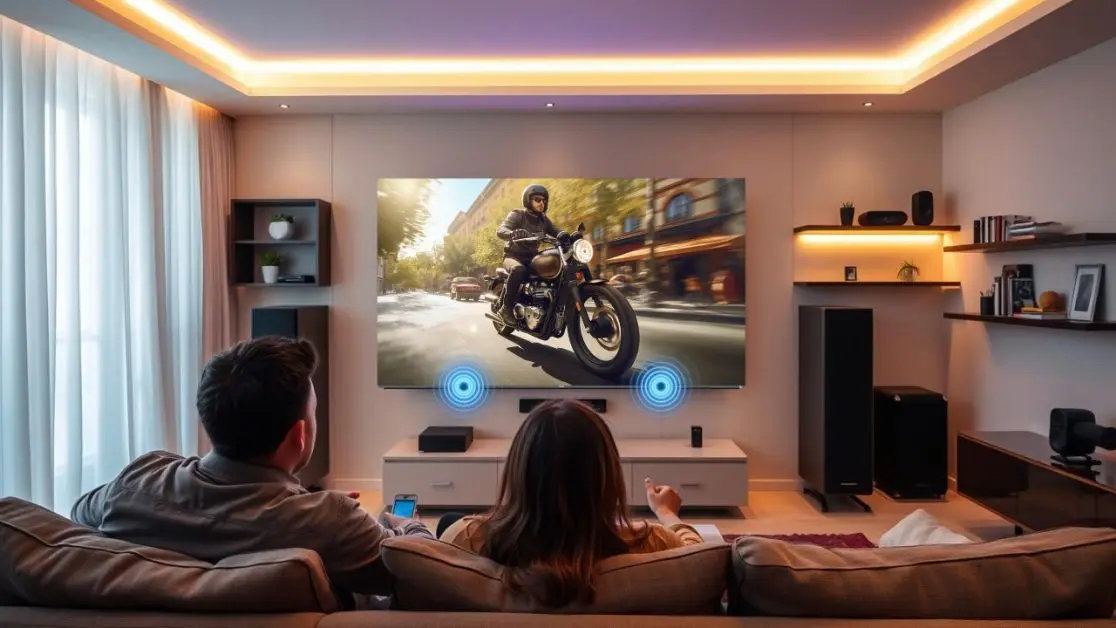
Indian homes are not sterile demo rooms.
They are dynamic.
Doors open. Pressure cookers whistle. Kids talk over scenes. Fans rotate overhead.
In this environment, audio clarity matters more than raw loudness.
KEF tuning prioritises:
- Vocal clarity
- Controlled bass
- Balanced midrange
- Wide dispersion
Wide dispersion matters. It ensures sound travels evenly across the sofa. Not just directly in front of the screen.
The result is simple.
Everyone hears clearly. Not just the person in the centre seat.
That changes group viewing.
And group viewing is where Indian televisions truly live.
Three Ways People Upgrade Audio
Let’s be honest. When audio feels weak, people have three options.
Option 1: Ignore It
Cost: Zero
Benefit: None
Hidden Cost: Reduced immersion, constant volume adjustments
Option 2: Add a Soundbar
Cost: ₹10,000 to ₹30,000
Benefit: Improved bass and clarity
Hidden Cost: Cable clutter, space planning, aesthetic compromise
Option 3: Choose a TV with KEF Audio Built-In
Cost: Part of the TV investment
Benefit: Cohesive design, calibrated performance, no extra setup
Hidden Cost: None visible
It is economically efficient and requires no additional hardware management.
And in a time when homes are becoming more minimal, fewer devices matter.
What Happens During a Cricket Match?
Picture this.
India chasing. Final over. Crowd roaring.
On a standard TV speaker, crowd noise compresses. Commentary struggles. The bat’s impact feels flat.
On a Haier M80F Mini LED 189cm (75) model H75M80FUX with Sound by KEF and Dolby Atmos:
- 2.1 stereo speakers
- 50W output
- 264 local dimming zones enhancing visual depth
The soundstage expands.
You hear stadium depth. Not just noise.
And because picture quality and sound design align, the emotional impact multiplies.
Audio and visuals are not separate experiences. They amplify each other.
That is systems thinking at work.
The Science of Why Bass Matters
Low frequencies create physical sensation.
They activate emotion.
Research in psychoacoustics shows deeper bass increases perceived immersion and emotional intensity. That is why theatres invest heavily in subwoofers.
When the Haier M80F 215cm (85) model H85M80FUX integrates a 2.1 channel system with KEF Audio and Dolby Atmos, it ensures bass is present but controlled.
Controlled bass matters more than loud bass.
Too much bass muddies dialogue.
Balanced bass anchors the scene.
That balance defines premium audio.
Gaming, OTT, and Everyday Use
Modern viewing is fragmented.
Morning news. Afternoon cartoons. Evening cricket. Late-night OTT. Weekend gaming.
Audio systems must adapt.
With HDMI 2.1 eARC support across the M80F range and AMD FreeSync Premium Pro in the M96 series , audio latency reduces during gaming.
Latency reduction means:
- Footsteps sync correctly
- Gunfire aligns with visuals
- Reaction timing feels natural
In gaming, milliseconds matter.
Integrated systems reduce signal path complexity.
And reduced complexity reduces delay.
Less Hardware. More Harmony.
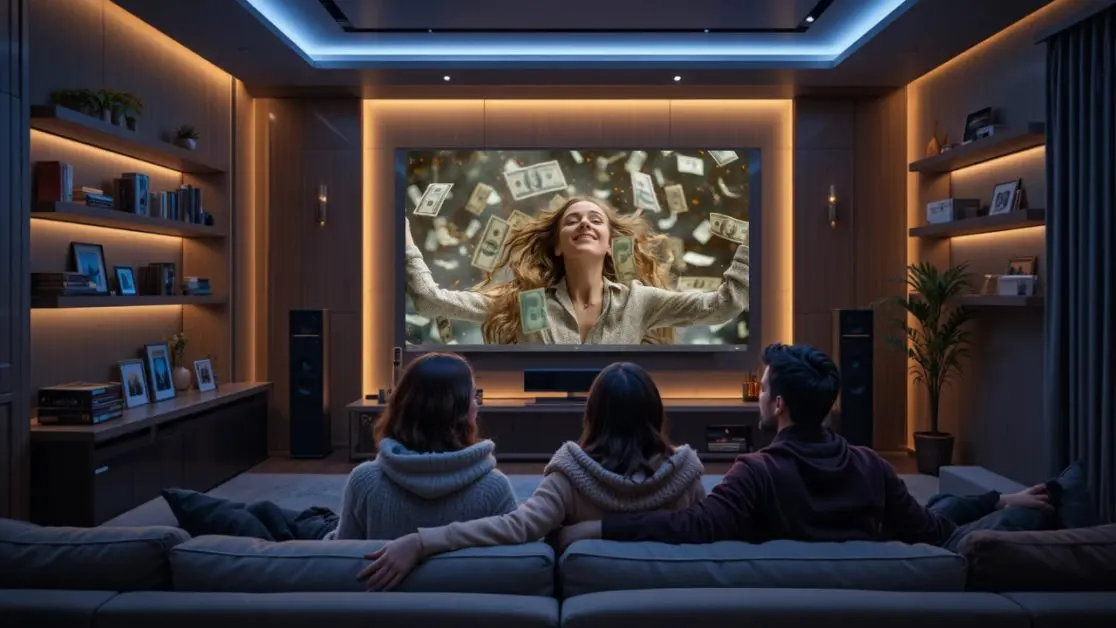
There is an aesthetic angle too.
Indian homes increasingly blend living and dining spaces.
Minimal furniture. Floating cabinets. Clean walls.
A soundbar adds:
- Another black strip
- Another visible wire
- Another object to dust
Integrated KEF Audio keeps the visual line clean.
Design integrity remains intact.
Sound should fill the room, not clutter it.
Why This Matters Beyond Entertainment
Sound influences stress.
Harsh audio fatigues faster.
Clear dialogue reduces cognitive load.
Lower cognitive load means longer, more comfortable viewing.
And comfort shapes habits.
When technology feels effortless, it gets used more.
That applies to TVs. It applies to appliances. It applies to life systems.
Reduce friction. Increase harmony.
When No Soundbar Becomes a Philosophy
“No Soundbar Needed” is not a marketing claim.
It is a design philosophy.
It says:
Build the system correctly from the start.
Do not rely on add-ons to fix core weaknesses.
In business. In homes. In product design.
The strongest systems integrate intelligence at the foundation.
Haier’s integration of KEF Audio across the M80F and M96 series reflects that mindset.
- 50W 2.1 channel on M80F
- 6.2.2 channel 90W on M96
- Dolby Atmos support
- HDMI 2.1 eARC
- AI-driven processing
These are not scattered features.
They form a coherent ecosystem.
The Broader Shift in Indian Homes
Indian households are upgrading with intention.
They are not chasing gadgets. They are chasing experiences.
Festival gatherings. IPL nights. Family movie Sundays. Solo unwind sessions after work.
Every moment benefits from clarity.
When sound feels full without extra hardware, a room feels finished.
And finished rooms create calm.
Calm homes create better conversations.
Better conversations create better evenings.
Technology rarely announces its impact loudly.
It shows up quietly. In how little you have to adjust.
The One Insight to Remember
A great system removes the need for correction.
When audio is engineered by KEF inside a Haier TV, you do not reach for extra hardware.
You press play.
And the room responds.
That is power.
Not a louder sound.
Smarter design.
Frequently Asked Questions
Do I really need a soundbar if I’m buying a Haier TV with KEF Audio?
If you’re choosing the M80F or M96 series, most users won’t. These TVs include tuned 2.1 or 6.2.2 channel systems with 50W–90W output and Dolby Atmos, delivering room-filling sound without extra hardware.
Why do so many people buy a soundbar after getting a new TV?
Because many TVs underdeliver on bass and clarity. Haier TVs powered by KEF Audio are engineered to close that expectation gap from day one.
Is built-in TV audio ever truly comparable to a soundbar?
In typical TVs, rarely. But with integrated KEF tuning and dedicated woofers (like in the M80F series), performance approaches mid-range soundbars without the extra cables or setup.
My living room has fans, open kitchens, and background noise. Will dialogue still be clear?
Yes. KEF tuning prioritizes vocal clarity and wide dispersion, meaning voices remain intelligible even off-center.
I sit on the side of the sofa. Will I hear properly?
Wide dispersion ensures sound spreads evenly across the seating area not just directly in front of the TV.
Does Dolby Atmos really make a difference in normal homes?
With support on both the M80F and M96 series, Atmos adds spatial layering, making crowd noise, ambience, and effects feel immersive even outside a theatre setup.
Is setting up a Haier TV with KEF Audio easier than installing a soundbar?
Yes. No extra cables. No remote pairing. No furniture adjustments. Just plug in the TV.
Will adding a soundbar create noticeable clutter?
Often yes extra wires, another visible device, additional dust surfaces. Integrated systems preserve minimalist aesthetics.
Does integrated audio reduce sync issues?
Yes. When audio and display are designed together, lip-sync and latency alignment improve.