
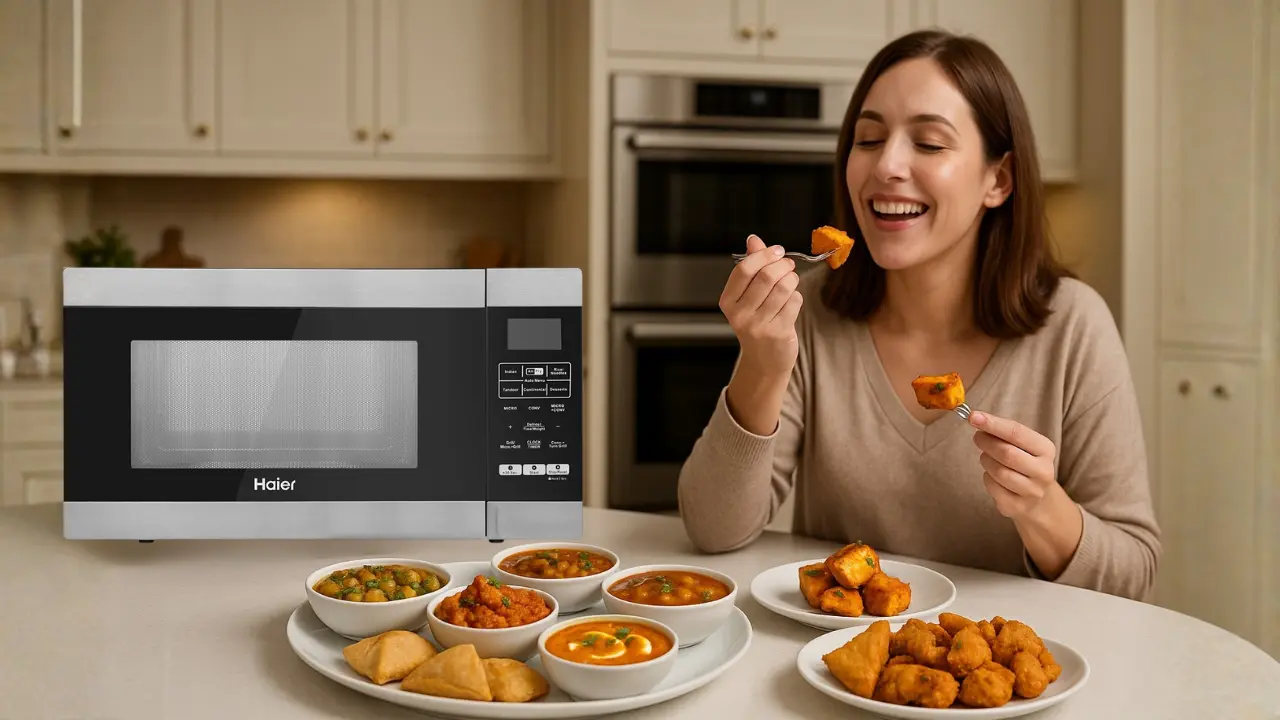

To reheat Indian curries without drying them out or losing flavour, use medium heat (600–700W) for 2–4 minutes, stirring midway.
In convection microwaves like the Haier 25L and 30L Convection Microwaves, this balances even heating with moisture retention keeping gravies silky and spices alive.
Every curry tells a story – and deserves the right reheat

There’s something sacred about a bowl of leftover curry.
It carries last night’s laughter, the perfect tempering you nailed, and the slow-simmered aroma that still lingers in the fridge. But when you reheat it wrong, that story changes. The oil splits, the spices turn bitter, and what was once a masterpiece becomes a memory.
So, what’s the right way to reheat an Indian curry?
The answer isn’t just “put it in the microwave.” It’s about understanding how heat behaves, how spices respond, and how appliances can make or break that balance.
Why reheating Indian curries is trickier than it looks
Curry is chemistry in motion.
Most Indian curries whether it’s rajma, dal makhani, or paneer butter masala contain oil, water, and dense spices. Each element absorbs heat differently.
- Oil heats fast.
- Gravy evaporates moisture quickly.
- Thick lentils or meats heat unevenly.
That’s why reheating on high power often causes one of two problems: either the surface bubbles up too soon while the centre stays cold, or the dish loses its moisture entirely.
Smart reheating is about gentle restoration, not speed.
The science of even reheating

Think of heat like sunlight through a window focused too sharply, and it burns; spread evenly, and it warms beautifully.
In a good convection microwave, like Haier’s 25L Convection Microwave (HIL2501CBSH), even heating comes from the stainless-steel cavity and automatic power-level combinations that mimic stovetop balance. The result? Uniform heat circulation that revives the curry’s texture instead of flattening it.
If your appliance allows, use a combination reheat setting (microwave + convection). It helps maintain flavour depth while avoiding overcooked edges.
How long should you reheat curries?
Here’s a simple, foolproof guide for most Indian homes:
| Type of Curry | Ideal Power (Watts) | Duration | Tips |
| Light gravies (kadhi, rasam, sambhar) | 600W | 2–3 mins | Stir once halfway. Add a spoon of water before reheating. |
| Medium-thick curries (paneer butter masala, chole) | 700W | 3–4 mins | Cover the bowl to trap steam; this keeps the gravy silky. |
| Thick dals (dal makhani, rajma, kala chana) | 700–800W | 4–5 mins | Reheat in short intervals. Stir well between cycles. |
| Dry curries (bhindi masala, chicken tikka) | 600W | 1–2 mins | Use the “Grill + Microwave” mode if available. |
Pro tip: Always use microwave-safe glass or ceramic bowls and never overfill them. Curries need space to reheat evenly.
Reheat like a chef: 3 smart tricks from Indian kitchens
1. Add moisture back in
Every curry loses a little moisture overnight. Reheating without compensating for it is like turning up a song with missing lyrics; it never feels right.
Before you hit start, add:
- 2–3 tablespoons of water for gravies.
- 1 teaspoon of ghee for lentil-heavy dishes.
- A splash of milk or cream for paneer-based curries.
This rebalances the texture and prevents splitting.
2. Use the lid to your advantage
Steam is your friend. It’s what keeps reheated food soft and aromatic.
Always cover the dish with a microwave-safe lid or vented cling wrap. The trapped steam distributes heat evenly and keeps the spice oils from burning. Haier’s 30L Convection Microwave with In-Built Air Fryer (HIL3001ARSB) goes a step further with a multi power-level control that lets you fine-tune the heat intensity, ensuring that reheated curries retain their natural richness.
3. Stir midway, always
The microwave’s waves heat from the outside in. Stirring halfway helps avoid “hot spots” and revives the texture, especially in thick dals and meat curries.
If you’re using a Haier microwave, its auto-cook memory function saves your preferred reheat combination so next time, it remembers exactly how your curry likes to come back to life.
Curries that actually taste better the next day
Here’s the beautiful secret: some curries are meant to be reheated.
In fact, chefs often swear by the “overnight curry rule.” Once spices mingle and fats settle, flavours deepen.
These are the dishes you should look forward to reviving the next morning:
- Rajma: the tomato base thickens and becomes silkier.
- Mutton rogan josh: the ghee carries the spice notes better on day two.
- Paneer tikka masala: smokiness matures into richness.
- Dal makhani: the quintessential “better tomorrow” curry.
When you reheat these gently low power, short intervals they become a new experience altogether.
Why the right appliance makes all the difference
Reheating is an art of restraint. The difference between soggy and soulful lies in how your appliance manages heat.
That’s where Haier’s convection microwaves stand out.
Let’s break it down:
| Model | Ideal For | Why It Works |
| Haier 20L Convection Microwave (HIL2001CSSH) | Small families, bachelors | Compact and efficient. 66 auto cook menus and stainless-steel cavity for even reheating. |
| Haier 25L Convection Microwave (HIL2501CBSH) | Indian homes that love variety | 305 auto cook menus and Bread Basket feature great for rewarming naan, paratha, and curry sides. |
| Haier 30L Convection Microwave (HIL3001ARSB) | Larger families, food lovers | Built-in Air Fryer and Rotisserie lets you reheat gravies while crisping kebabs perfectly. |
What these models share is a focus on evenness, no cold centres, no overheated rims, no loss of aroma.
They make reheating feel like an extension of cooking, not an afterthought.
Common reheat mistakes and how to fix them
1. Overheating oily curries
When gravies like butter chicken or korma bubble aggressively, the oil separates and the spices lose balance.
Fix: Reheat at 600W with the lid on. Stir once midway.
2. Reheating directly from the fridge
Cold food creates uneven heat pockets.
Fix: Let the curry sit at room temperature for 10–15 minutes before reheating.
3. Ignoring moisture loss
Curries stored overnight thicken.
Fix: Add 2 tablespoons of water or milk before reheating.
4. Using metal containers
Microwaves and metal don’t mix.
Fix: Always transfer to a microwave-safe bowl.
The quiet evolution of Indian reheating culture
Our parents reheated food on gas stoves, stirring endlessly to avoid burning. Today, we’re learning to trust technology that understands food like we do.
Smart convection microwaves aren’t about convenience alone, they’re about precision, preservation, and progress. They let a working professional enjoy dinner like it was freshly cooked. They let a family of four save time without compromising warmth. They let a student in a new city bring home taste to the table.
Reheating, done right, isn’t lazy. It’s intelligent.
A new way to think about leftovers
Leftovers are not yesterday’s food, they’re today’s comfort, made smarter.
When your microwave remembers your reheat pattern, your curries come back exactly the way you like them: warm, layered, and alive. That’s not just technology; that’s empathy in design.
The Haier 25L and 30L Convection Microwaves embody that idea beautifully. From ghee-laden gravies to thick dals, they preserve the rhythm of home cooking one reheat at a time.
Final thought
The best reheating isn’t about chasing heat, it’s about restoring harmony.
When done right, it reminds you why Indian curries are timeless. Because every spoonful, even the next day, should still taste like care.