
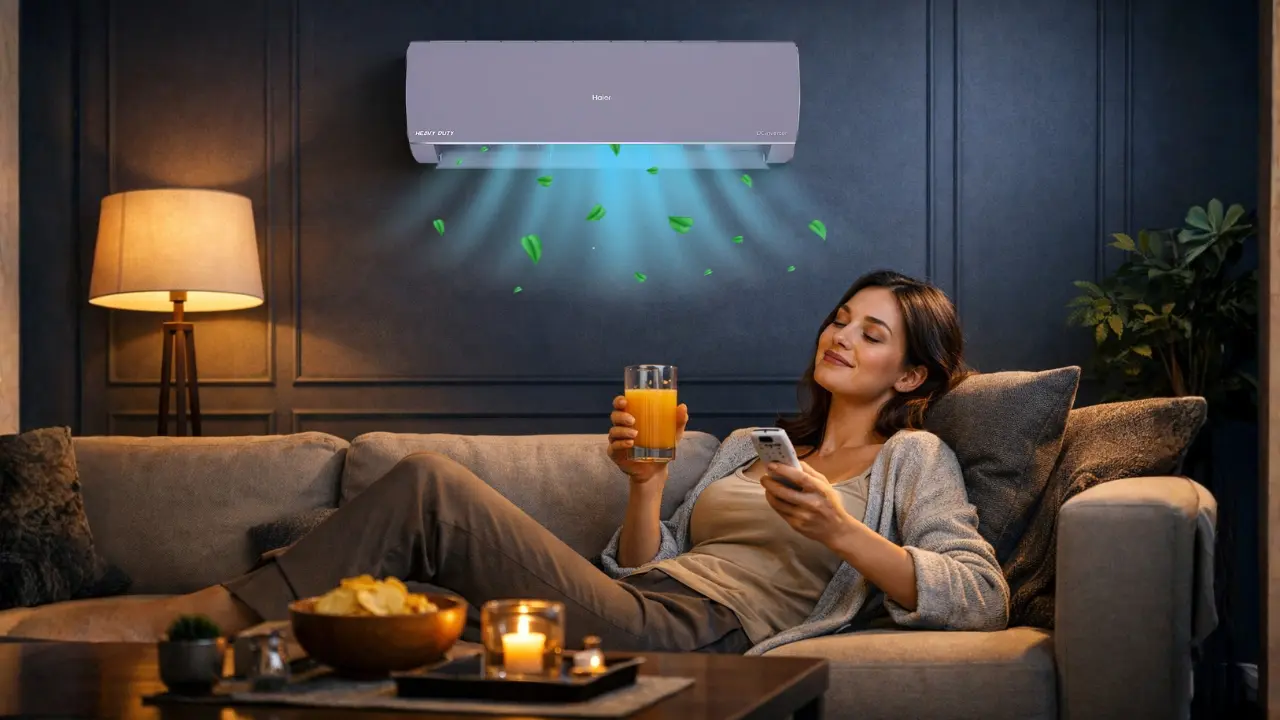

You stay comfortable without freezing the whole house. Instead of cooling the entire room, you’re only cooling where people live.
Climate technology does this today with zoned air delivery, smart sensors and responsive cooling that provides comfort where you need it and eliminates waste.
It’s a win-win.
You feel better. You save on power. And your home just doesn’t feel so… cold.
Why cooling an entire room often solves the wrong problem?
Walk into many Indian homes during peak summer.
The AC is set to 20°C.
The room feels cold enough to store mangoes.
Someone on the sofa is still feeling warm.
It sounds strange, but it happens often.
Traditional air conditioners follow a simple rule.
Cool everything.
They lower the temperature of the entire room until the thermostat reaches a target level. Walls, furniture, unused corners, and empty spaces all receive the same cooling treatment.
But people rarely use every corner of a room.
Think about a typical evening:
- A parent sits near the sofa watching television.
- Someone else works on a laptop at the dining table.
- A child lies on the floor playing with toys.
The room is large.
But comfort is personal.
Cooling the entire room treats space like the priority.
Modern cooling technology treats people like a priority.
And that shift quietly changes everything.
The Hidden Cost of Overcooling
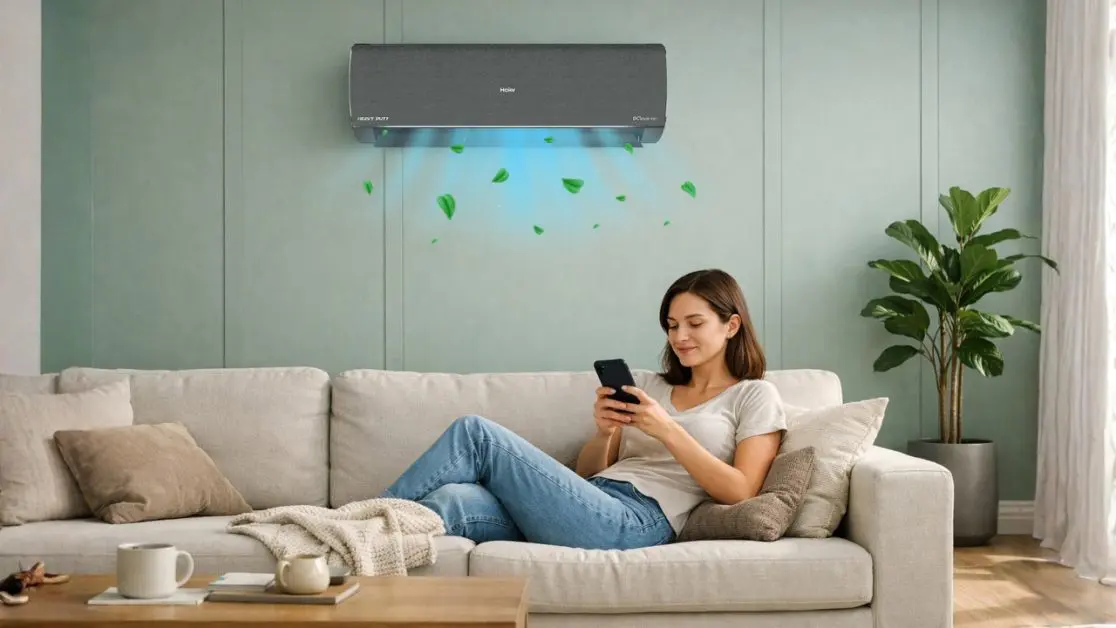
Overcooling does more than waste electricity.
It changes how a home feels.
Most households notice three patterns when cooling technology runs too aggressively.
| Overcooling Effect | What Actually Happens | Result in Daily Life |
| Temperature imbalance | Some areas feel too cold | People constantly adjust settings |
| Higher electricity use | Compressor runs longer | Rising energy bills |
| Reduced comfort | Cold air spreads unevenly | Blankets appear in summer |
According to global energy studies from the International Energy Agency, space cooling already accounts for nearly 10 percent* of global electricity consumption. Efficient cooling strategies reduce both energy demand and environmental impact.
But the bigger insight is this.
Cooling technology designed for buildings rarely understands human behavior.
Smart cooling technology does.
Comfort Is Not About Temperature. It Is About Air Movement
A cinema hall provides a useful analogy.
The entire hall is not cooled equally.
Airflow is designed so people sitting in seats feel comfortable. Walk into a hallway near the exit and the temperature often feels different.
Homes work the same way.
People do not sit in every corner of the living room.
They sit in zones.
Common Comfort Zones in Indian Homes
- The sofa zone
Evening television, conversations, cricket matches. - The dining table zone
Family meals and quick laptop work. - The bedroom sleep zone
Rest, reading, and winding down.
Cooling these zones effectively delivers comfort faster than cooling an entire room.
This is where modern air conditioning technology begins to change the equation.
Targeted Cooling: Comfort That Follows You
Traditional cooling spreads air across the room and waits for temperature to drop everywhere.
Targeted cooling flips the logic.
Cool the person first.
Some advanced technology uses installation position data and airflow mapping to send cool air exactly where it is needed.
Instead of treating the entire room as equal space, cooling focuses on specific zones such as a sofa or bed.
The benefit becomes clear within minutes.
Air reaches people faster.
And the rest of the room gradually stabilizes.
What Target Cooling Changes
- Faster perceived comfort
- Lower compressor load
- Reduced energy consumption
Think of it like sunlight through a window.
The beam focuses on one spot.
But warmth spreads naturally afterward.
Cooling can work the same way.
Three Ways Modern Homes Achieve Personal Comfort
Different households approach personal comfort differently.
The smartest homes combine several strategies.
Option 1: Intelligent Climate Control
Smart air conditioners analyze temperature, humidity, and environmental conditions before adjusting cooling levels.
Some technologies even learn usage patterns over time and optimize cooling automatically. These AI-driven technologies analyze room conditions and user behavior to adjust airflow and temperature without manual input.
Benefits
- Automatic temperature adjustment
- Reduced manual control
- Balanced comfort across seasons
Cost
- Slightly higher appliance investment
- Minimal learning period
Option 2: Target Cooling for Focused Comfort
Instead of cooling every corner of the room, airflow is directed toward specific activity areas.
Examples include:
- A reading chair near the window
- The sofa during movie time
- The bed during sleep
Target cooling technology uses airflow mapping and sensors to deliver cooling precisely where people sit.
Benefits
- Faster comfort
- Reduced energy waste
- More consistent airflow
Cost
- Requires correct AC placement
Option 3: Predictive Pre-Cooling
Imagine walking into a cool room the moment you arrive home.
Predictive technology uses behavioral patterns or geolocation triggers to start cooling before occupants arrive.
For example, certain AI-enabled ACs begin pre-cooling when the technology detects that the user is approaching the home area.
Benefits
- Immediate comfort on arrival
- Reduced waiting time for cooling
- Better temperature stability
Cost
- Requires smart connectivity features
The Energy Equation: Comfort Without Waste
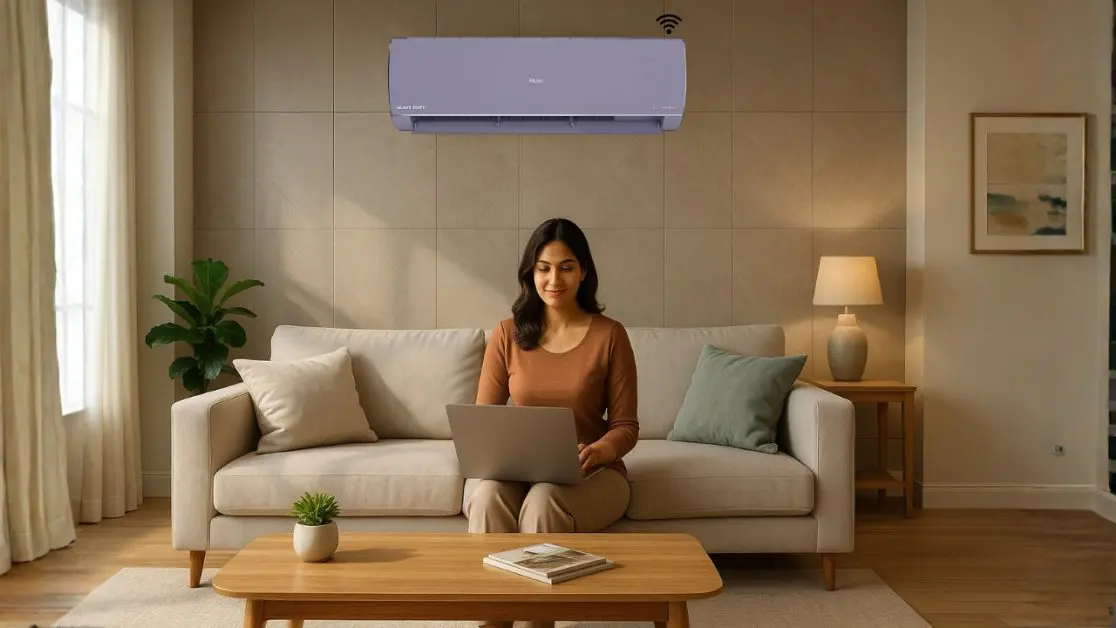
Electricity consumption from cooling grows rapidly in India every summer.
But the problem is rarely the AC itself.
The problem is how cooling is distributed.
Consider this simple comparison.
| Cooling Method | Cooling Approach | Energy Efficiency |
| Traditional cooling | Whole room cooling | Lower efficiency |
| Target cooling | Focused airflow | Higher efficiency |
| AI climate control | Adaptive cooling | Highest efficiency |
Smart technology combines environmental sensing with machine learning to adjust performance dynamically. They track temperature, operating modes, and power usage to generate optimized cooling plans over time.
The result is an interesting shift.
The AC stops behaving like a machine.
It behaves like a climate assistant.
A Small Habit That Changes the Entire Cooling Experience
There is a simple insight most households overlook.
Comfort is not achieved by the lowest temperature.
Comfort comes from the right airflow at the right place.
A room set to 24°C with focused airflow often feels cooler than a room set to 20°C with poor airflow distribution.
This is why modern cooling design focuses on airflow direction, occupancy detection, and adaptive climate control rather than just temperature numbers.
How Modern Indian Homes Are Rethinking Cooling
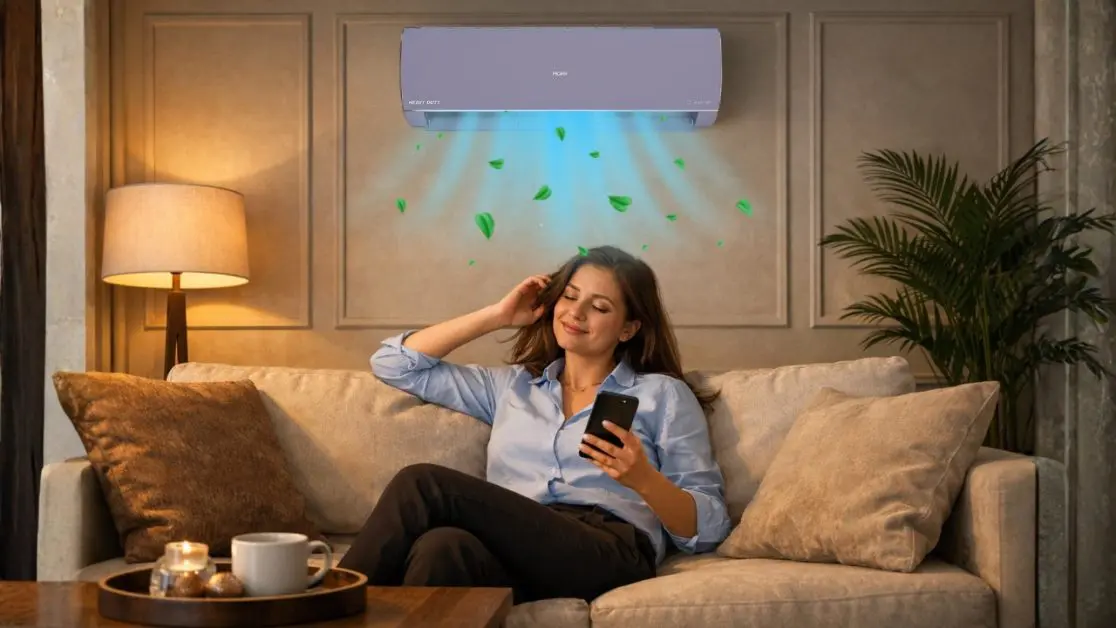
Cities. Mumbai. Bengaluru. Delhi. Apartments everywhere are getting smarter.
Rooms are getting smaller.
Consumers are becoming more energy-conscious.
Electricity bills are important.
This means consumers start to ask a new set of questions. They stop asking:
“How cold can I make the room?”
And start asking:
“How comfortable can I make my space?”
This change in thinking is what leads to smart ACs such as Haier’s AI powered- Atmox smart ACs that combine temperature control, occupancy sensing, power monitoring and variable cooling into one appliance.
Forget pressing the temperature setting on the AC every hour. Let the AC sense the environment and do the math to cool your room optimally.
Minimal effort. Maximum efficiency. Less hassle.
A New Way to Think About Cooling
Cooling used to be about lowering temperature.
Now it is about managing comfort.
The difference matters.
Think about how lighting evolved.
Older homes used a single bright bulb in the center of the room.
Modern homes use layered lighting.
- A warm lamp near the sofa
- Soft light near the dining table
- Focused light on the reading desk
Cooling is moving in the same direction.
Layered comfort.
Focused airflow.
Adaptive intelligence.
The One Insight Most Homes Discover Too Late
The goal of an air conditioner is not to cool air.
It is to improve how people feel inside a space.
And once cooling becomes personal instead of uniform, something interesting happens.
Homes feel calmer.
Electricity bills drop.
And the room finally feels comfortable without turning into a freezer.
The smartest cooling technology understands this quiet truth.
Comfort does not come from cooling everything.
It comes from cooling exactly where it matters most.
Frequently Asked Questions
I keep lowering my AC temperature, but I still don’t feel comfortable. What am I doing wrong?
You’re likely chasing temperature instead of airflow. Comfort isn’t just about how cold the room is, it’s about whether cool air is actually reaching you. If airflow isn’t directed where you sit or sleep, even 20°C can feel ineffective.
Should I set my AC to 20°C or 24°C for better comfort?
24°C with proper airflow often feels cooler than 20°C with poor air distribution. Lower temperatures increase energy use but don’t guarantee better comfort.
Why does my room feel unevenly cooled even when the AC is running?
Traditional ACs cool the entire room uniformly, but people occupy specific zones. This creates hot and cold pockets depending on where airflow reaches.
Why do I sometimes need a blanket even in summer with the AC on?
That’s a classic sign of overcooling. The AC is cooling the entire space aggressively instead of focusing on occupied areas, creating unnecessary cold zones.
Why does my house feel uncomfortable even when it’s technically cool?
Because comfort isn’t uniform. Overcooling can make some areas too cold while others remain warm, leading to constant adjustments and discomfort.
What does “AI cooling” in modern ACs actually do?
AI-powered ACs analyze temperature, humidity, and usage patterns to automatically adjust cooling. They optimize airflow and power usage without constant manual input.
Can an AC really learn my habits?
Yes. Smart systems track patterns like when you arrive home or sleep, then adjust cooling accordingly (e.g., pre-cooling before you arrive).
Is targeted cooling better than traditional AC cooling?
Yes. Targeted cooling focuses airflow where people are, delivering faster comfort and reducing energy waste.
Do I really need smart features, or is a regular AC enough?
A regular AC works, but smart features reduce effort, improve comfort consistency, and lower energy consumption over time.