
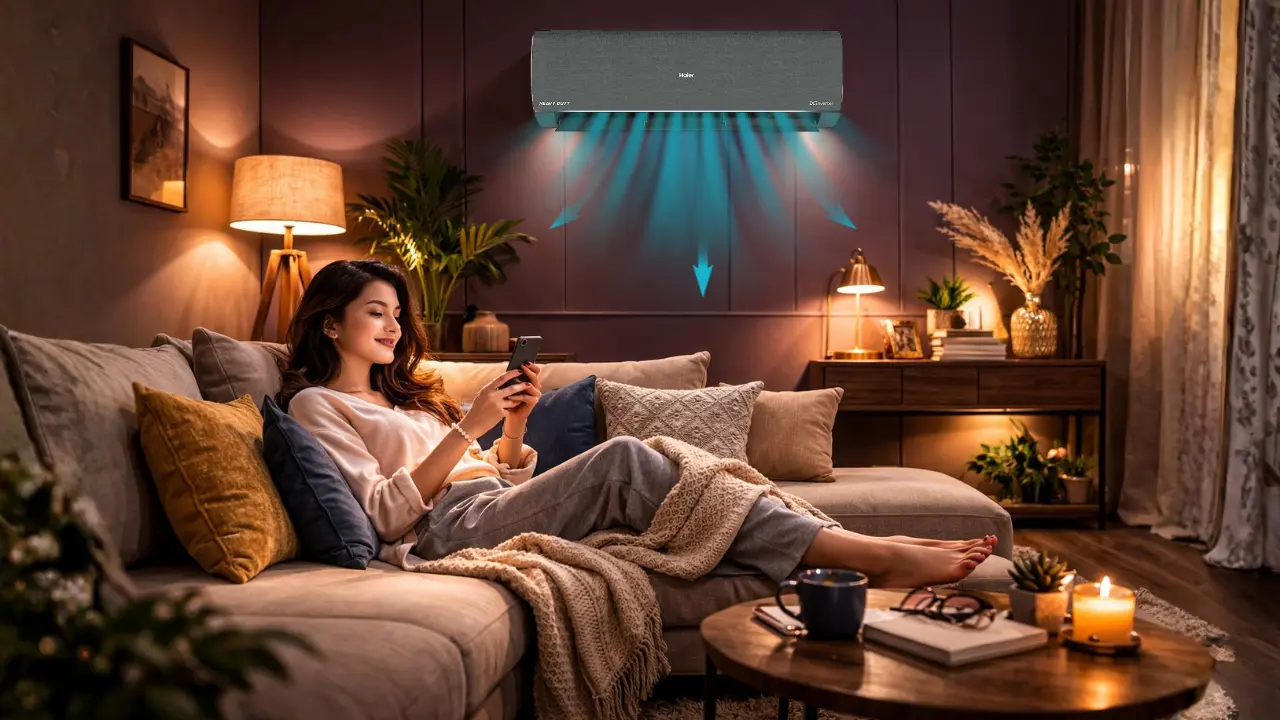

Personalised cooling for every seating position means your air conditioner directs the right amount of cool air exactly where people are sitting, instead of treating the whole room the same.
It adapts to movement, occupancy, and temperature gaps in real time, so the sofa, the study desk, and the floor mattress each feel equally comfortable.
That is the short answer.
The longer one lives in Indian living rooms.
Why does one room rarely feel the same in every corner?
Walk into a typical home at 8:30 pm.
One person is on the sofa watching highlights.
A child is doing homework at the dining table.
Someone is sitting cross-legged on the floor near the balcony door.
The AC runs at 24°C.
Yet one says it feels too cold.
Another says it is still warm.
Someone quietly pulls a shawl.
This is not a temperature problem.
It is a distribution problem.
According to the India Meteorological Department, many Indian cities see temperature swings of 10°C within a single day. Add ceiling fans, kitchen heat, balcony drafts, and human body heat, and the room becomes a moving climate system.
Most conventional ACs push air in one dominant direction. Physics does the rest. Cool air sinks. Warm air rises. Corners behave differently.
When cooling is uniform, comfort is uneven.
That is the hidden system.
The myth of “set it and forget it” cooling
We were told something simple.
Set 24°C.
Let it run.
Trust the machine.
But here is what actually happens:
- The sofa near the indoor unit gets direct airflow.
- The corner near the window warms faster.
- The person under the fan feels colder due to the wind chill.
The Bureau of Energy Efficiency reports that air conditioners account for nearly 40 percent of peak household electricity load in urban India. Yet most units still cool the entire volume equally, whether occupied or not.
Uniform cooling wastes energy.
And it ignores people.
Comfort is personal. Energy is expensive. Precision solves both.
What personalised cooling really changes
Personalised cooling is not about making the room colder.
It is about making specific zones comfortable.
With systems like AI Target Cooling and AI Human Detection built into Haier’s AI Atmox platform , the AC uses sensors and installation data to focus airflow toward occupied seating areas instead of empty corners.
Here is what that does in practice:
1. Targeted comfort
- Air reaches the sofa faster.
- The study desk feels balanced.
- The floor mattress does not freeze.
According to internal AI system logic described in AI Atmox, the unit uses environmental data and position mapping to optimize cooling dynamically.
Cool where needed.
Not everywhere.
2. Energy efficiency
When only part of a room needs active cooling, energy demand reduces.
AI Eco 2.0 modes automatically shift between levels depending on temperature gaps. If the difference is large, the system works harder. If the gap narrows, it eases off.
Cooling becomes responsive.
Not rigid.
3. Fewer remote battles
In many homes, someone keeps adjusting the temperature every 20 minutes.
Personalised cooling reduces that friction.
And friction, in homes or organisations, drains energy.
Three ways households handle uneven cooling today
Let us be honest.
Most families solve comfort gaps in predictable ways.
One option is manual adjustment
- Lower the temperature further.
- Increase fan speed.
- Redirect flaps manually.
Cost: Higher electricity bills.
Benefit: Temporary relief.
The second option is compromise
- One person tolerates extra cold.
- Another tolerates mild heat.
Cost: Silent discomfort.
Benefit: No argument.
The third option is intelligent adaptation
- AI detects where people sit.
- Airflow shifts automatically.
- Energy adjusts in real time.
Cost: Smarter upfront investment.
Benefit: Long term comfort and savings.
Systems win over shortcuts.
Always.
How AI Human Detection changes empty rooms
There is another invisible waste.
Empty rooms.
AI Human Detection technology senses occupancy and shifts to energy saving mode when no one is present.
The system logic works like this:
- No activity for 15 minutes triggers Auto L3 Eco mode.
- Extended absence powers down cooling intelligently.
This matters because residential electricity tariffs in major Indian cities have steadily increased over the past five years.
A room without people does not need premium cooling.
Energy saved is comfort extended.
Personalised cooling is also about arrival timing
Consider this scene.
You leave the office at 7 pm.
Traffic takes 40 minutes.
You enter a warm apartment.
Traditional cooling starts after you press the remote.
AI Pre-Cooling changes that equation.
Using geofencing up to 100 metres, the system anticipates your arrival and begins cooling in advance.
No timers.
No guesswork.
The room feels ready.
In urban India, where summer temperatures regularly exceed 40°C, that first wave of cool air changes your entire evening mood.
Small shifts create big relief.
What personalised cooling teaches us about systems
Air conditioning is not just about hardware.
It is about understanding patterns.
In organisations, leaders do not treat every department the same. They allocate resources where impact matters most.
Personalised cooling follows the same principle.
Not every corner needs equal attention.
Not every moment needs maximum power.
Not every person feels temperature the same way.
When machines learn habits, track usage, and auto generate optimized energy plans , comfort becomes adaptive.
And adaptive systems scale better than fixed ones.
A quick comparison: uniform vs personalised cooling
| Factor | Uniform Cooling | Personalised Cooling |
| Airflow | Same everywhere | Directed to occupied zones |
| Energy Use | Constant load | Dynamic adjustment |
| Comfort Level | Uneven | Balanced per seating area |
| Manual Effort | Frequent remote use | Minimal |
| Long Term Cost | Higher | Controlled |
This is not about luxury.
It is about alignment.
Why seating position matters more in modern homes
Indian homes have evolved.
Open kitchens merge with living areas.
Work from home setups occupy corners.
Floor seating during gatherings is common.
A single airflow direction cannot handle that diversity.
The AI Atmox framework combines environmental analysis, user habit tracking, and real time performance tuning.
It adapts across:
- Summer heatwaves
- Monsoon humidity
- Mild winter afternoons
According to global HVAC studies, adaptive climate control systems can improve perceived comfort by up to 30 percent compared to static settings.
That difference feels human.
Smarter cooling also reduces maintenance friction
Comfort declines when AC performance drops.
Dust buildup reduces efficiency.
Clogged coils increase energy use.
AI IDU Frost Self Clean and AI ODU Cyclone Clean automatically maintain internal and external units.
Cleaner coils mean:
- Faster cooling
- Lower bills
- Longer lifespan
Maintenance becomes proactive.
Not reactive.
What this means for young couples and solo professionals
If you are setting up a new home, comfort feels simple.
Until routines evolve.
One works late.
One wakes early.
Parents visit.
Friends stay over.
Personalised cooling scales with change.
For working professionals, electricity monitoring dashboards that display consumption in graphical or calendar formats create awareness.
Awareness changes behaviour.
Behaviour changes bills.
And bills influence long term financial health.
The bigger idea: precision is the future of comfort
We used to think bigger capacity meant better cooling.
Now we know better.
Precision beats power.
Adaptation beats force.
Intelligence beats manual effort.
Personalised cooling for every seating position reflects a larger shift in how homes function.
Homes are no longer static spaces.
They are dynamic systems.
When air flows exactly where it is needed, energy flows wisely. When systems adapt automatically, people relax naturally.
That is the quiet power of intelligent climate control.
Not louder.
Not colder.
Smarter.
And in a country where climate, family structure, and daily schedules change faster than ever, smarter systems define modern comfort.
Because the real luxury is not lower temperature.
It is the feeling that your home understands you.
Frequently Asked Questions
Why does my living room feel uneven even when my AC is set to 24°C?
Because most ACs cool the room uniformly, not based on where people are sitting. Cool air sinks, warm air rises, and seating positions (sofa, floor, near balcony) create micro-climates.
I keep adjusting my AC every 20 minutes. Is something wrong with my unit?
Not necessarily. It may be a distribution issue, not a temperature issue. Conventional ACs push air in one direction, leading to uneven comfort across seating zones.
Why does my spouse feel cold while I still feel warm in the same room?
Airflow direction, proximity to the indoor unit, ceiling fan wind chill, and drafts all affect how temperature is perceived individually.
Is “set it and forget it” cooling a myth in Indian homes?
In many cases, yes. Indian homes experience daily temperature swings, balcony drafts, kitchen heat, and varied seating styles, making static settings ineffective.
Should I lower the temperature further to fix uneven cooling?
Lowering the temperature may temporarily help but often increases electricity bills without solving airflow imbalance.
Why does my AC struggle to cool evenly after a few months?
Dust buildup on coils reduces efficiency and airflow strength, affecting distribution.
Does cleaning my AC actually improve comfort?
Yes. Cleaner coils mean faster and more consistent cooling, lower energy use, and longer unit lifespan.
How do self-cleaning features really help me?
Systems like AI frost or cyclone cleaning keep internal and external units clean automatically, reducing performance drop over time.
If one corner of my room feels warmer, is it poor insulation or airflow?
It could be both, but often it’s airflow direction and lack of adaptive sensing.