


Smarter picture processing is what makes today’s TVs adapt to what you are watching instead of forcing you to adjust settings every time.
It uses AI to recognise scenes, motion, lighting, and content type, then fine-tunes colour, contrast, clarity, and motion in real time so movies feel cinematic, sports stay sharp, and games feel responsive without effort.
That is the short answer.
The real story is more interesting.
Because picture quality is no longer just about screen size or resolution. It is about intelligence. And in Indian homes, that intelligence quietly changes how evenings unfold.
The moment you realise your TV is doing the thinking.
It usually happens on a regular evening.
You switch from a late-night movie to a live cricket match.
Then to a YouTube highlight reel.
Then to a quick gaming session before bed.
The room lighting changes.
The content changes.
Your expectations change.
Older TVs treated all of this the same way.
Modern TVs do not.
Smarter picture processing works like a good host. It reads the room. It understands context. And it adjusts without asking for attention.
The insight is simple.
A great picture is not fixed. It is responsive.
Why processing matters more than raw resolution

4K resolution sounds impressive. And it is.
But resolution is just data. Processing is interpretation.
Think of it like ingredients versus cooking.
Two kitchens can have the same vegetables. Only one knows how to bring out flavour.
In real homes, most content is mixed quality.
OTT shows vary by budget.
Live sports are compressed.
Old movies are upscaled.
Games push motion limits.
This is where smarter picture processing steps in.
AI-driven processors analyse each frame as it appears and make decisions instantly.
- Is this a fast-moving scene or a static one?
- Is the focus on faces, landscapes, or text?
- Is the room bright or dim?
- Is the content cinematic, live broadcast, or interactive?
These decisions shape what you see.
Movies feel cinematic because light and depth are controlled
Films are about intention, not brightness
Good movies are not always bright.
Some scenes live in the shadows.
Some moments rely on subtle colour.
Some frames are meant to feel quiet.
Smarter picture processing recognises this.
Instead of boosting everything to look vivid, it preserves contrast, controls highlights, and deepens blacks where needed.
Technologies like Dolby Vision IQ adjust HDR based on ambient room light so details remain visible even during daytime viewing.
HDR10+ adds scene-by-scene optimisation so brightness and colour adapt dynamically rather than staying fixed.
The result feels natural.
You stop noticing the TV.
You start noticing the film.
Sports demand clarity, not exaggeration
Fast motion exposes weak processing instantly
Sports are unforgiving.
A football crossing the screen.
A cricket ball travelling at pace.
Players moving across wide fields.
Poor processing creates blur.
Lag breaks immersion.
Judder causes eye strain.
Smarter picture processing focuses on motion prediction and correction.
High refresh rates like 144Hz reduce blur. Motion estimation and compensation smooth transitions. AI motion tracking keeps moving objects sharp without making footage look artificial.
The benefit is practical.
You follow the ball.
You read player movement.
You feel present in the action.
And you do not need to switch to a special mode every time.
Gaming reveals the truth about a TV instantly
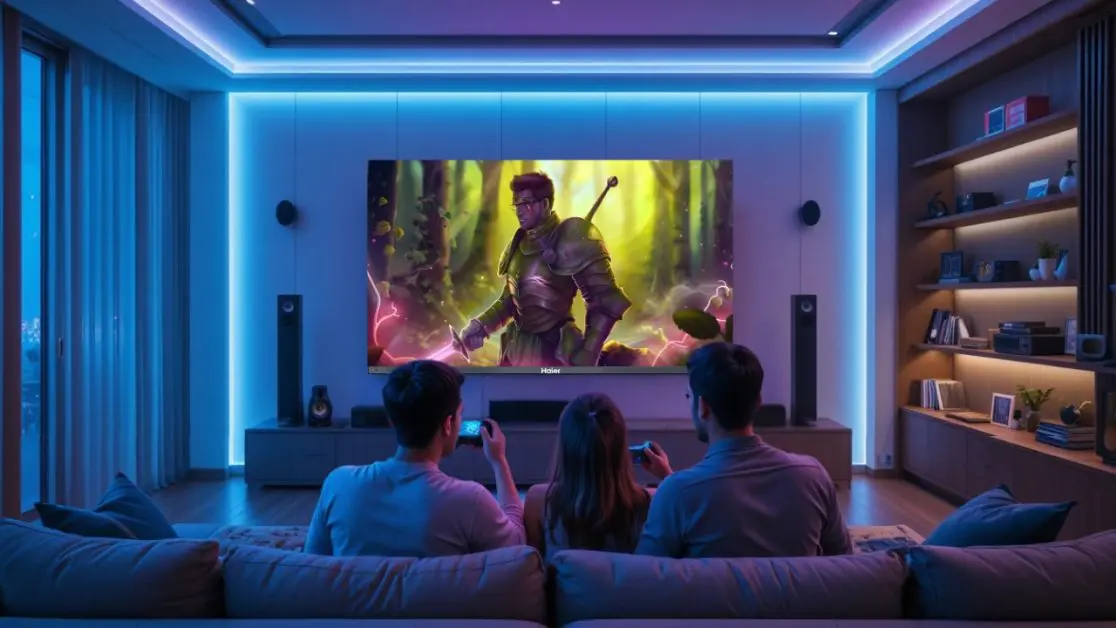
Gamers notice latency before colour
Gaming is the fastest way to test a screen.
Input lag shows immediately.
Screen tearing breaks immersion.
Inconsistent frame handling ruins control.
Smart picture processing designed for gaming synchronises the display with the console or GPU.
Features like variable refresh rate, auto low latency mode, and technologies such as AMD FreeSync Premium Pro align frame delivery with screen refresh.
Processing here is about restraint.
It removes unnecessary enhancement.
It prioritises speed.
It keeps visuals stable.
The insight is counterintuitive.
The best gaming picture is the one that interferes the least.
One screen. Three very different needs
Most Indian households use one TV for everything.
Movies with family.
Sports with friends.
Gaming solo.
Smarter picture processing makes this possible without compromise.
The system works because it adapts
One option is manual control. Constant adjustments. Endless menus.
The second option is fixed presets. Acceptable, but limiting.
The third option is adaptive intelligence. Context-aware. Automatic.
The third option wins because it respects time and attention.
How AI scene recognition actually helps daily viewing
AI scene detection is not a marketing phrase. It is pattern recognition at scale.
Modern processors can identify multiple scene types in real time. Landscapes, night scenes, close-ups, fast action, animation.
Each category triggers different optimisation logic.
- Colour saturation adjusts for animated content.
- Contrast depth increases for cinematic frames.
- Sharpness shifts for text-heavy visuals.
- Motion handling changes for sports.
This happens frame by frame.
On Haier’s premium large-screen TVs, this intelligence is centralised through an AI-driven processing system that integrates visuals, sound, and gaming response into one adaptive engine, as outlined in the product for the Haier S90 QLED 254cm (100) Google TV with AI Center Max.
You never see the system working.
You only feel the result.
Smarter processing reduces fatigue, not just improves quality
This part is rarely discussed.
Bad picture processing tires the eyes.
Over-sharpening strains vision.
Excess brightness causes discomfort.
Inconsistent motion leads to fatigue.
Smarter systems optimize for comfort over long sessions.
This matters in real homes where screens stay on longer.
After work viewing.
Weekend sports marathons.
Late-night gaming.
A good picture should feel effortless to watch.
When the room becomes part of the system
Picture processing no longer ignores the environment.
Ambient light sensors inform brightness and contrast decisions.
Daylight viewing stays clear.
Night viewing stays gentle.
This matters in Indian homes where lighting changes often.
Curtains open.
Tube lights on.
Warm lamps in the evening.
The TV adjusts so you do not have to.
The quiet role of sound and picture alignment
Smarter picture processing increasingly works alongside sound.
Audio cues align with visual depth.
Dialogue clarity matches facial focus.
Action scenes sync motion and soundstage.
When visuals and audio processing work together, immersion improves.
You stop feeling like you are watching a screen.
You feel like you are inside for a moment.
What this means for everyday decision-making

Buying a TV is no longer about chasing specs.
It is about choosing intelligence.
Screen size still matters.
Panel quality still matters.
But processing defines experience.
The question to ask is simple.
Does this screen adapt to how my home actually works?
If the answer is yes, everything else falls into place.
The bigger pattern hiding in plain sight
Smart appliances succeed when they reduce decision fatigue.
A fridge that manages freshness automatically.
An AC that learns usage patterns.
A TV that understands content context.
The pattern is clear.
The best technology disappears into routine.
Smarter picture processing does exactly that.
It removes friction.
It respects time.
It enhances without interrupting.
And that is what modern Indian homes quietly value most.
The takeaway worth remembering
Picture quality is no longer something you set.
It is something that responds.
When processing becomes intelligent, screens stop demanding attention and start earning trust.
That is when a TV stops being a device.
And starts becoming part of daily life.
Frequently Asked Questions
Is smarter picture processing really noticeable in daily life, or is it just marketing?
It’s noticeable when you don’t notice it working. The picture feels consistently comfortable across movies, sports, and YouTube, even as lighting and content change, without constant manual tweaks.
If my TV is already 4K, why does processing still matter?
4K is just raw data. Processing decides how that data is displayed. Most real-world content is compressed, upscaled, or mixed quality. Smart processors interpret each frame so faces, motion, and contrast look natural instead of harsh.
Why do two 4K TVs look completely different with the same content?
Because their processors make different decisions about colour, motion, and contrast. The panel may be similar, but the intelligence behind it defines the experience.
What does Dolby Vision IQ or HDR10+ actually do for movies?
They adjust HDR dynamically. Dolby Vision IQ considers room lighting, while HDR10+ fine-tunes brightness and colour scene by scene, so daytime and night viewing both look balanced.
Do I really need high refresh rates like 120Hz or 144Hz for sports?
Higher refresh rates reduce motion blur and improve clarity during fast action. Combined with AI motion handling, they help you follow the ball naturally without artificial smoothing.
What do VRR and ALLM actually do for gaming?
Variable Refresh Rate (VRR) prevents screen tearing by syncing frames, while Auto Low Latency Mode (ALLM) reduces delay automatically when gaming starts, no manual switching required.