


Premium audio for large living rooms is not about louder sound. It is about control, clarity, and calm.
In big Indian living rooms with open layouts, high ceilings, and constant movement, sound has to work harder. When audio is designed right, it fills the space evenly, keeps voices clear, and makes entertainment feel effortless instead of overwhelming.
That is where premium, integrated audio starts to matter.
Why do large living rooms expose audio weaknesses first?
Small rooms forgive mistakes.
Large rooms amplify them.
Modern Indian homes are changing fast. Living rooms are wider. Kitchens are open. Balconies slide open. Ceilings stretch higher. Sound now has more space to travel, reflect, and disappear.
This is why many households experience the same frustrations:
- Dialogues feel faint unless volume is pushed
- Background music overpowers conversations
- Action scenes sound noisy instead of cinematic
- You keep adjusting volume scene by scene
This is not a content problem.
It is a sound system problem.
Large spaces demand precision, not brute force.
The real role of premium audio in Indian homes
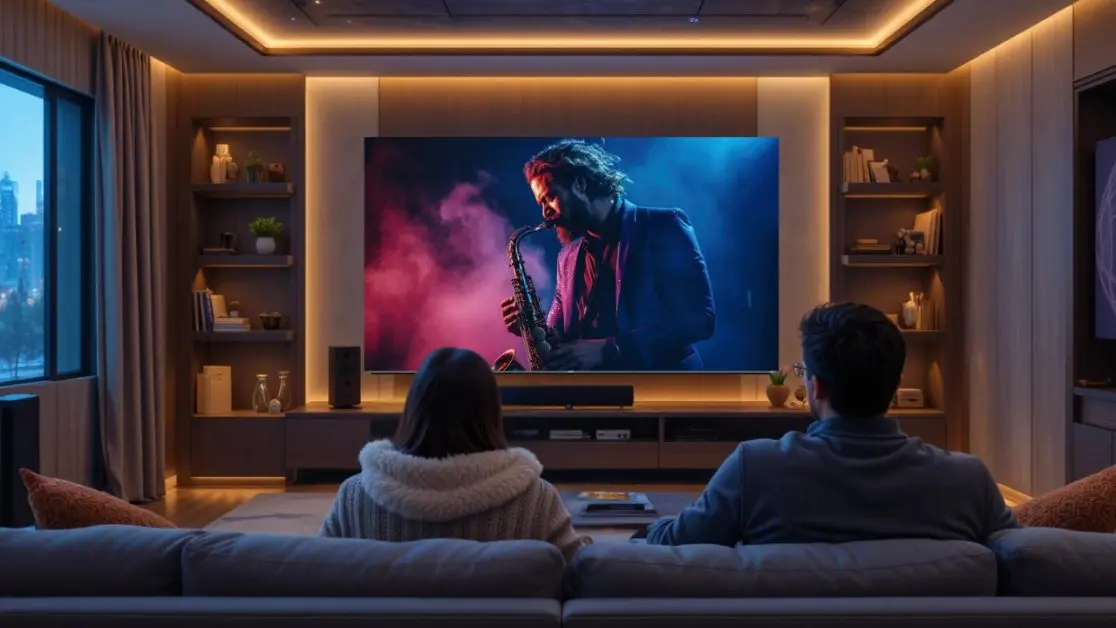
Premium audio is not meant to impress visitors.
It is meant to reduce daily friction.
When sound is tuned properly:
- Dialogues stay clear even during kitchen noise
- Late night viewing works without blasting volume
- Parents do not struggle with muffled speech
- Music fills the room without feeling sharp
Good audio removes effort.
Great audio fades into the background.
That is the difference.
What actually makes audio premium in a large living room
Specs alone do not define quality.
Design decisions do.
1. Multi-channel speaker architecture
In large rooms, sound must move in layers.
Premium TVs use multi-channel speaker layouts to separate voices, background scores, and effects. Instead of everything coming from one direction, sound spreads horizontally and vertically.
This creates space between elements.
And space creates clarity.
The Haier New M96 Series 254cm (100) QD-Mini LED AI Smart Google TV (H100M96FUX) uses a powerful multi-channel speaker system with Sound by KEF, designed to deliver layered sound that suits wide living rooms rather than compact bedrooms.
2. Sound tuning, not simple amplification
Many TVs focus on volume output.
Premium systems focus on balance.
Sound by KEF is built around speaker engineering that prioritises:
- Clear, anchored dialogues
- Controlled bass that does not overpower
- Smooth mids for natural vocals
- Clean treble without harshness
This matters in Indian homes where TVs run for hours, not minutes. Fatigue-free sound keeps people watching longer.
3. Dolby Atmos for spatial immersion
Large rooms need depth.
With Dolby Atmos, sound is not just pushed forward. It is placed around you. Voices stay centered. Effects move naturally. Music feels layered instead of flat.
On a screen as large as 254cm (100), flat audio breaks immersion instantly. Spatial audio restores balance between what you see and what you hear.
The Haier New M96 Series supports Dolby Atmos, creating a three-dimensional soundstage designed for expansive spaces rather than narrow viewing distances.
Movies feel different when sound matches screen size
A big screen changes expectations.
When visuals stretch wall to wall but audio feels thin, the illusion breaks. Premium audio restores proportion.
In large living rooms:
- Dialogues remain clear without subtitles
- Background scores build emotion gradually
- Action scenes feel spacious, not chaotic
You stop noticing speakers.
You start noticing storytelling.
That is when the cinema moves home.
Music reveals audio quality faster than movies
Movies hide flaws.
Music exposes them.
In large rooms, music often sounds either hollow or overly bass-heavy. Premium audio solves this by keeping frequencies in balance.
This matters during:
- Morning playlists while getting ready
- Evening bhajans or soft instrumental tracks
- Weekend cleaning sessions
- Festive background music during gatherings
Balanced sound makes the room feel alive without demanding attention.
Three common audio paths Indian households take
Every home chooses differently.
Option one: Standard TV speakers
- Minimal setup
- No additional cost
- Limited depth for large rooms
Works, but struggles as room size increases.
Option two: External soundbars
- Better bass and clarity
- Extra wiring and remotes
- Requires placement planning
An improvement, but still front-focused.
Option three: TVs with integrated premium audio
- Multi-channel speaker design
- Optimised tuning with visuals
- Cleaner interiors and fewer devices
For large living rooms, this option feels the most natural.
Why integrated audio systems age better

Separate devices add complexity.
Integrated systems remove it.
When audio is built into the TV:
- Sound processing syncs perfectly with visuals
- Scene-based tuning happens automatically
- No calibration fatigue or clutter
The Haier New M96 Series 254cm (100) integrates AI-powered sound processing through its AI Center, aligning audio performance with visuals, gaming, and content type automatically.
This matters in homes where technology should simplify life, not add steps.
Key audio features that matter for large living rooms
Here is what makes a real difference in daily use:
- Sound by KEF for precise, balanced audio
- Dolby Atmos for spatial depth
- High audio output power suited for large spaces
- Multi-channel speaker layout for separation and clarity
- AI-driven sound optimisation that adapts scene by scene
These features work together as a system. Individually, they help. Collectively, they transform the room.
How premium audio quietly changes daily habits
The impact shows up slowly.
- Volume stays consistent across scenes
- Viewing sessions stretch longer
- Background noise feels less distracting
- Family members stop asking, “Can you increase the sound?”
Sound shapes behaviour more than we realise.
When audio works, people relax.
The hidden system most people overlook
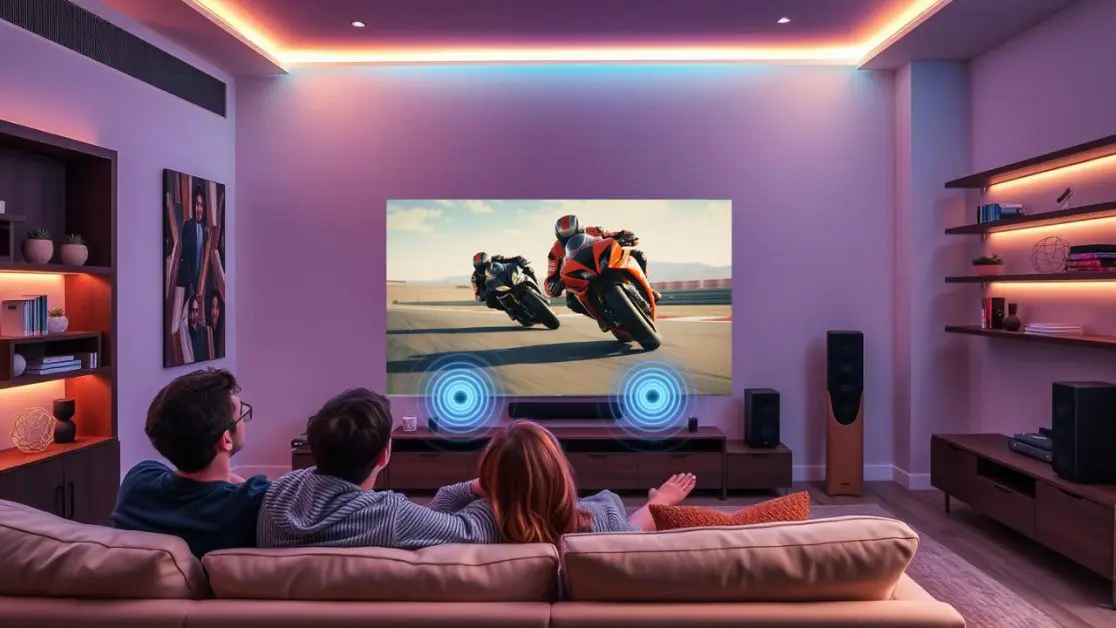
Here is the pattern.
Poor audio increases effort.
Effort reduces enjoyment.
Reduced enjoyment shortens engagement.
Premium audio reverses this quietly.
It removes friction.
It extends attention.
It improves comfort.
In large living rooms, this effect multiplies.
What to ask before choosing premium audio
Before buying, pause and listen.
- Are dialogues clear at low volume?
- Does bass support instead of dominate?
- Does sound feel evenly spread across the room?
- Does the system suit your room size, not just the spec sheet?
Better questions lead to better long-term satisfaction.
Why this matters now
Indian homes are no longer single-purpose spaces.
The living room hosts work calls, movie nights, festivals, quiet evenings, and loud match days. One room. Many moods.
Premium audio supports this flexibility without asking for attention.
It adapts.
It blends in.
It supports everyday life quietly.
The bigger takeaway
The future of premium home technology is not about adding more gadgets. It is about designing systems that do more with less effort.
In large living rooms, premium audio stops being a luxury and starts becoming infrastructure.
When sound feels right, everything else feels easier.
And the best systems are the ones you stop noticing.
That is how you know they belong in your home.
Frequently Asked Questions
How do I know if my living room actually needs premium audio?
If you keep adjusting volume scene by scene, struggle to hear dialogues at low volume, or feel action scenes are noisy instead of cinematic, your room is outgrowing basic audio.
Why do dialogues disappear when someone is cooking or walking around?
In large Indian living rooms, background noise competes with speech. Premium audio systems anchor dialogues in a dedicated channel, keeping voices clear even with ambient activity.
Isn’t premium audio just about louder speakers?
No. Loudness without control increases fatigue. Premium audio is about balance, separation, and smooth tuning, so sound feels effortless over long viewing hours.
Why does my TV sound harsh when volume goes up?
Entry-level speakers distort at higher levels. Premium systems use better driver design and tuning so clarity holds even as volume rises.
What does “Sound by KEF” actually change in real use?
KEF’s tuning focuses on dialogue anchoring, controlled bass, and smooth highs. The result is sound that stays natural during long viewing sessions, especially important in large rooms.
Does Dolby Atmos really matter in a living room, or is it marketing?
In large spaces, Dolby Laboratories Atmos adds depth and placement, preventing audio from feeling flat against a massive screen.
Why do action scenes feel noisy instead of cinematic?
When effects, music, and speech come from the same channel, they clash. Multi-channel layouts separate these layers, restoring clarity and scale.