
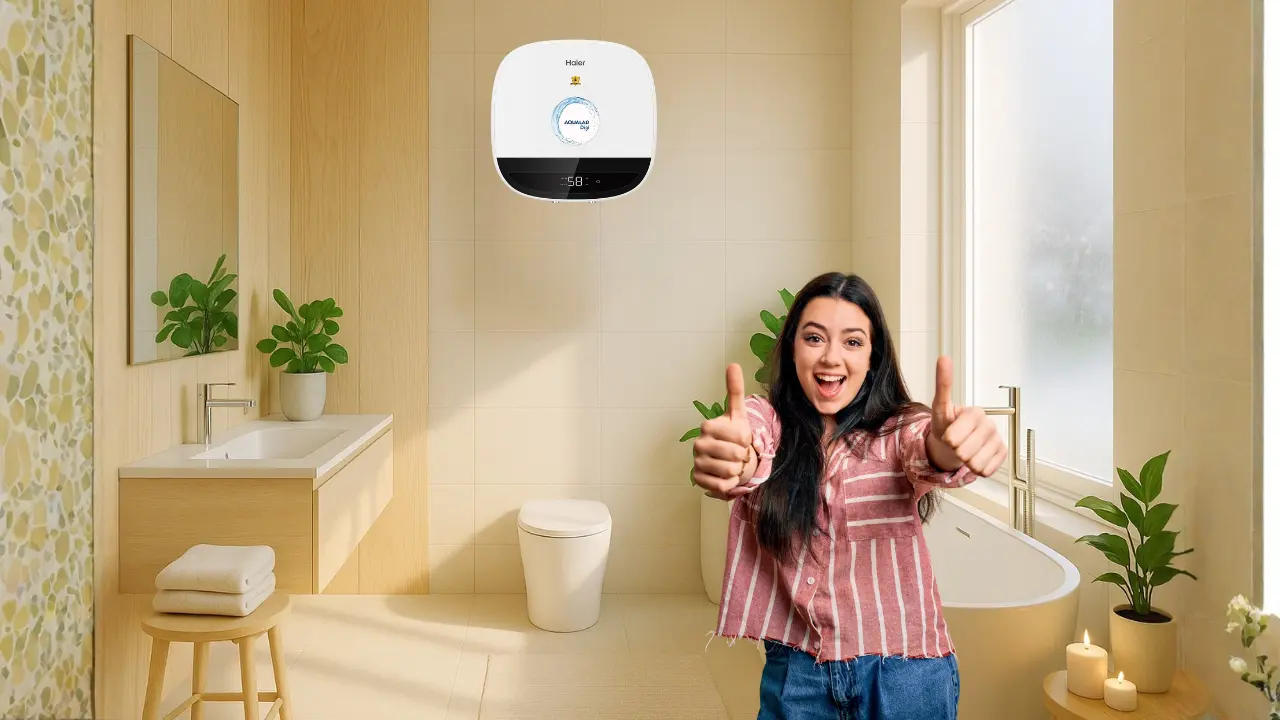

The best ways to save electricity while using a water heater include heating only the amount of water you actually need, choosing the right temperature setting, reducing reheating cycles through better insulation, timing your usage to avoid standby losses, and using a 5 star, well insulated storage heater that retains heat for longer.
A model with PUF insulation and dual thermostats, like Haier’s AQUALAD PRO Square Series, reduces energy wastage significantly .
Why Water Heaters Quietly Shape Your Monthly Electricity Bill
Every Indian home has that one moment when the geyser switch becomes a timer of its own.
Morning rush hours. Evening baths after a long commute. A quick bucket fill before a late night workout.
Hot water is everyday comfort, but it is also an everyday cost.
That is the hidden truth of a modern home.
Comfort stacks up. Cost stacks up with it.
And the water heater is often the appliance nobody blames until the electricity bill arrives.
Yet there is a pattern here.
Hot water doesn’t drain wallets.
Waste does.
The goal of this guide is simple.
To show how smarter use, not sacrifice, saves electricity.
To explain why a few small habits save hundreds every month.
And to reveal how a well designed heater makes the rest effortless.
What Makes Water Heaters Consume The Most Electricity?
A water heater consumes power for three reasons:
1. Heating cold water up to your desired temperature.
2. Keeping stored water hot for long durations.
3. Reheating cooled water due to heat loss.
These three moments form a cycle.
Break the cycle, and your electricity bill drops.
Storage heaters lose heat when insulation is weak.
Poor thermostats cause unnecessary reheating.
Low efficiency tanks cool faster in winter.
Older heaters overheat because sensors are limited.
This is where technology becomes a cost saving tool.
Take Haier’s AQUALAD PRO Square Series, which uses PUF insulation to retain heat for long periods, reducing reheating cycles significantly. The insulation system is highlighted in the product sheet as a key feature for electricity savings .
The invisible system matters more than the visible appliance.
Hot Water Habits Decide Hot Water Costs
Every household has its own rhythm.
Families with school-going kids need early and efficient heating.
Working professionals heat water late in the evening.
Grandparents prefer steady warm water for longer showers.
But across Indian homes, the big problem is the same.
We heat more water than we need.
We heat it hotter than necessary.
We reheat water we never used.
Saving power begins with breaking the loop.
1. Heat Only What You Need
This is the simplest rule of electricity savings.
Most people run their heaters for longer than required.
They overestimate how much water they actually use.
The result is a full tank of water heated twice the temperature needed.
A 15L or 25L tank is more than enough for everyday use.
Haier’s Square AQUALAD PRO comes in both capacities, designed to handle real household usage without unnecessary power draw .
Quick Capacity Guide
| Household Type | Ideal Size | Reason |
| Single person | 10L to 15L | Quick bucket use and short showers |
| Couple | 15L to 25L | Consecutive usage |
| Family of 3 to 4 | 25L | Multiple back to back requirements |
Heat only what the tank size supports.
No more. No less.
2. Choose the Right Temperature Setting
Overheating wastes power.
A 60 degree setting is more than enough for Indian bathing needs.
Experts from the International Energy Agency have repeatedly stated that every 10 degree reduction can save up to 10 percent electricity on heating.
Most people heat water to 75 degrees without knowing it.
This forces the heater to cycle again and again.
The dual thermostat sensors in the AQUALAD PRO prevent overheating by cutting off the element once the temperature hits the limit. Its TTS Technology uses two sensors for accurate temperature control, reducing electricity waste due to overheating and unnecessary reheating cycles .
The lesson is simple.
Let technology decide the temperature band.
Not guesswork.
3. Avoid Frequent On-Off Cycles
Turning the heater on and off multiple times creates spikes in energy usage.
A better method is predictable, timed heating.
One option is heating water once and using it immediately.
A second option is heating water early, then relying on insulation to keep it warm.
The third option is scheduling usage so the tank does not cool down between consecutive baths.
This is where insulation becomes the hero.
High density PUF insulation in Haier’s models keeps water hot for long durations without the element switching back on. The brochure emphasises this insulation as a major electricity-saving feature, because it reduces reheating requirements dramatically .
Fewer reheats.
Less electricity.
More comfort.
4. Reduce Heat Loss at Home
Heat loss is not only about the tank.
It happens outside the heater too.
Long pipes cool water by the time it reaches the bathroom.
Exposed plumbing loses heat.
Cold bathroom tiles reduce the temperature faster.
Three simple habits reduce this:
- Keep the bathroom door closed after heating.
- Use short piping wherever possible.
- Install the heater closer to the usage point.
These tiny changes create compounding savings.
Because electricity is never lost in big chunks.
It escapes slowly.
Through pipes, gaps, and habits.
5. Use 5 Star Appliances With Better Heating Elements
A non efficient heater behaves like an old car.
It runs longer to do the same job.
Better heating elements reduce time to heat water, which directly reduces electricity use.
The AQUALAD PRO Series uses a high power 2200W titanium heating element for fast heating, reducing active run time without compromising comfort. The product sheet shows the exact element and mentions “high power for a comfortable bath experience” which indirectly means shorter heating cycles and lower electricity waste .
High power is not expensive.
High power is high speed.
And speed saves electricity.
6. Use BPS Mode Only When Necessary
The Bacteria Proof System heats water to 80 degrees to deactivate bacteria.
It is useful.
It is hygienic.
But it is also energy intensive.
Using it once in a while keeps the tank clean.
Using it daily creates unnecessary load.
The Haier brochure shows exactly how the bacteria reduce at 50, 65 and finally 80 degrees in BPS mode, making it clear that the function is meant for occasional hygiene cycles, not everyday heating .
Think of it like washing clothes with hot water.
Helpful.
But not every day.
7. Choose Storage Heaters With Safety and Smart Controls

Safety indirectly saves electricity too.
Shock proof design, as shown in the brochure diagrams, not only protects users but also stabilises performance of the heating element over long term usage. The AQUALAD PRO converts rated voltage to safe voltage during leakage, reducing component stress and increasing efficiency .
A heater that lasts longer saves money.
A heater that performs consistently saves electricity.
This is the hidden connection between safety and savings.
8. Understand Real Costs: Upfront vs Lifetime
A cheaper heater without insulation costs less today.
But it costs more every month.
A 5 star model with insulation and dual thermostats costs slightly more upfront.
But the reduced running time pays back the difference in months.
Energy savings are not an expense.
They are an investment.
The Haier water heaters include multi usage valves, titanium tanks, magnesium rods and bi capillary thermostats which protect the tank from stress, increasing lifespan and reducing long term power loss due to wear and tear .
Longevity is a form of saving.
Durability is a form of efficiency.
9. When Should You Upgrade Your Water Heater?
If your heater is over 8 years old, it is likely consuming more electricity than you think.
Signs include:
- Longer heating times
- Water not retaining heat
- Discoloration or poor water quality
- High electricity bill despite same usage
- Frequent thermostat trips
Modern heaters solve these issues with insulation, titanium elements and better thermostat technology.
Upgrading is not a luxury.
It is a cost decision.
10. A Smarter Water Heater Helps You Save Without Trying

This is the part people misunderstand.
Electricity savings do not always come from discipline.
Sometimes they come from design.
Technology does the heavy work.
Haier’s AQUALAD PRO Square Series includes RSC Technology which keeps water flowing consistently inside the tank. This prevents stagnation and improves heating efficiency, reducing the amount of power needed for uniform heating .
Better circulation means less waste.
Less waste means lower bills.
Lower bills mean higher comfort.
Efficiency is not just a feature.
It is a daily feeling.
The Five Principles of Low Electricity Water Heating
1. Heat less.
Use the right tank size and heat only what is needed.
2. Heat smarter.
Let thermostats and insulation do the work.
3. Lose less.
Minimise heat loss inside and outside the tank.
4. Reheat rarely.
Install well insulated 5 star models that retain heat longer.
5. Upgrade wisely.
Modern heaters save more in a year than they cost upfront.
These principles work because they address the hidden system of hot water usage.
Not just the appliance.
Not just the habit.
The entire chain.
That is where true efficiency lives.
Why Homes Choose Haier
This blog is not about selling a heater.
It is about understanding how homes work.
But if a reader looks for a heater that already solves half the electricity problem, the AQUALAD PRO Square Series is worth mentioning.
It includes:
- PUF insulation to reduce reheating
- Dual thermostats for perfect cut off
- Titanium heating element for faster heating
- 5 star energy rating
- BPS Mode for hygiene cycles
- RSC Technology for consistent flow
- Shock proof protection for long lifespan
It is not selling comfort.
It is ensuring it.
That is the difference.