
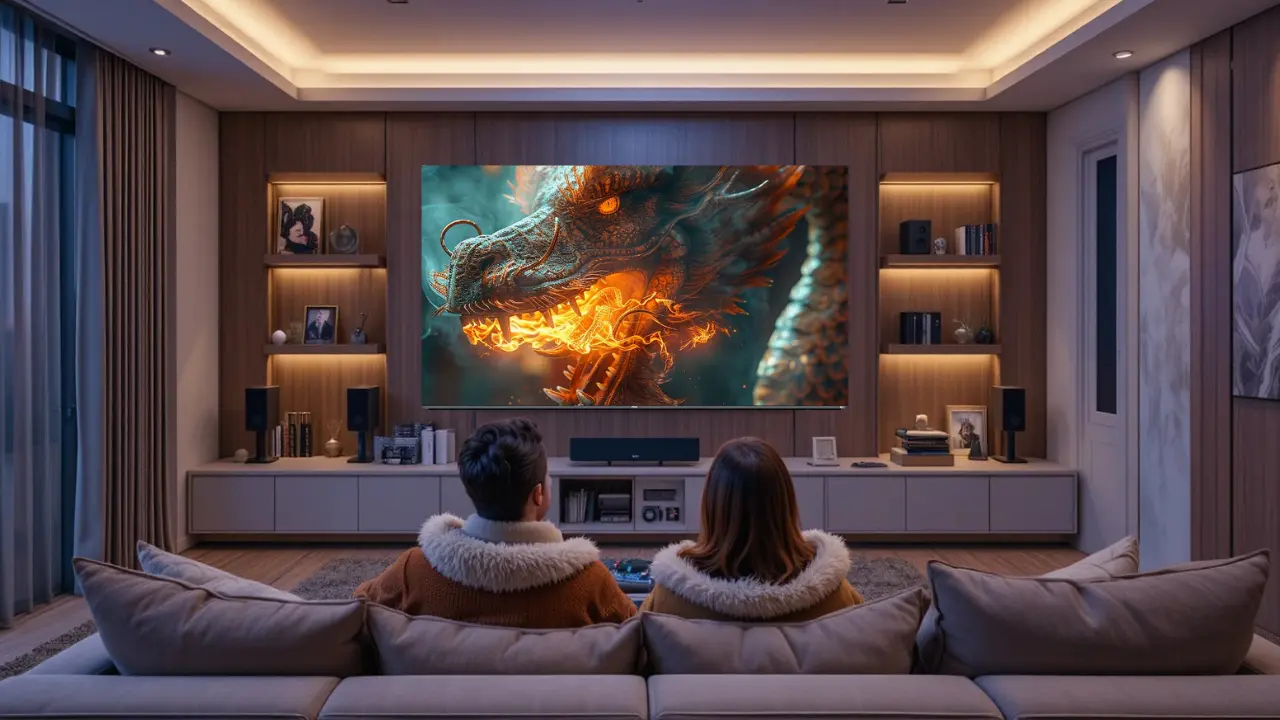

Immersion happens when a screen stops behaving like an object and starts behaving like an environment.
Large screens feel immersive because they align with how the human brain processes space, motion, light, and sound. When enough of your visual field is filled, distractions fall away, attention settles, and the brain shifts into presence mode.
That shift is not emotional.
It is neurological.
It always begins with a very ordinary moment
A long workday ends.
Dinner plates move aside.
Someone casually turns the TV on.
No ceremony. No intention to be amazed.
And yet, ten minutes later, the room feels different.
The screen feels closer than it is.
The world outside the frame feels quieter.
That is immersion quietly doing its job.
Immersion starts when a screen matches how humans actually see

Human vision is wide, not boxed.
We do not see life in neat rectangles. We experience it as a horizontal sweep, with sharp focus at the centre and context living at the edges.
Smaller screens force the brain to constantly separate content from surroundings. Larger screens reduce that separation.
The critical variable is field of view
When a screen fills roughly 30 to 40 percent of your horizontal field of vision, your brain begins treating it as the primary environment.
This is the same principle cinema halls rely on.
Large screens simply bring that logic home.
What happens then:
- Peripheral vision gets engaged
- Background clutter fades
- Visual attention stays locked longer
Immersion is not something you feel.
It is something your brain decides.
Size alone is not immersion. Scale is.
A large screen mounted poorly still feels like a big rectangle.
Immersion depends on proportion.
One option is a small screen placed close
- High sharpness
- Easy fit
- Frequent eye refocusing
The second option is a large screen at the right distance
- Natural eye movement
- Wider visual coverage
- Lower mental fatigue
The third option is a large screen placed too close
- Initially impressive
- Quickly tiring
- Breaks immersion instead of building it
The science is clear.
When screen size, seating distance, and resolution align, the brain relaxes.
And relaxed brains absorb more.
Why motion feels more real on large screens
Motion perception is not about speed.
It is about continuity.
On smaller screens, fast action compresses detail into limited space. Your brain has to fill in gaps.
Large screens spread motion across more visual real estate.
This is where refresh rate matters.
A 144Hz refresh rate updates frames frequently enough to keep fast-moving content like live sports smooth and readable, without blur or judder .
Your eyes track motion naturally.
Your brain stops guessing.
That reduction in effort is what feels immersive.
Contrast is what convinces the brain the image is real
The human brain trusts light that behaves like light in the real world.
Real shadows are deep, not grey.
Real highlights carry detail, not glare.
For large screens, contrast accuracy becomes non-negotiable.
What actually creates belief
- Very high contrast ratios
- Thousands of local dimming zones
- Brightness that holds detail even in sunlit rooms
QD Mini LED displays are designed for this exact challenge. They preserve depth and detail even when the screen surface becomes expansive .
The image stops looking flat.
It starts feeling dimensional.
Colour accuracy matters more as screens get bigger

Your brain knows what marigolds look like.
What skin tones look like.
What a sunset feels like.
On a large screen, any colour mistake becomes obvious.
That is why wide colour gamut coverage, close to 99 percent DCI-P3, is critical on big displays .
Not louder colours.
Truer ones.
Accuracy keeps immersion intact.
Sound is not an add-on. It is structural.
Your brain expects sound to match scale.
A large image with thin audio creates cognitive dissonance. Something feels off, even if you cannot explain why.
Immersive sound works when:
- Audio moves with on-screen action
- Voices feel anchored to faces
- Bass adds weight without overwhelming dialogue
Multi-channel speaker systems with layered output create a sound field that matches the visual size of the screen .
When sound fills space evenly, the screen disappears.
Large screens reduce mental switching
Small screens invite distraction.
Large screens command presence.
When most of your visual field is occupied:
- Peripheral distractions reduce
- Phone-checking impulse drops
- Cognitive switching slows
This is not discipline.
It is dominance.
Immersion works because it simplifies attention.
The quiet role of AI in immersion
The most effective immersion systems are invisible.
AI processors analyse content frame by frame:
- Adjust brightness to room lighting
- Balance contrast dynamically
- Smooth motion without artefacts
Technologies like Dolby Vision IQ adapt visuals based on ambient light, reducing eye strain while preserving detail .
You do nothing.
The screen adapts.
That is immersion without effort.
Why room setup matters more than people admit
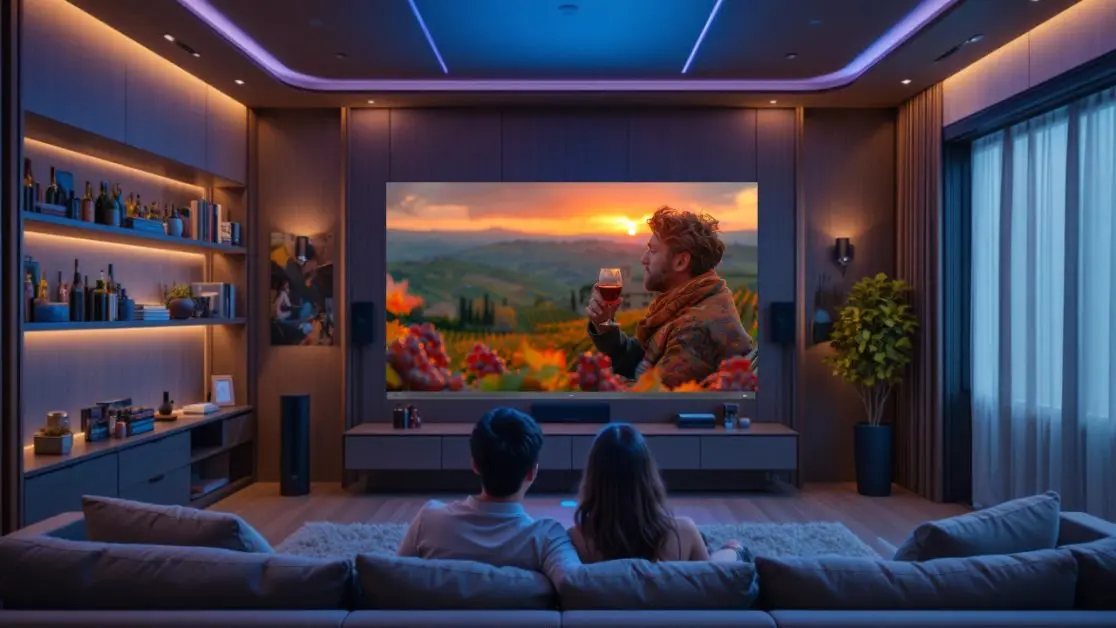
Immersion is a system, not a single purchase.
The screen is one part.
The room completes the experience.
Small changes make large differences:
- Soft ambient lighting
- Neutral wall colours
- Seating aligned to the screen centre
- Minimal clutter around the display
The brain rewards coherence.
Chaos breaks immersion faster than low resolution ever could.
Why Indian homes are choosing bigger screens now
Homes have changed roles.
Living rooms host match nights.
Bedrooms become personal cinemas.
Solo professionals look for deeper downtime, not background noise.
Streaming quality has improved.
The content scale has expanded.
Large screens are not excess anymore.
They are aligned.
Where the Haier New M96 Series 254cm (100) QD Mini LED AI Smart Google TV fits in
A screen this size only works when science supports scale.
The Haier New M96 Series 254cm (100) QD Mini LED AI Smart Google TV brings together:
- A 254cm (100) display designed for correct field-of-view immersion
- QD Mini LED technology with extensive local dimming
- 144Hz refresh rate for smooth sports and fast motion
- Dolby Vision IQ and HDR10+ for adaptive, room-aware visuals
- Multi-channel sound tuned for large spaces
- AI-powered processing that works quietly in the background
Nothing here exists to impress on paper.
Everything exists to reduce effort for the brain.
The deeper insight most people miss
Immersion is not about escape.
It is about presence.
When a screen aligns with how humans naturally see, hear, and focus, life feels more intentional. Even entertainment becomes restorative instead of draining.
The best large screens do not pull you away from reality.
They help you experience moments more fully.
What this means going forward
The future of home screens is not about bigger numbers.
It is about better alignment.
As displays grow, the real question becomes simpler and more human.
Does this screen understand how people actually live, watch, rest, and recharge?
When the answer is yes, immersion stops being a feature.
It becomes a feeling you stop noticing.
And that is when it works.