
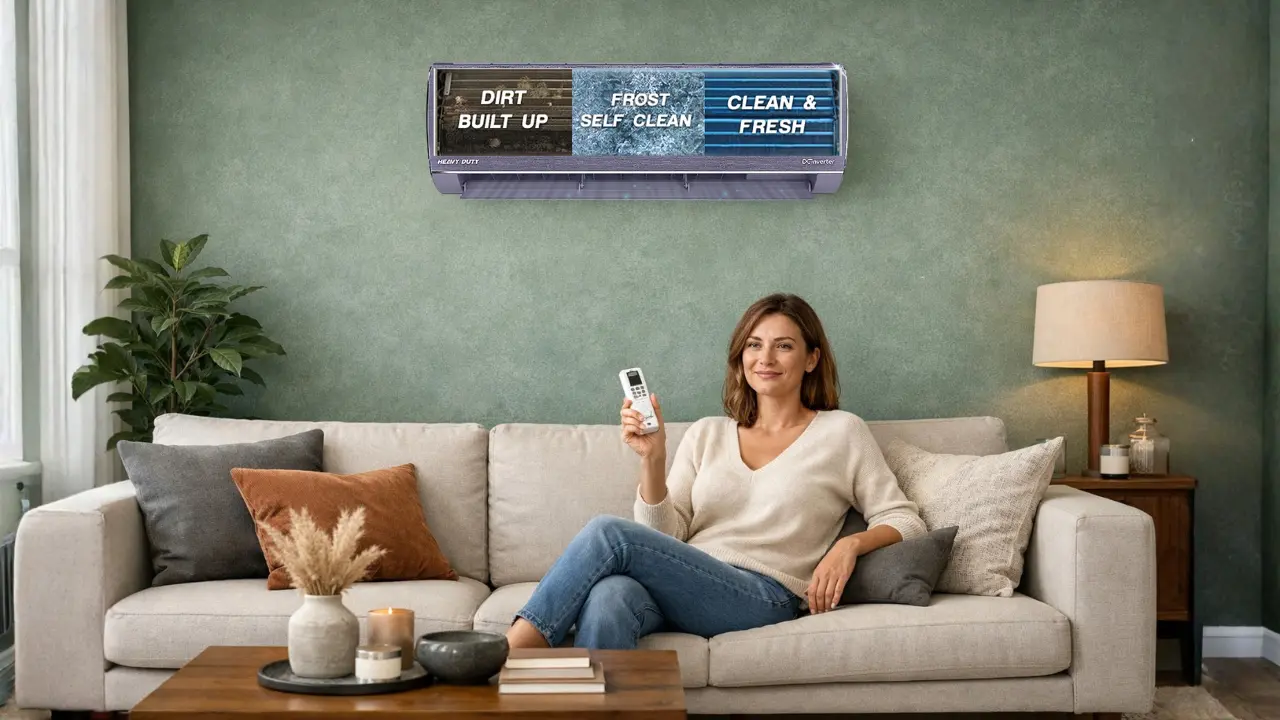

An air conditioner with a self-cleaning function safeguards residences against germs and smells by routinely refreshing its inner parts where dampness and debris tend to gather..
Methods like freeze-based self-maintenance and programmed condenser washing eliminate germ deposits within the unit, leading to purer air, improved cooling performance, and healthier interior settings for daily comfort.
A familiar moment in many Indian homes.
You turn on the AC after a few days.
Cool air arrives.
But something else arrives too.
A faint smell.
Not strong. Not alarming. Just… slightly stale.
Many households experience this. Especially during humid summers or after the monsoon season.
The assumption is usually simple.
Maybe the room smells.
But the real story sits inside the air conditioner.
Cooling systems move air through coils, filters, and ducts. Over time dust settles. Moisture collects. Microbial life begins to grow in hidden corners.
And slowly, the AC that once felt fresh begins to feel tired.
Cooling machines do not only control temperature.
They shape the air people breathe every day.
Why air conditioners slowly develop bacteria and odors
Every air conditioner works through a basic physical process.
Warm air enters.
Cooling coils remove heat.
Moisture condenses on the coil surface.
That moisture does not disappear instantly.
It sits inside the unit.
Now add dust from daily life. Tiny particles from clothing, skin, furniture, and outdoor air pass through the system.
Together they create a thin film across internal surfaces.
This environment encourages bacterial growth.
The process looks like this:
| AC Condition | What Happens Inside the Machine | Result for the Room |
| Condensation | Moisture forms on evaporator coils | Damp surfaces remain inside unit |
| Dust accumulation | Airborne particles stick to coils | Reduced airflow and efficiency |
| Microbial growth | Bacteria grow on damp surfaces | Musty smell and stale air |
In countries with humid climates like India, this process happens faster.
More humidity means more moisture.
More moisture means faster microbial growth.
This is why modern cooling systems are beginning to focus not only on temperature control, but also internal hygiene.
The hidden system inside your AC
Most people think an air conditioner has one job.
Cooling.
But internally, four systems operate simultaneously.
- Air circulation
Fans pull warm air across cooling coils. - Heat exchange
Refrigerant absorbs heat and cools the air. - Condensation formation
Cooling surfaces create water droplets. - Particle accumulation
Dust and micro debris settle on internal surfaces.
Over time these systems interact in ways that create buildup inside the machine.
Cooling efficiency drops.
Air freshness declines.
Unless the AC actively cleans itself.
What a self-cleaning AC actually does
Self-cleaning air conditioners solve this problem by automating internal cleaning.
Instead of waiting for technicians to manually wash the system, the AC periodically removes moisture and dust on its own.
Think of it like a dishwasher cycle inside the cooling system.
Several technologies now make this possible.
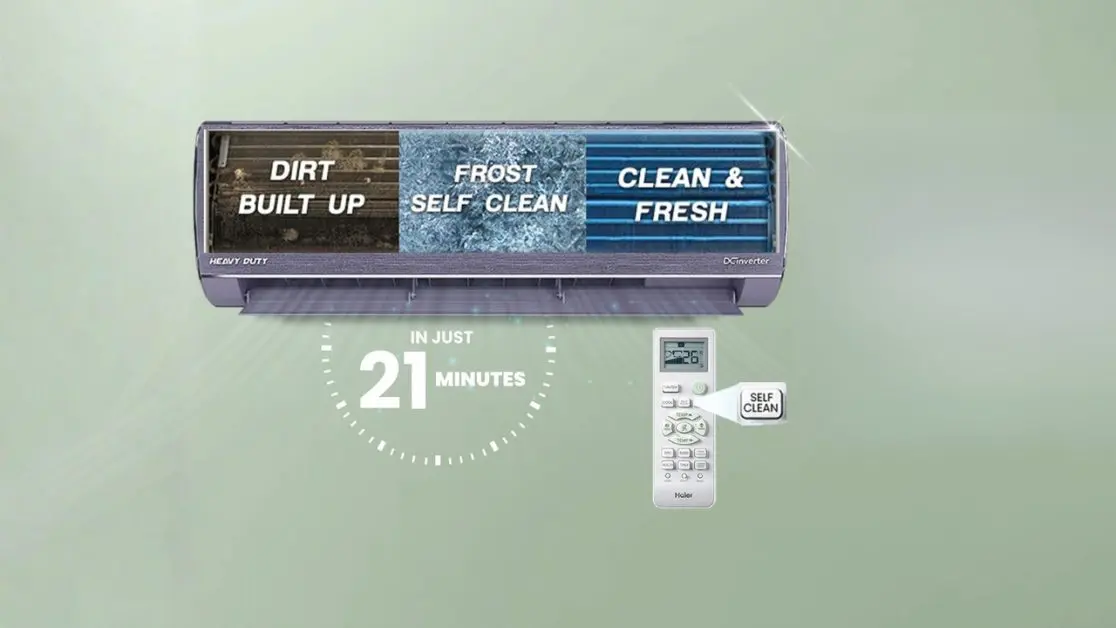
1. Frost Self-Cleaning
One of the most effective systems freezes moisture on the evaporator coil and then melts it.
During the melting phase, water flows across the coil surface and washes away dust, bacteria, and residue.
The result is a cleaner internal unit.
Some systems automatically trigger this process after extended use, keeping internal components hygienic without requiring manual maintenance.
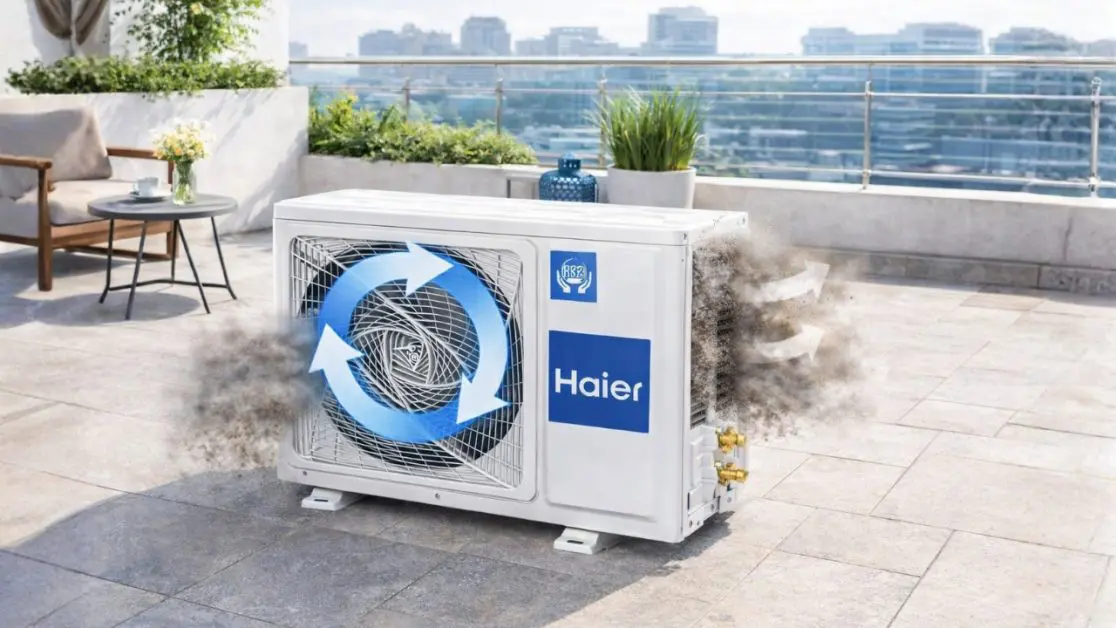
2. Outdoor Unit Cyclone Cleaning
Many people forget that the outdoor condenser also collects dust.
Advanced cooling systems now include reverse airflow technology that blows dust off the condenser surface shortly after the AC shuts down.
This helps maintain heat exchange efficiency and prevents long-term buildup.
Cleaner coils lead to:
- faster cooling
- improved airflow
- lower electricity consumption
3. Automated Cleaning Cycles
Some air conditioners track operating hours.
After extended usage, the system prompts a self-cleaning cycle and notifies the user once cleaning is complete.
This automated routine helps maintain long-term hygiene and cooling performance.
Machines that maintain themselves simply last longer.
Where AI begins to change the experience
Cooling technology is also becoming intelligent.
Modern systems do more than maintain temperature.
They analyze behavior.
This is where AI Atmox technology introduces a new layer of intelligence.
AI Atmox creates an adaptive cooling system that studies environmental conditions, user habits, and power consumption to optimize performance automatically.
Instead of reacting to commands, the system begins anticipating needs.
AI Atmox capabilities include
- AI Climate Control that analyzes room conditions and adjusts cooling automatically
- AI Pre-Cooling that predicts arrival and prepares the room in advance
- AI Target Cooling that directs airflow where cooling is needed most
- Electricity monitoring 2.0 that tracks power usage in real time
- AI Human Detection that reduces power when the room becomes empty
These capabilities create a system that learns, adapts, and optimizes comfort.
In simple terms.
The AC becomes smarter every day.
Three ways households approach AC maintenance
When it comes to AC hygiene, households usually follow one of three paths.
Option 1: Regular manual servicing
Professional technicians clean coils and internal components.
Benefits:
- deep cleaning
- reliable performance
Costs:
- service visits required
- recurring expense
- scheduling effort
Option 2: Basic filter cleaning
Some households clean filters occasionally but ignore internal components.
Benefits:
- minimal effort
- low cost
Costs:
- hidden dust buildup continues
- odors eventually develop
- efficiency declines
Option 3: Self-cleaning intelligent AC systems
Modern air conditioners combine automated cleaning with intelligent monitoring.
Benefits:
- automatic internal cleaning
- reduced microbial growth
- improved cooling performance
- less frequent servicing
Costs:
- higher initial investment
But over time, automated maintenance simplifies daily life.
Why this technology matters in Indian homes
Climate conditions in India make AC hygiene particularly important.
Three environmental realities accelerate internal buildup.
Humidity during monsoon
Moisture remains trapped longer inside cooling systems.
Urban dust levels
Fine particles enter homes daily through ventilation and movement.
Long cooling hours
During peak summer, ACs run continuously for hours.
More runtime means more condensation and dust accumulation.
Self-cleaning technology interrupts this cycle before buildup becomes a problem.
Cleaner machines produce cleaner air.
A small evening moment that explains everything
Imagine returning home after a long day in May.
The sun is still warm outside. The air feels heavy.
You switch on the AC.
Within minutes the room cools down. The air feels crisp. Fresh.
Nobody notices the system inside the machine that made this possible.
But it is working.
Fans circulating air.
Sensors adjusting cooling.
Cleaning cycles prevent bacterial growth.
Comfort is rarely accidental.
It is engineered.
The deeper insight behind self-cleaning ACs
Cooling technology is evolving toward a simple goal.
Remove friction from everyday life.
Older machines required constant attention.
Clean the filter.
Call the technician.
Deal with odors.
Modern intelligent systems reduce that burden.
They monitor themselves.
Clean themselves.
Adapt automatically.
The best appliances quietly take care of the things people forget.
What the future of air conditioning looks like
Cooling systems are becoming intelligent environmental managers.
Not just temperature controllers.
They optimize power consumption.
Predict user behavior.
Maintain internal hygiene.
Technologies like AI Atmox climate intelligence combine smart cooling with automated cleaning, creating systems that learn from daily use and continuously improve performance.
And when technology works like this, something subtle happens.
The air feels fresher.
Comfort becomes effortless.
That is the promise of the next generation air conditioner.
Cooler air.
Cleaner air.
And a machine that quietly takes care of itself so households can focus on living well.
Frequently Asked Questions
Do I actually need a self-cleaning AC, or is regular servicing enough?
If you already do consistent professional servicing, you may not need it. But if you often delay maintenance or live in humid/dusty conditions, a self-cleaning AC reduces buildup automatically and keeps performance stable between services.
Is a self-cleaning AC worth the higher price for my home?
It’s worth it if you value convenience, cleaner air, and fewer service calls. Over time, it can offset maintenance costs and improve energy efficiency.
I already cleaned my AC filters. Why would I need self-cleaning technology?
Filters are just one part. The real issue happens inside coils where moisture + dust = bacteria. Self-cleaning systems target those hidden areas.
Will a self-cleaning AC reduce my electricity bill or is that a myth?
Cleaner coils improve airflow and heat exchange, which can reduce energy consumption slightly over time especially in heavy-use seasons.
I live in a humid city. Does that make self-cleaning more important for me?
Yes. Humidity accelerates moisture buildup, which speeds up bacterial growth. Self-cleaning becomes significantly more useful in such environments.
What is AI climate control in my AC and how does it help me daily?
It studies room conditions (temperature, humidity) and adjusts cooling automatically for comfort and efficiency.
Can my AC really predict when I’ll come home and pre-cool my room?
Yes, with features like AI pre-cooling that learn your routine or use app-based triggers.
What is AI human detection and does it save electricity?
It detects whether people are in the room and reduces or adjusts cooling when the room is empty saving power.
How does AI improve comfort compared to a normal AC?
Instead of manual adjustments, it continuously optimizes airflow, temperature, and power usage based on your habits.