
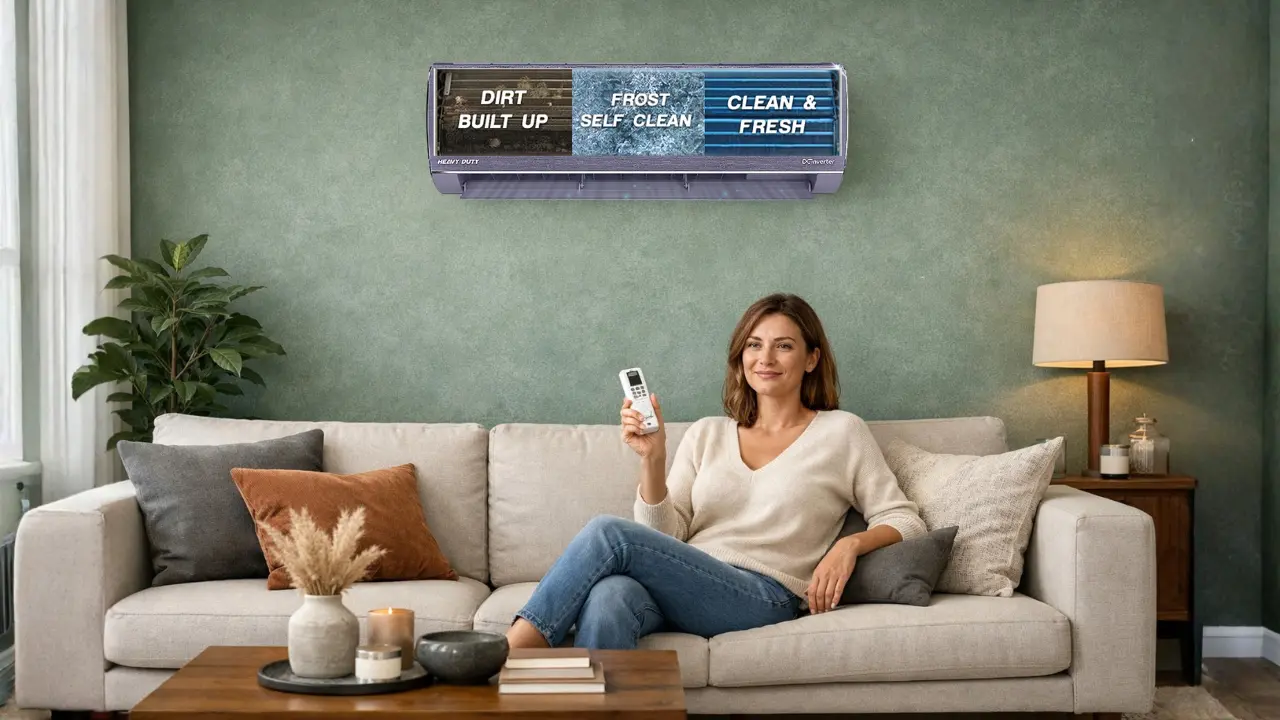

Self-cleaning matters in Indian conditions because dust, humidity, pollution, and long usage cycles quietly reduce appliance performance long before we notice it.
In a country where homes face everything from coastal moisture to city smog and dry summer dust, appliances that clean themselves stay efficient, hygienic, and reliable with far less effort from the people using them.
This is not about luxury.
It is about alignment with reality.
The invisible Indian problem nobody budgets for.
Indian homes are not gentle environments.
Dust settles fast. Humidity lingers. Pollution enters through windows even when they are shut. Add long summers, short winters, and appliances running for months without pause.
The result is predictable.
Appliances age faster on the inside than they look on the outside.
Air conditioners lose cooling efficiency. Odours appear. Energy bills climb quietly. Manual servicing gets delayed because life gets busy.
The system breaks not because people are careless, but because the environment is unforgiving.
Maintenance fails when it depends entirely on memory and motivation.
Self-cleaning is not convenient. It is climate strategy
In cleaner, drier regions, maintenance can be occasional.
In India, it has to be continuous.
Self-cleaning systems work quietly in the background, responding to real conditions rather than ideal ones. They assume dust will come back tomorrow. They assume moisture will stay trapped. They assume people will forget to call the technician.
That assumption makes them practical.
One option is manual cleaning.
The second option is scheduled servicing.
The third option is automated self-cleaning built into the system.
Only one scales across Indian households consistently.
What actually builds up inside an appliance
Open an AC that has run through one Indian summer.
You will find:
- Dust layering on coils
- Moisture trapped after shutdown
- Microbial growth encouraged by heat and humidity
- Reduced airflow and heat exchange efficiency
Each of these adds friction to the system.
Not a dramatic failure.
Slow inefficiency.
Most appliances do not die suddenly. They suffocate slowly.
Why Indian usage patterns amplify the problem
Indian homes use appliances differently.
ACs run overnight. Then again in the afternoon. Then again during the evening heat. Often at higher loads because insulation is inconsistent and external temperatures are extreme.
Servicing cycles rarely match this intensity.
Self-cleaning closes that gap by operating based on hours of use, not calendar reminders.
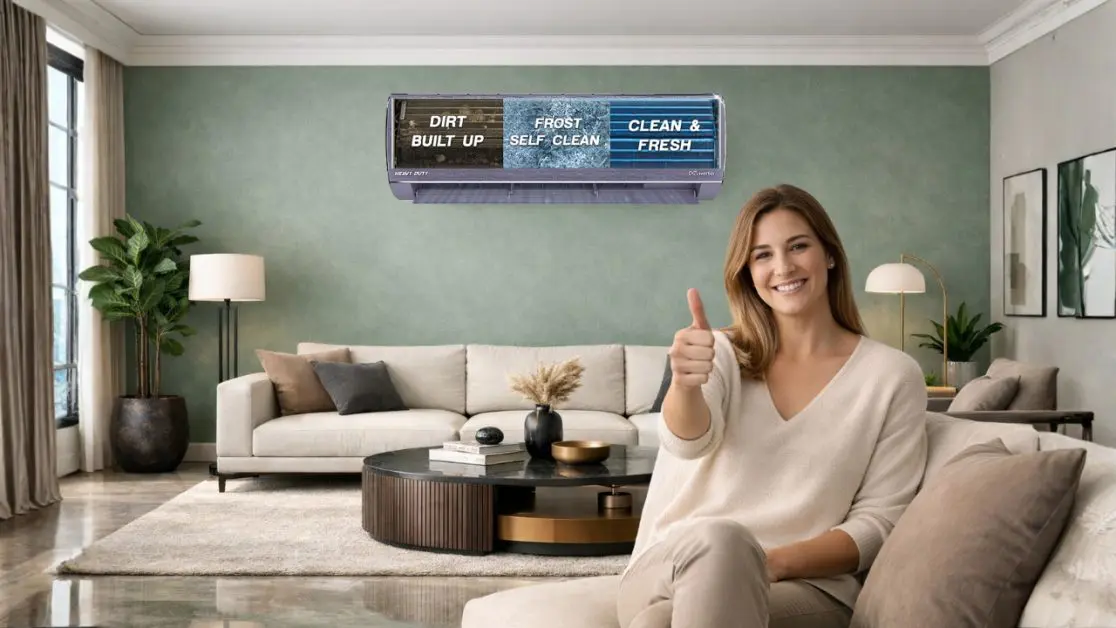
According to Haier’s AI-driven cleaning logic, indoor units trigger frost-based self-clean cycles after defined operating hours, while outdoor units actively reverse airflow after shutdown to clear accumulated dust from condenser coils.
This matters because cleaning aligned to usage protects performance, not just appearance.
The hygiene layer nobody sees
Cooling is not just about temperature.
It is about air quality.
When moisture and dust stay inside internal components, they create conditions that affect indoor air freshness. Odours appear. Allergens linger. Comfort drops even when cooling feels strong.
Self-cleaning addresses this at the source.
Not by masking symptoms.
By removing buildup internally.
Clean systems produce clean outcomes.
The energy bill connection most people miss
Dirty systems consume more power.
That is not a design flaw. It is physics.
When coils are clogged, compressors work harder. Fans run longer. Cooling cycles stretch. Electricity consumption rises gradually.
Most households respond by lowering the temperature.
The cycle worsens.
Self-cleaning interrupts this loop by restoring heat exchange efficiency automatically. Cleaner coils cool faster. Faster cooling means shorter cycles. Shorter cycles mean lower power draw.
Efficiency is not just about star ratings.
It is about staying clean enough to perform as designed.
Why outdoor self-cleaning matters just as much
Indoor cleanliness gets attention.
Outdoor units do not.
Yet Indian outdoor environments are harsher. Road dust. Construction debris. Leaves. Pollution. Moisture during monsoons.
When outdoor condensers clog, cooling efficiency collapses silently.
Modern systems now use reverse fan action shortly after shutdown to blow dust off condenser fins. No technician. No dismantling. No reminder needed.
The best maintenance is the one that happens before you notice a problem.
Manual cleaning versus self-cleaning in Indian homes
| Aspect | Manual Cleaning | Self-Cleaning Systems |
| Frequency | Irregular | Usage-based |
| Effort | High | None |
| Performance recovery | Partial | Consistent |
| Energy efficiency | Degrades between services | Maintained continuously |
| Hygiene control | Surface-level | Internal |
The difference is not comfort.
It is reliable.
The psychological shift modern homes need
Self-cleaning changes behaviour without demanding it.
There is no guilt when servicing is delayed.
No compromise when schedules clash.
No drop in performance during peak season.
The system takes responsibility.
This matters in homes where:
- Both partners work
- Single professionals live alone
- Parents manage multiple routines
- Servicing access is inconvenient
Automation succeeds when it removes decisions, not when it adds features.
Why Indian buyers are starting to value this quietly
Nobody walks into a store asking for self-cleaning first.
They ask about cooling. Noise. Bills.
But long-term satisfaction comes from what does not go wrong.
No smell after monsoon.
No sudden bill spike in May.
No emergency servicing before guests arrive.
Self-cleaning is rarely the headline.
It is often the reason for peace later.
Self-cleaning as part of a larger smart ecosystem
Self-cleaning works best when paired with sensing, learning, and energy management.
Modern AI-powered systems track operating hours, humidity patterns, and shutdown cycles to trigger cleaning automatically. They integrate cleaning with energy optimisation so the appliance stays efficient across seasons, not just during peak months.
This systems-level thinking reflects how Indian homes actually function.
Dynamic. Unpredictable. Always occupied.
Smart appliances succeed when they adapt to life, not when life adapts to them.
What this signals about the future of Indian appliances
Indian conditions are not changing.
Cities will grow denser. Dust will increase. Summers will lengthen. Energy costs will rise.
Self-cleaning is not a premium add-on in this context.
It is a foundational design.
Just like frost-free refrigerators became standard, self-cleaning climate systems will quietly become expected.
Because once you experience stable performance without intervention, going back feels inefficient.
The quiet upgrade that changes everything
Self-cleaning does not flash.
It does not announce itself daily.
It works at night. After shutdown. Between cycles.
That is why it matters.
In Indian conditions, the most valuable features are the ones that respect effort, time, and reality.
Clean systems last longer.
Efficient systems cost less.
Autonomous systems reduce friction.
And homes that reduce friction feel better to live in.
That is the real upgrade.
Frequently Asked Questions
Why isn’t occasional servicing enough in India?
Because dust and moisture return daily. Servicing works only at a fixed moment, while Indian conditions require continuous maintenance, not reminders every few months.
Is self-cleaning a luxury feature or a necessity?
In Indian conditions, self-cleaning is not luxury. It is a climate strategy that compensates for harsh environments and real-life usage patterns.
Does internal dirt affect indoor air quality?
Yes. Dirty internal components reduce air freshness, allow allergens to linger, and lower comfort even when cooling feels strong.
How does self-cleaning help reduce power usage?
By restoring clean heat exchange surfaces, self-cleaning allows faster cooling, shorter cycles, and lower compressor load, reducing electricity draw automatically.
How do modern systems clean outdoor units automatically?
They use reverse fan action after shutdown to blow dust off condenser fins, no technician, no dismantling, no reminders.
How is self-cleaning more reliable?
It works automatically in the background, maintaining performance continuously instead of restoring it temporarily.