

Smart cooling that listens to you means your AC learns your habits, senses your presence, tracks energy use, and adjusts itself automatically for comfort and savings.
It does not wait for instructions.
It predicts.
It adapts.
It cools with intent.
In modern Indian homes, where mornings start early and nights end late, smart cooling is no longer about temperature alone. It is about timing, efficiency, and intuition.
Because comfort today is not about power.
It is about awareness.
Why does cooling still feel manual in a smart home?
Picture a typical weekday in Bengaluru.
The AC runs in the bedroom while someone joins a video call in the living room. A child naps in one corner. The balcony door opens. Heat drifts in. Nobody adjusts the remote.
This is not negligence.
It is life.
Traditional air conditioners wait for you to react. Smart cooling technology like Haier’s AI Atmox platform responds before you do .
That difference matters.
According to India’s Bureau of Energy Efficiency, air conditioners can account for up to 40 percent* of a household’s summer electricity bill. Most of that consumption comes from inefficient usage patterns, not extreme weather.
Cooling is rarely about the climate.
It is about behavior.
Smart cooling that listens to you solves for behavior.
What makes cooling truly “smart”?
Smart cooling works across three invisible technology:
1. It learns your patterns
Haier’s AI Climate Control analyzes room temperature, humidity, and usage habits in real time .
It tracks:
- Mode usage duration
- Power consumption trends
- Seasonal adjustments
- Geo location patterns
Over time, it builds a personalized comfort profile.
The AC stops being reactive. It becomes predictive.
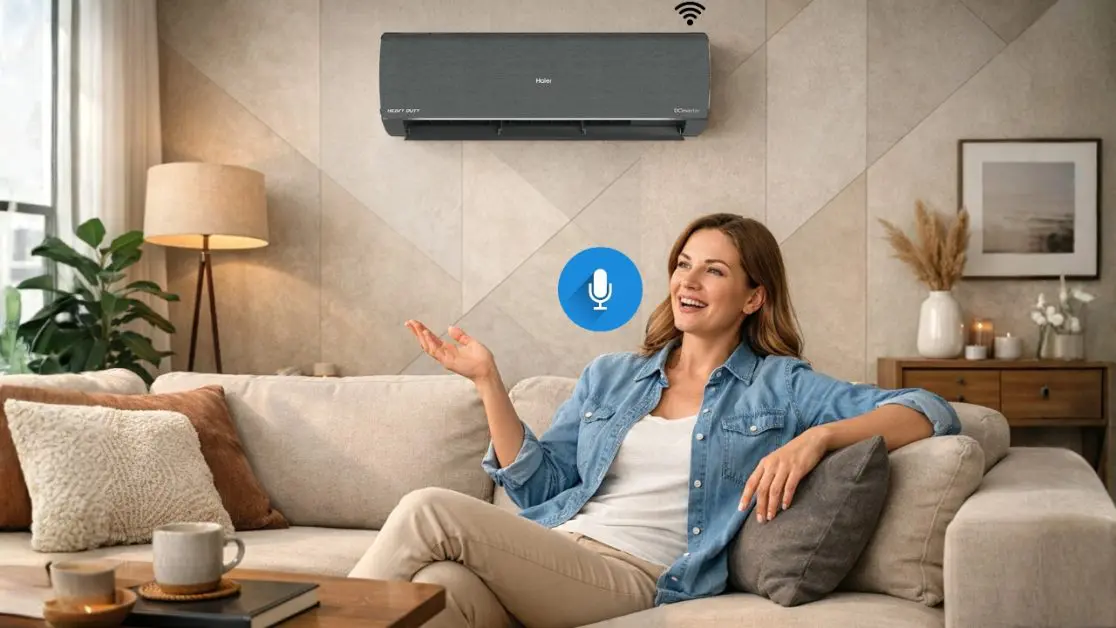
2. It listens to your voice
Direct Voice Control in select models allows you to control the AC even without Wi Fi .
No searching for the remote.
No app loading delay.
Just say what you need.
In homes where hands are busy with cooking, kids, or laptops, that friction disappears.
3. It senses your presence
AI Human Detection monitors occupancy and automatically shifts to energy saving modes when the room is empty .
- Auto L3 mode after 15 minutes of inactivity
- Power off after 30 minutes
- 12 metre sensing range
Energy waste drops without anyone noticing.
Efficiency works best when it is invisible.
The power of pre cooling: Why timing changes everything
One of the most overlooked frustrations in Indian summers is the first 10 minutes after you enter a hot room.
You switch on the AC.
You wait.
You feel the heat linger.
Haier’s AI Pre Cooling predicts arrival using geo fencing technology up to 100 metres .
When you enter the preset zone, the AC begins cooling automatically.
No manual scheduling.
No guessing.
Comfort greets you at the door.
Why this matters
| Traditional Cooling | AI Pre Cooling |
| Starts after you enter | Starts before you arrive |
| Manual timers required | Geo fence activated |
| 5 to 10 minute delay | Instant comfort |
| Higher peak load | Smarter energy distribution |
Comfort feels effortless because planning happens in the background.
Good technology removes waiting.
Target cooling: Why the whole room does not need to freeze
Walk into any living room at night.
One person sits on the sofa.
Another lies on the floor mattress.
Someone works near the dining table.
Traditional ACs cool the entire room equally. AI Target Cooling focuses only where needed .
Using installation position data and cloud intelligence, cool air reaches you faster while reducing energy waste.
The result?
- Faster cooling at the right spot
- Reduced compressor load
- Balanced airflow
Cooling becomes directional, not wasteful.
Precision always beats power.
AI Eco 2.0 and Electricity monitoring 2.0: Savings you can see
Comfort without cost awareness feels incomplete.
Haier’s AI Atmox Power Manager combines AI Eco 2.0 and Electricity monitoring 2.0 to give visibility into energy usage .
You can:
- View usage in graphical format
- Track normal vs eco mode duration
- Display consumption in currency
- Set custom energy targets
When the temperature gap exceeds 3°C, AI Eco 2.0 shifts modes automatically. As the room stabilizes, it adapts again .
It is dynamic.
The cost benefit balance
- It is economically efficient and requires no manual monitoring
- It reduces peak load stress on compressors
- It prevents overcooling
- It builds long term energy discipline
Energy awareness is not about restriction.
It is about clarity.
Human detection: The quiet guardian of efficiency
Think about the last time you left the room for “just five minutes.”
Five minutes become thirty.
Traditional technology keeps running. Smart cooling detects absence and optimizes instantly .
The AC switches to energy saving mode and powers off if inactivity continues.
No reminders.
No guilt.
Just logic.
This matters more in mid sized and large homes where multiple rooms operate simultaneously. Multiply small inefficiencies across rooms, and the cost compounds.
Smart cooling prevents compound waste.
Self cleaning technology: Because efficiency begins inside
Dust buildup affects cooling performance and increases energy use.
Haier’s AI IDU Frost Self Clean and ODU Cyclone Clean technology automatically clean indoor and outdoor units .
- Frost wash every 240 hours
- Reverse airflow after switch off to remove condenser dust
- Improved heat exchange efficiency
Cleaner coils mean faster cooling and lower power bills.
Maintenance shifts from reactive service calls to proactive automation.
Performance lasts when upkeep becomes automatic.
Three ways to think about smart cooling
When choosing cooling technology today, Indian households usually face three options.
One option is manual control.
Lower upfront complexity.
Higher long term energy drift.
Dependent on human memory.
The second option is programmable cooling.
Better than manual.
Requires setup discipline.
Still static.
The third option is AI driven smart cooling.
Learn continuously.
Adapts dynamically.
Optimizes invisibly.
The third option aligns with how modern homes actually live.
Because homes are not fixed technology.
They are moving ecotechnology.
Why smart cooling reflects a larger shift
Smart cooling that listens to you is not just a feature upgrade. It reflects how decisions are evolving across Indian households.
People want:
- Devices that reduce cognitive load
- technology that prevent mistakes
- Appliances that blend into routines
- Energy transparency without effort
This mirrors what organizations face during uncertain and exciting times. Efficiency no longer depends on working harder. It depends on designing better technology.
The same applies at home.
When your AC predicts arrival, senses absence, and monitors energy automatically, it removes micro decisions from daily life.
And micro decisions add up.
The future of cooling feels personal
In earlier decades, cooling meant raw power. Bigger tonnage. Lower temperature.
Today, cooling means intelligence.
- Learns, adapts, cool
- Smarter cooling, lower bills
- Tracks every unit, saves every day
Those ideas are not slogans. They describe a shift from mechanical response to intelligent collaboration .
Smart cooling that listens to you does not shout. It adjusts.
It notices when the monsoon humidity rises.
It prepares before summer evenings peak.
It pauses when rooms are empty.
Comfort becomes a conversation.
And when technology listens, homes feel calmer.
The one insight worth remembering
Comfort is not about lower numbers on the thermostat.
It is about fewer decisions in your day.
Smart cooling that listens to you removes friction, reduces waste, and restores attention to what matters.
In homes balancing work calls, school schedules, family dinners, and festival preparations, that quiet support changes everything.
Because the best technology does not demand attention.
It earns trust.
And in a country where summers test patience and electricity bills test discipline, smart cooling feels less like a luxury and more like thoughtful design.
Sometimes the future is not louder.
It is simply more aware.
Frequently Asked Questions
What does “smart cooling that listens to you” actually mean?
Smart cooling refers to air conditioners that use AI sensors and behavior data to automatically adjust cooling, energy usage, and airflow. Instead of waiting for manual input, the system predicts usage patterns, detects occupancy, and optimizes temperature in real time.
How is smart cooling different from a regular air conditioner?
Traditional ACs respond only to manual commands. Smart cooling systems analyze temperature, humidity, occupancy, and historical usage to automatically adapt cooling behavior.
Will smart cooling really reduce how often I use the remote?
Yes. Features like voice control, geo-fenced pre-cooling, and AI-based automation reduce the need to constantly adjust temperature settings.
Is AI cooling only useful in large homes?
No. Even in small apartments, AI cooling reduces energy waste by detecting room occupancy and optimizing compressor usage.
Why is coil cleanliness important for cooling performance?
Dirty coils reduce heat exchange efficiency, forcing compressors to work harder and increasing electricity consumption.
How often do self-cleaning cycles run?
Some AI cooling systems trigger frost cleaning roughly every 240 hours of operation to maintain performance.