
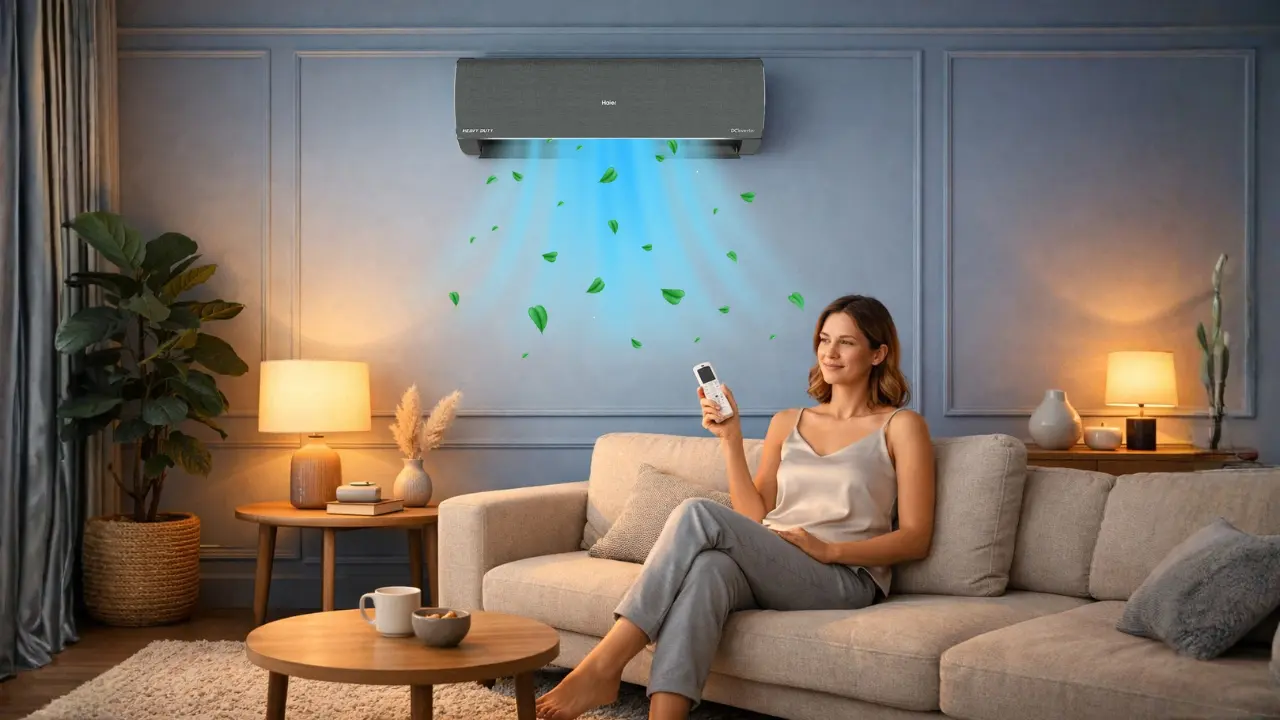

Smart airflow follows your comfort needs by understanding where you are, how your space behaves, and what comfort actually feels like in that moment.
Instead of blasting air everywhere, modern AI-driven airflow systems direct cooling exactly where it is needed, adjust automatically as conditions change, and reduce energy waste without asking you to intervene.
Comfort stops being a setting.
It becomes a response.
The problem with air that does not think
It usually starts with a familiar scene.
You come home after work.
The room feels warm.
You switch on the AC.
Cold air hits the curtains first. Then the ceiling. Then parts of the room nobody is sitting in.
You wait.
Five minutes later, the sofa finally feels comfortable. Ten minutes later, the room is too cold. So you reach for the remote again.
This is not inefficiency caused by the user.
It is inefficiency built into the system.
Traditional airflow assumes that comfort is uniform. Indian homes prove otherwise.
Why airflow matters more than temperature
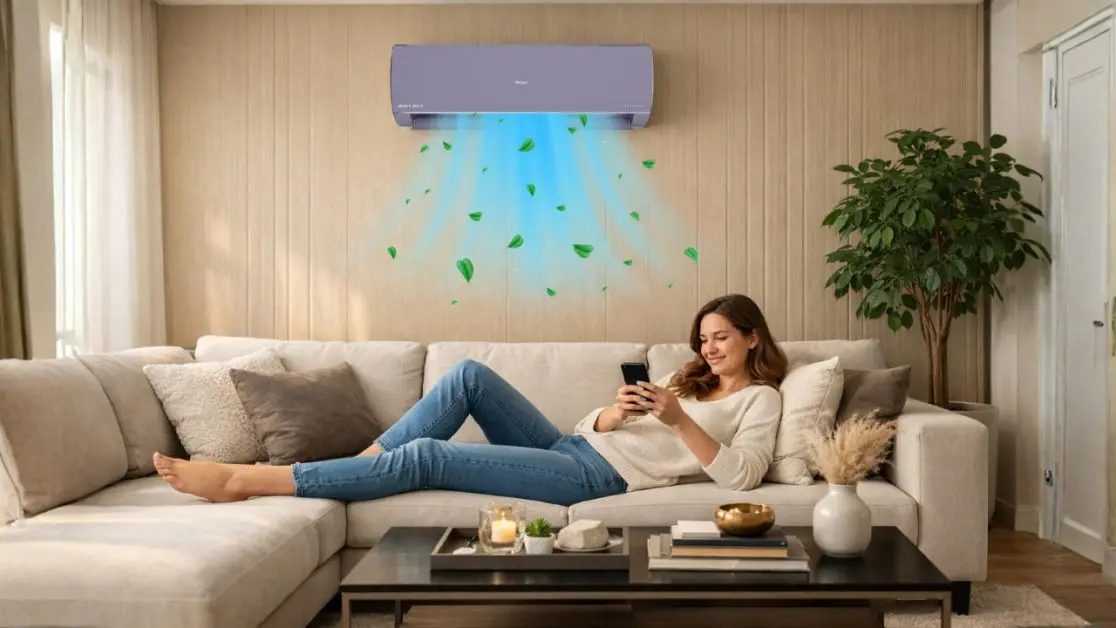
Most people think comfort is about degrees.
Set it to 24°C.
Set it to 22°C.
Adjust until it feels right.
But comfort is not just temperature. It is airflow direction, speed, and timing.
Consider three everyday scenarios.
1. A parent reading quietly while a child sleeps nearby
2. A couple watching a late-night movie with lights dimmed
3. A professional working at a desk with a laptop running hot
All three share the same room. None of them need the same airflow.
That is where smart airflow changes the equation.
Smart airflow is not stronger air. It is smarter intent
The real leap in modern air conditioning is not higher tonnage or faster cooling.
It is intentional.
Smart airflow systems understand where comfort is required and shape air movement accordingly. Instead of cooling the entire volume of air in a room, they focus on cooling where people actually are.
This shift matters.
Because cooling air is expensive.
Cooling people is efficient.
How intelligent airflow actually works in real homes
Smart airflow uses a combination of spatial awareness, usage patterns, and environmental sensing.
According to Haier’s AI-Atmox platform, modern AI climate systems continuously analyze room conditions, user presence, and layout data to adjust airflow dynamically, without manual input .
In practical terms, this shows up in small but powerful ways.
1. Targeted airflow instead of blanket cooling
Traditional ACs cool the entire room, even when only one corner is in use.
Smart airflow focuses cooling where you are sitting, lying, or working.
The benefit is immediate.
- Faster comfort
- Lower energy usage
- Less overcooling
The cost is minimal.
The impact is constant.
2. Adaptive direction based on activity
Reading. Sleeping. Working out. Hosting guests.
Each activity changes how air should move.
Smart airflow adjusts direction and intensity based on usage patterns. The air slows down when you rest. It becomes more active when heat builds up. It avoids blowing directly when comfort would suffer.
Good airflow behaves like a considerate presence.
I noticed. Then adjust.
The invisible system behind everyday comfort
Most people do not notice when airflow works well.
That is the point.
Smart systems operate quietly in the background, making hundreds of micro-adjustments across a day. Temperature shifts. Humidity changes. Sunlight angles move. Occupancy changes.
Older systems treat all these as irrelevant.
Smarter ones treat them as signals.
AI-powered climate platforms like Haier AI-Atmox build personalized comfort models over time by learning usage habits, duration patterns, and power behavior, then optimize airflow automatically to balance comfort and efficiency .
This is not automation for novelty.
It is automation for relief.
Why Indian homes benefit more from smart airflow
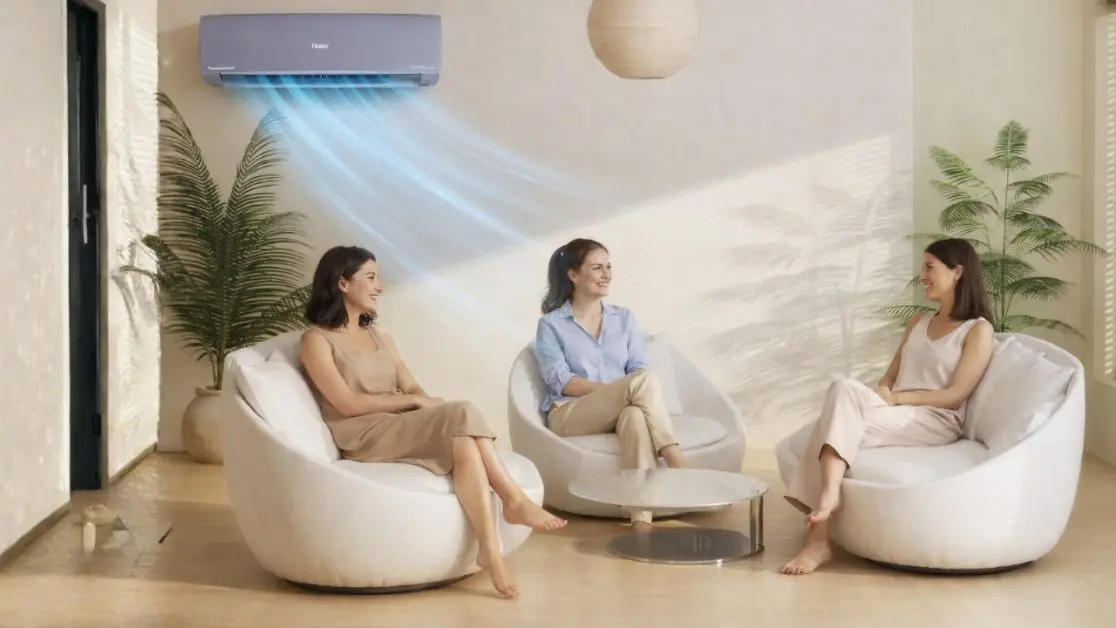
Indian homes face unique airflow challenges.
- High humidity during monsoon
- Mixed-use rooms that change purpose throughout the day
- Shared spaces with different comfort expectations
- Power sensitivity and rising electricity costs
In this context, airflow that adapts is not luxury. It is practicality.
Smart airflow prevents common issues Indian households quietly tolerate.
- Overcooling at night
- Uneven cooling across rooms
- ACs running longer than necessary
- Discomfort caused by direct air blasts
When airflow follows comfort, usage becomes intuitive.
And intuition saves energy.
The energy conversation nobody enjoys but everyone feels
Electricity bills do not spike because people enjoy cooling.
They spike because systems waste effort.
Smart airflow reduces waste by design.
By cooling only occupied zones, adjusting output dynamically, and avoiding unnecessary runtime, intelligent airflow systems can reduce overall power consumption without sacrificing comfort.
Haier’s AI-Atmox Power Manager, for example, tracks electricity usage in real time, shows consumption patterns, and adjusts performance automatically to prevent overuse while maintaining comfort .
Lower bills are not achieved by discomfort.
They are achieved by precision.
Three approaches to airflow. Only one scales
When households think about cooling comfort, they usually choose one of three paths.
Option one: Manual control
- Constant remote adjustments
- Trial and error
- Inconsistent comfort
Low cost upfront. High mental load long term.
Option two: Timers and presets
- Scheduled cooling
- Some predictability
- Limited flexibility
Better structure. Still rigid.
Option three: Smart airflow that adapts
- Automatic direction control
- Real-time optimization
- Minimal intervention
Higher intelligence. Lower effort.
The third option scales with life.
The others require constant attention.
Comfort improves when control disappears
There is a misconception that smarter systems reduce control.
In reality, they remove unnecessary decisions.
You do not lose control over airflow.
You gain freedom from managing it.
Smart airflow allows people to focus on moments that matter.
- Family conversations
- Quiet evenings
- Focused work
- Better sleep
Comfort becomes a baseline.
Not a task.
Why airflow design shapes emotional experience
Airflow is not just physical.
It affects mood.
Direct blasts can feel aggressive.
Uneven cooling creates restlessness.
Overcooling disrupts sleep.
Smart airflow respects human sensitivity.
By softening air delivery, reducing noise, and aligning airflow with activity, intelligent systems create spaces that feel calmer and more intentional.
Good airflow does not announce itself.
It supports everything else.
The future of cooling is contextual, not constant
The old model of cooling was simple.
On. Off. Faster. Slower.
The new model is contextual.
Who is in the room?
What are they doing?
What does space need right now?
Smart airflow answers these questions automatically.
As Indian homes become smarter, smaller, and more multifunctional, airflow that adapts will define everyday comfort more than raw cooling power.
What smart airflow really teaches us
Smart airflow is not about air.
It is about respect for context.
It recognizes that comfort changes.
That people move.
That space evolves.
And when technology learns to follow human needs instead of forcing humans to adjust, life quietly improves.
That is the real promise of smart airflow.
Not colder rooms.
Better living.
Frequently Asked Questions
Why do I keep adjusting my AC remote even though the temperature is already set?
Because temperature alone does not equal comfort. Traditional ACs cool the room uniformly, not where you are. That forces you to constantly intervene to fix airflow problems the system cannot understand.
Is it normal that my room feels too warm first and then suddenly too cold?
Yes and it’s a system flaw, not user error. Conventional airflow cools curtains, ceilings, and empty corners before reaching people, causing delayed comfort and eventual overcooling.
Why does direct AC airflow feel uncomfortable or aggressive at night?
Direct air blasts disrupt sleep by overcooling exposed skin and drying the air too quickly. Smart airflow softens and redirects air during rest periods.
My child sleeps while I read in the same room. Why can’t one AC setting work for both of us?
Because comfort is contextual. A sleeping child needs gentler, indirect airflow, while an adult may need light cooling. Smart airflow adapts direction and intensity to shared spaces.
Why does uneven cooling make me restless even if the room is technically cool?
Human comfort depends on consistency. Hot spots, cold drafts, and fluctuating airflow create subconscious discomfort, even at the “right” temperature.
Is faster cooling always better for comfort?
No. Faster cooling often means stronger airflow, which can feel harsh. Comfort improves when airflow is intentional, not aggressive.
Why does airflow direction matter more than I thought?
Because air hitting walls, ceilings, or fabrics first wastes energy. Directed airflow cools people directly, reducing overcooling and runtime.
Why does my sofa or bed feel comfortable much later than the rest of the room?
Traditional systems cool air volume, not usage zones. Smart airflow targets occupied areas first.
Can smart airflow really reduce power consumption without reducing comfort?
Yes. By cooling only occupied zones and adjusting output dynamically, smart airflow reduces waste by design not by discomfort.
What actually improves when airflow becomes intelligent?
Comfort stabilizes. Noise reduces. Sleep improves. Bills are lower. Most importantly, attention returns to living not managing air.
Can airflow really affect mood and emotional comfort?
Yes. Harsh drafts feel aggressive, uneven cooling causes restlessness, and overcooling disrupts sleep. Gentle, adaptive airflow creates calmer spaces.
I want fast cooling initially but softer airflow later is that possible automatically?
With AI ECO, yes. It cools aggressively at first, then tapers output as comfort is reached. Standard Eco modes usually can’t do this smoothly.
Why does Eco mode sometimes feel slow but still too cold later?
Because it limits power uniformly. It doesn’t balance when to cool fast versus when to slow down.
Is AI ECO better for long sleep cycles?
Yes. It adapts over hours, not just minutes, which aligns better with 6–8 hour sleep patterns.