
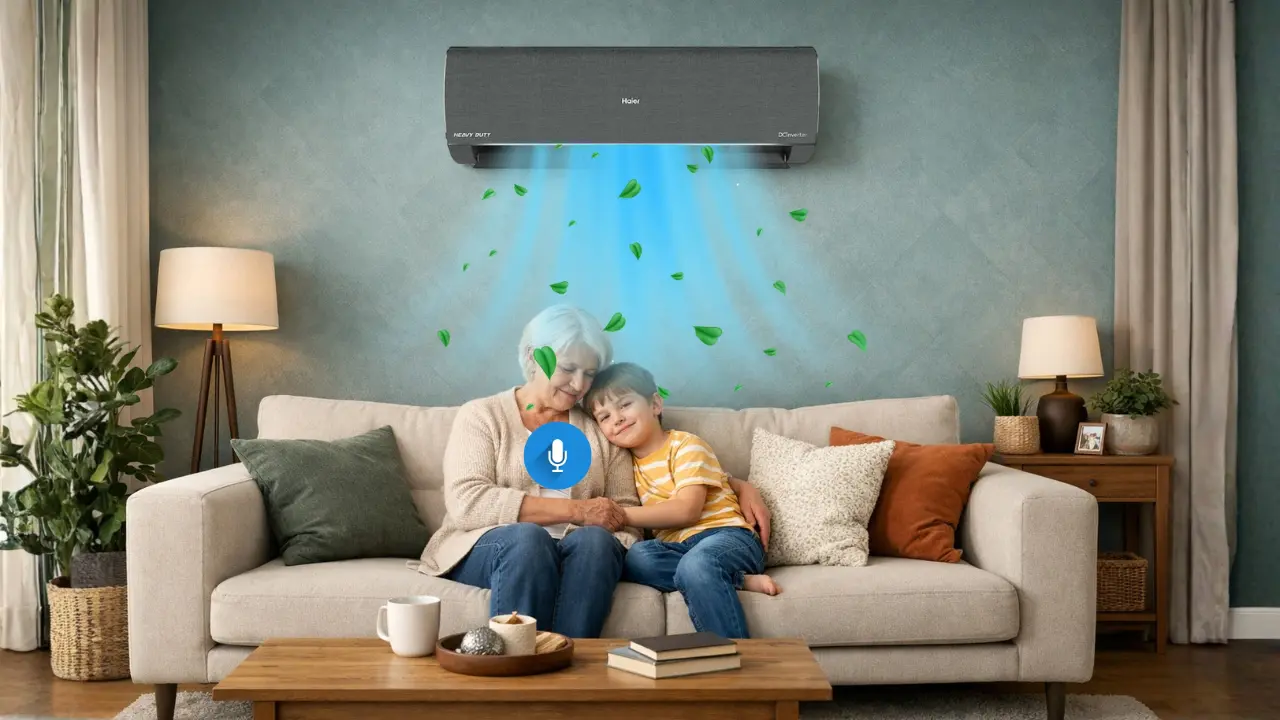

Smart cooling solutions with voice control help elderly family members and children stay comfortable and safe without needing physical effort or technical know-how.
By responding to simple voice commands and adapting automatically to room conditions, these systems reduce health risks, save energy, and bring everyday ease to modern Indian homes.
Comfort should never feel complicated. Especially at home.
Why does cooling needs change with age and stage of life?
A July afternoon in Nagpur feels very different to a January evening in Bengaluru.
But inside Indian homes, the real variation is human.
A grandparent who feels cold faster.
A toddler who cannot explain discomfort.
A working parent trying to manage both.
Cooling is not just about temperature anymore. It is about sensitivity.
Medical studies consistently show that elderly people regulate body temperature less efficiently, while children are more vulnerable to dehydration and heat stress.
According to the World Health Organization, extreme indoor temperatures increase health risks for both groups, even when adults feel fine.
The system fails when one remote tries to serve everyone.
The hidden friction in traditional AC usage

Most air conditioners still assume one thing.
That someone is always available to adjust them.
Reality disagrees.
- Elderly users struggle with small buttons, remotes, and complex modes
- Children change settings unknowingly
- Overcooling happens at night
- ACs run longer than needed during the day
The cost is not just higher bills. It is discomfort that goes unnoticed until it becomes a problem.
A system designed for adults creates friction for everyone else.
Voice control changes the relationship with technology
The moment cooling becomes conversational, the power dynamic flips.
Instead of reaching for a remote, a voice does the work.
Instead of remembering settings, the system remembers you.
Voice control in modern air conditioners allows users to adjust temperature, modes, and power state simply by speaking. For elderly users, this removes physical strain. For children, it creates safer interaction under supervision.
Haier’s Direct Voice Control feature, available in select models, works even without WiFi, which is crucial for reliability in Indian homes where connectivity can be inconsistent .
When technology listens, people relax.
How AI-driven cooling protects health quietly
Smart cooling is not reactive. It is predictive.
Modern AI systems analyse room temperature, humidity, occupancy, and usage patterns to avoid extremes. This matters more than it sounds.
Overcooling at night can cause joint pain and respiratory issues in elderly users. Sudden temperature drops can disturb children’s sleep cycles.
AI Climate Control learns behaviour over time and adjusts cooling dynamically without manual input. It balances comfort with restraint, maintaining steady conditions rather than sharp swings.
Comfort is not colder.
It is consistent.
Targeted cooling is safer than blanket cooling
Most rooms do not need uniform cooling.
A child playing on the floor.
A grandparent resting on a chair.
A parent working at a desk.
AI Target Cooling focuses airflow exactly where it is needed instead of chilling the entire room. This reduces direct cold exposure and lowers energy use at the same time .
Think of it like a reading lamp instead of a floodlight.
Focused. Gentle. Efficient.
Pre-cooling reduces shock and stress
One of the most overlooked health risks is temperature shock.
Walking into a hot home and immediately turning the AC to the lowest setting stresses the body, especially for elderly users.
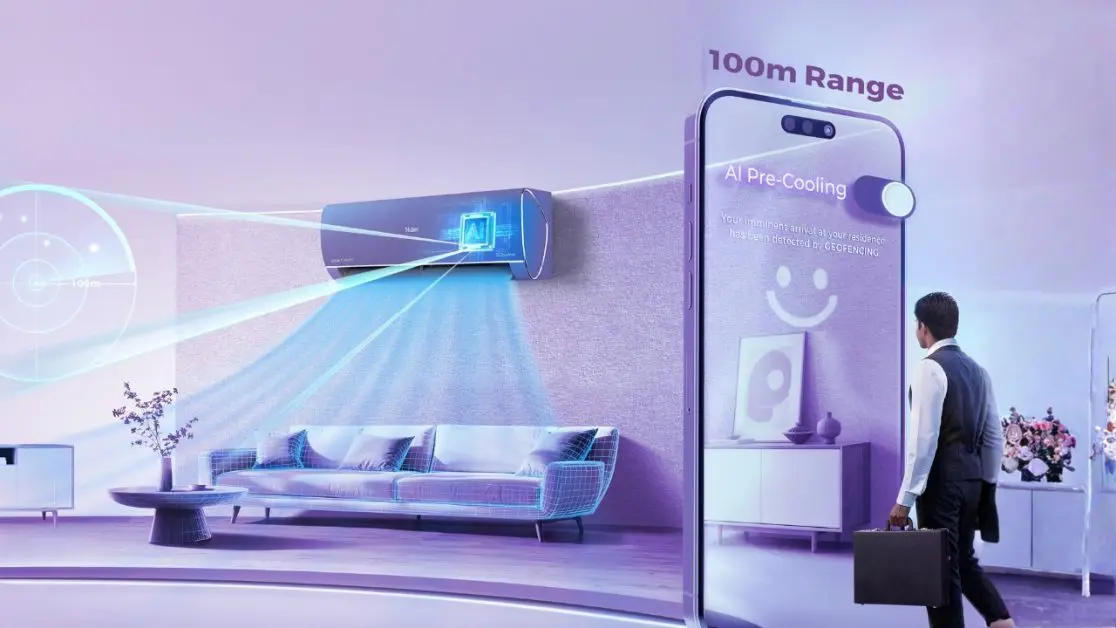
AI Pre-Cooling solves this quietly.
By predicting arrival using geofencing, the system begins cooling before someone enters the room. The transition feels natural, not abrupt .
The room feels welcoming instead of aggressive.
Energy savings are a health feature too
Electricity anxiety affects decisions.
Many families hesitate to use ACs for elderly parents due to rising bills. Smart energy management removes that guilt.
Features like AI Eco 2.0 Mode and Electricity monitoring 2.0 show real-time usage, adapt output based on temperature gaps, and optimize performance without user effort .
Lower bills mean consistent usage.
Consistent usage means stable comfort.
Health improves when comfort is affordable.
A simple framework for choosing the right smart AC
When evaluating smart cooling for elderly and children, focus on systems, not specs.
One option is manual-heavy ACs
Lower upfront cost, higher daily effort, higher risk.
The second option is app-dependent smart ACs
Convenient for adults, less intuitive for elderly users.
The third option is AI-driven voice-first cooling
Minimal effort, adaptive behaviour, safer defaults.
The difference is not intelligence.
It is empathy built into design.
Why this matters more in Indian homes
Indian households are multi-generational by default.
One space serves many needs. One AC serves many bodies.
Smart cooling systems that adapt automatically reduce conflict, manual intervention, and silent discomfort. They respect the fact that not everyone experiences temperature the same way.
Haier AI Atmox ecosystem brings together climate control, voice operation, targeted cooling, and energy intelligence into one cohesive system rather than disconnected features .
Systems work best when they work together.
The future of cooling is invisible care
The best technology does not demand attention.
It listens.
It adjusts.
It steps back.
For elderly parents, it restores independence.
For children, it creates safety without supervision.
For families, it removes one more daily decision.
Smart cooling is no longer about luxury. It is about designing homes that take care of people quietly.
The most powerful upgrade is not colder air.
It is peace of mind.
Frequently Asked Questions
Why do regular AC remotes create problems for elderly users?
Small buttons, complex modes, and visual strain make everyday adjustments difficult or intimidating.
How does AI Pre-Cooling help?
By predicting arrival (via geofencing), the AC cools gradually before someone enters.
Why do families avoid AC usage for elderly parents?
Fear of high electricity bills leads to inconsistent cooling, which worsens health outcomes.
Why is overcooling at night risky for elderly users?
It can worsen joint pain, respiratory discomfort, and disturb sleep cycles.
How does AI cooling protect health without constant adjustment?
AI systems analyze temperature, humidity, usage patterns, and occupancy to prevent extreme swings automatically.