
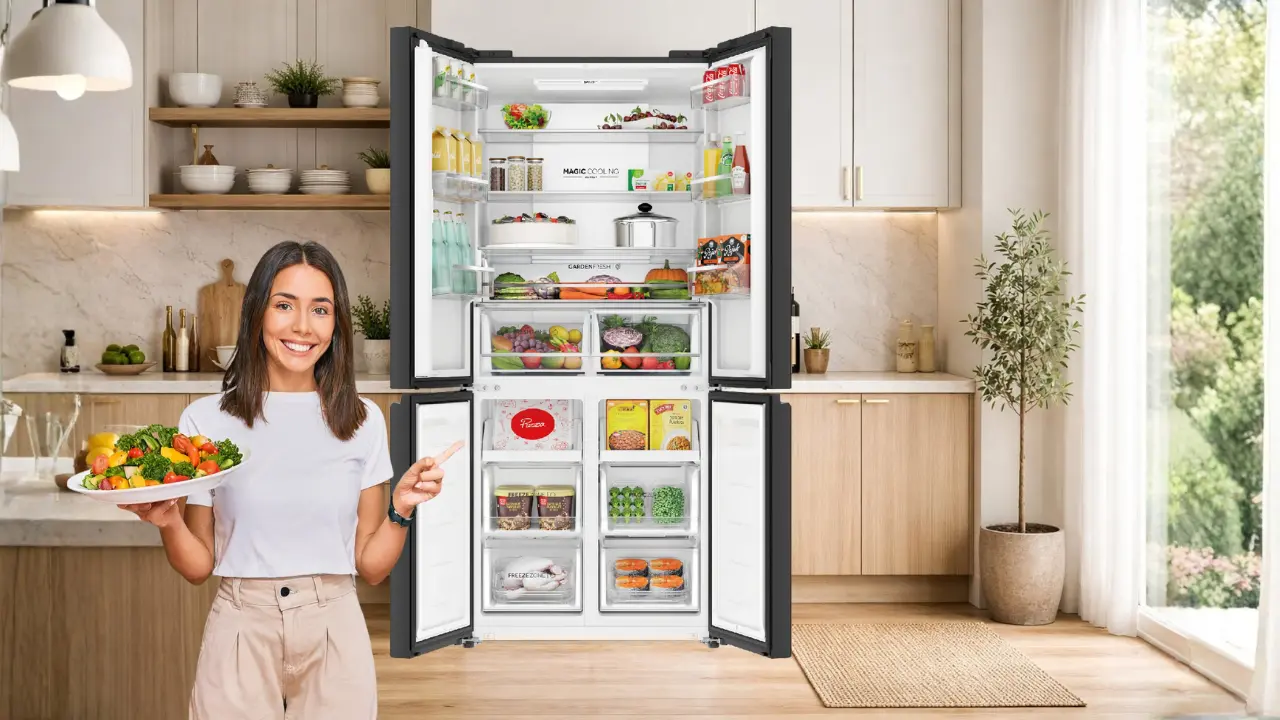

Smart food management is about keeping food fresh, organised, and usable for longer without adding effort to daily life.
In Indian homes, it means fewer forgotten containers, less waste, and refrigerators that understand how we cook, store, and eat. When food lasts longer, kitchens feel calmer and routines feel lighter.
That is the idea.
The reason it matters runs deeper.
Why does food spoil faster in Indian homes than we expect?
Open the fridge on a regular weekday night.
There is leftover dal in a steel bowl.
Cut fruits wrapped carefully.
Milk packets stacked upright.
A box of sabzi waiting for tomorrow.
Everything looks fine.
Yet a few days later, something smells wrong.
Food spoilage in Indian households is rarely about negligence. It is about systems not matching real life.
High humidity.
Frequent door opening.
Mixed storage of cooked food, raw vegetables, dairy, and condiments.
According to global food studies, nearly one third of household food waste comes from storage issues, not overbuying. In India, where cooking is frequent and meals change daily, temperature fluctuation and moisture imbalance accelerate spoilage quietly.
Food spoils when three forces work together.
- Inconsistent temperature
- Excess moisture or dryness
- Odour and bacterial transfer
Most kitchens face all three every day.
The silent cost of wasted food
Food waste rarely announces itself.
It shows up as a sour smell.
A soggy vegetable.
A container that goes straight to the sink.
The cost is not just financial. It is emotional and habitual.
Planning groceries.
Cooking with care.
Saving food for later.
When food spoils, all of that effort disappears without a conversation.
Indian household studies estimate that families lose a noticeable portion of their monthly grocery spend to avoidable food waste. The bigger loss is confidence. You stop trusting leftovers. You cook less intentionally.
Waste is not dramatic. It is repetitive.
Smart food management starts with a better question
Most people ask,
“How long will this last?”
Smarter homes ask,
“What does this need to stay fresh?”
That shift changes everything.
Different foods age differently.
- Leafy vegetables need humidity balance
- Dairy needs stable cold zones
- Cooked food needs odour control
- Fruits need airflow without dehydration
One temperature cannot serve all needs.
Traditional refrigerators treated cooling as uniform. Modern kitchens need zoned thinking.
What smart food management actually looks like at home
Smart food management does not mean doing more.
It means thinking less.
One option is manual discipline
You label containers.
Track expiry dates mentally.
Rearrange shelves every few days.
This works.
It also demands attention every single day.
The cost is time and mental load.
The second option is better storage design
Clear compartments.
Dedicated vegetable and fruit zones.
Spill-proof shelves that encourage order.
This reduces friction.
But it still depends on consistent habits.
The third option is intelligent food systems
Refrigerators that sense, adapt, and remember.
Not loudly.
Quietly.
They track what is stored.
They stabilize temperatures after frequent door openings.
They help families plan shopping together.
This is where smart food management becomes invisible support.
Why visibility reduces food waste
Most food waste begins with forgetfulness.
If you cannot see it, you forget it exists.
Behavioral research consistently shows that visibility directly affects consumption. Clear storage layouts increase usage before expiry. Better lighting reduces forgotten items at the back.
When food stays visible, it gets eaten.
When it hides, it expires.
Design matters more than reminders.
Freshness is no longer just about cold air
Modern freshness is about controlled environments.
Air purification systems reduce odour mixing.
Even cooling prevents warm spots.
Stable temperatures protect sensitive foods.
This matters in Indian refrigerators that store everything from raw vegetables to cooked curries and dairy products together.
Technologies that limit bacterial growth and maintain internal hygiene address spoilage at its source, not after it happens.
Consistency builds trust.
Trust changes habits.
How smart food management fits real family rhythms
Think about a typical evening.
One person eats early.
Another returns late.
The fridge opens multiple times.
Traditional cooling systems struggle here.
Smart systems learn usage patterns and adjust cooling automatically. They protect items like milk, paneer, and leftovers even when the door opens often.
The home does not change its behaviour.
The appliance adapts instead.
Good systems adjust to people, not the other way around.
Festive cooking reveals weak storage systems
Festivals expose every limitation.
Diwali, Eid, weddings, birthdays.
Suddenly the fridge stores:
- Prepped ingredients
- Bulk sweets
- Cooked food for guests
- Drinks chilling continuously
This is where smart food management shows its value.
Convertible storage zones that shift between fridge and freezer space allow homes to adapt without stress.
More fridge space during heavy cooking.
More freezer space when storage increases.
Flexibility replaces compromise.
Smart food management also saves energy
Freshness and energy efficiency are linked.
When cooling is even and intelligent, compressors work less aggressively. Temperature recovery happens faster. Power consumption stays stable.
Energy studies show that inverter-based cooling systems reduce electricity usage significantly in high-use households.
Saving food often saves energy.
That is intentional design.
Where smart connectivity becomes genuinely useful
Smart connectivity matters when it reduces duplication.
Shared shopping lists.
Tracking what is already stored.
Checking fridge status remotely.
In nuclear families and shared homes, coordination is the real challenge. Smart food management turns storage into a shared system rather than an individual responsibility.
Less guessing.
Less waste.
A real example of smart food management in practice
The Haier 630L Black Glass 4-Door Lumiere Refrigerator (HRB-700KGU1) brings these principles together in one system.
Its convertible fridge space adapts to changing needs.
Dedicated zones support different food types.
Built-in antibacterial and deodorising technologies protect freshness.
Smart connectivity supports tracking and planning.
The design is not about features for display. It is about coherence. Food stays fresher because the system understands how Indian kitchens actually function .
Technology stays in the background.
Benefits show up every day.
What smart food management teaches beyond the kitchen
Food systems reflect life systems.
When storage works, decisions simplify.
When waste reduces, guilt fades.
When freshness lasts, routines relax.
This principle appears across modern homes.
Smart ACs that optimize cooling automatically.
TVs that adjust sound for shared spaces.
Appliances that remove friction instead of adding steps.
The future of home living is not louder technology.
It is quieter intelligence.
The bigger implication
Smart food management is not a feature.
It is a mindset.
A belief that homes should support better choices without effort. That everyday frictions deserve thoughtful solutions. That freshness should feel effortless, not managed.
When food stays fresher for longer, life feels more organised.
That feeling compounds.
And that is how smart homes quietly make everyday living better.