
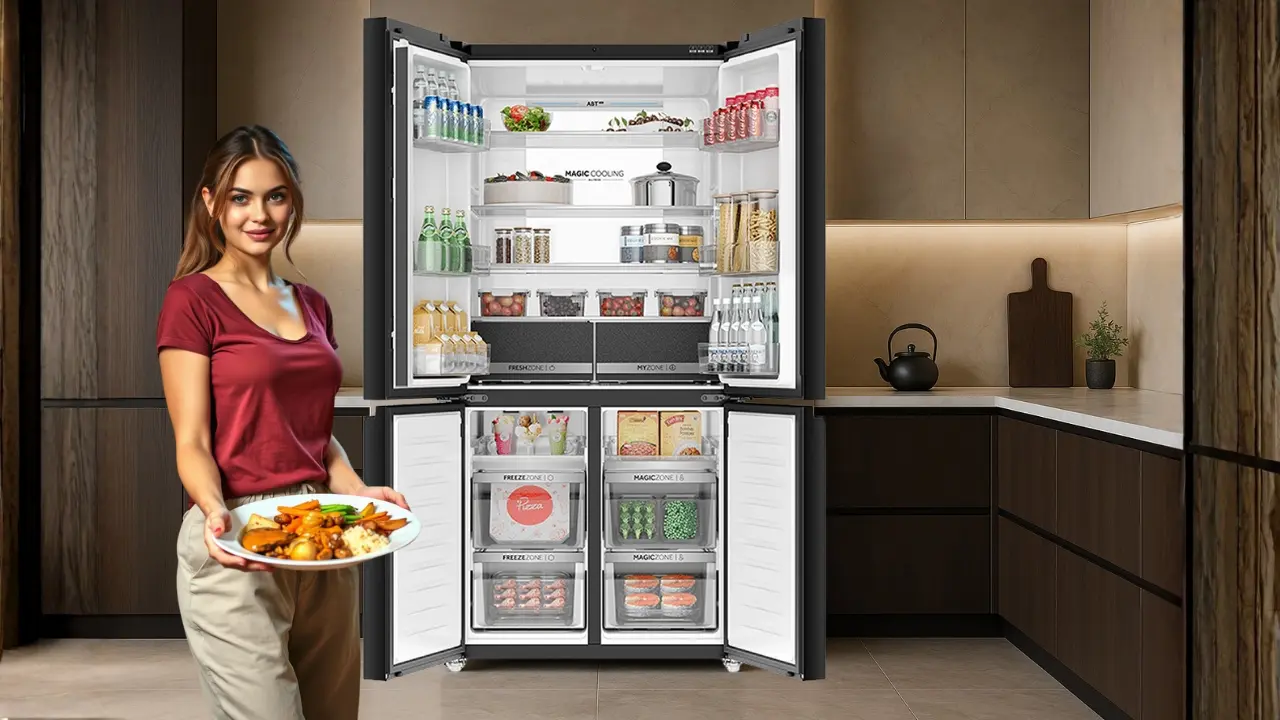

The smartest way to manage leftovers from monsoon comfort foods is to treat your fridge as more than storage.
Use its convertible spaces, freshness tech, and smart settings to keep food safe, flavorful, and ready for second servings without waste.
Why Monsoon Always Brings More Food Than We Finish

Every Indian family knows this pattern.
It’s raining outside, you crave pakoras, khichdi, or steaming bowls of rasam. Someone makes a big batch, because cooking in small portions feels almost wrong in this season. By dinner, everyone is full but the pot still looks half untouched.
Leftovers are inevitable. And here’s the paradox: they feel like a blessing when you’re hungry at 11 pm, but a burden when you discover they are spoiled the next morning.
So the real question is how do you make the fridge your ally in this cycle of monsoon comfort food?
Leftovers Are Not Just Storage They’re Strategy
Food stored without intention turns into waste. Food stored with a system turns into tomorrow’s comfort.
Your refrigerator isn’t just a cold box; it’s a decision-making partner. When managed well, it reduces waste, saves money, and ensures that the joy of monsoon meals lingers a little longer.
Step One: Match Storage to the Food Type

Not all monsoon foods behave the same way once refrigerated.
1. Crispy foods (pakoras, samosas, bhajiyas)
- Store them in air-tight glass containers lined with tissue.
- Keep them in the fridge for 1 day max.
- To revive crispiness, reheat in an oven or air fryer, not the microwave.
2. Rice dishes (khichdi, pulao, curd rice)
- Spread them in shallow containers before storing.
- Consume within 24–36 hours.
- Reheat thoroughly with a sprinkle of water to avoid dryness.
3. Soups and curries (rasam, dal, kadhi, chicken curry)
- Store in covered stainless-steel bowls or sealed boxes.
- Safe up to 2 days if kept in the coldest fridge section.
- Stir well when reheating to even out consistency.
4. Sweets (jalebi, kheer, halwa)
- Place in small portions in sealed containers.
- Most dairy sweets need to be consumed within 1–2 days.
- Avoid mixing hot and cold sweets in one container.
Principle: The fridge doesn’t just preserve food; it preserves the mood that food was meant to create.
Step Two: Use the Right Zones in Your Fridge
The invisible mistake in most Indian homes? Treating the fridge as one uniform space.
But a fridge has zones each with different temperatures and airflow.
How to use zones smartly:
- Upper shelves: Great for dairy-based foods like kheer or curd rice.
- Middle shelves: For curries and dals, stable cooling prevents quick spoilage.
- Crisper boxes: Store fresh coriander, curry leaves, and green chilies separately so they don’t get soggy.
- Door shelves: Reserve only for drinks and sauces, never milk or leftover curry, since this zone faces the most temperature swings.
This is where modern appliances shine. For instance, the Lumiere 630L refrigerator offers a convertible fridge space. That means you can switch sections based on the food you’re storing, an underrated feature during monsoon when the fridge fills up faster than usual.
Step Three: Tackle Odours Before They Spread

Monsoon leftovers come with strong aromas, fried pakoras, spiced curries, fermented batters. If not managed, one dish can easily overpower the others.
Quick fixes:
- Always cool food before storing.
- Use tight-lid containers to avoid cross-odour.
- Keep cut lemon slices or baking soda inside to neutralize smells.
But even these tricks have limits. This is why refrigerators like the Lumiere use ABT Pro technology to absorb odours and keep food fresher without you improvising hacks.
Step Four: Think in Time, Not Just Temperature
Most people ask: “How cold should I keep the fridge?”
The smarter question is: “How long before I plan to eat this again?”
- Within 12 hours? Store on the middle shelf, easy to reheat.
- Next day lunch? Place in coldest zones.
- Unsure? Freeze small portions.
Here’s where Smart Sense AI in refrigerators helps it learn your family’s usage patterns and adjusts cooling to save energy while keeping leftovers at optimal freshness.
Because freshness is a moving target. And the best fridges move with it.
Step Five: Convert Leftovers into Next-Day Comfort
Leftovers don’t have to feel like yesterday’s story. With a little creativity, they can be tomorrow’s highlight.
Ideas that work:
- Pakoras – Curry: Reheat pakoras in a tangy tomato gravy.
- Dal – Parathas: Use leftover dal as a kneading base for breakfast parathas.
- Rice – Tikki: Mix with mashed potatoes, shape into cutlets, shallow fry.
- Kheer – Smoothie base: Blend with milk and nuts for a rich morning drink.
The fridge keeps the ingredients safe, your imagination keeps them exciting.
Step Six: Track, Label, Share

In busy homes, the real issue isn’t storage. It’s a memory.
We forget what’s in the fridge until it’s too late.
Simple systems:
- Use masking tape to label containers with dates.
- Place older leftovers at the front.
- Share reminders on family WhatsApp groups if food needs finishing.
Smart Connectivity with the Haismart app pushes this further. You can track what’s inside, create shopping lists, and share them with family. A fridge that talks reduces the silence of wasted food.
The Bigger Picture: Why Leftovers Matter
Managing leftovers may seem like a small domestic concern. But zoom out.
- Food waste is an economic cost. According to UNEP’s Food Waste Index Report 2024, Indian households waste over 50 million tonnes of food annually. Much of it comes from everyday leftovers.
- It’s also environmental. Wasted food = wasted water, energy, and resources.
- And it’s cultural. Indian homes have always valued frugality. Wasting food goes against the grain of our traditions.
A fridge, then, is not just about cooling. It’s about respecting what we cook and consume.
Table: Monsoon Food Shelf-Life in a Fridge
| Food Type | Shelf Life (Fridge) | Storage Tip |
| Pakoras/Bhajiyas | 1 day | Air-tight, tissue-lined container |
| Khichdi / Rice dishes | 24–36 hours | Shallow box, sprinkle water when reheating |
| Curries / Rasam / Dal | 2 days | Coldest shelf, covered container |
| Dairy sweets (Kheer) | 1–2 days | Small sealed portions |
| Fresh herbs | 3–5 days | Separate crisper storage |
This table isn’t just data. It’s a map of how freshness lives and dies in a fridge.
What Smart Appliances Reveal About Modern Indian Homes
Every season tests a different appliance. In summer, the AC proves its worth. During festivals, ovens and microwaves get the spotlight. But the monsoon belongs to the fridge.
Because this is the season of abundance and unpredictability. Comfort food collides with dampness, cravings with caution. And the fridge is the only constant that makes this dance sustainable.
A model like the Lumiere 4-Door 630L Refrigerator embodies this shift. With spacious 425L storage, flexible convertible sections, and AI-driven cooling, it’s built for families that want style without compromise, and convenience without shortcuts.
Final Insight: Freshness Is a Form of Care
When we manage leftovers well, we’re not just preventing waste. We’re extending the comfort of monsoon food, making sure joy doesn’t spoil overnight.
And that’s what a fridge is really about not storage, but stewardship.
Memorable line to leave with:A well-used fridge doesn’t just keep food fresh. It keeps families nourished, connected, and free from the guilt of waste.