


Formula 1 is about speed.
But the moments that matter most often happen in a split second: a team order, a wheel gun slip, a driver’s instinctive move.
A Smart TV lets you pause, rewind, and replay those flashes until they make sense, transforming fleeting chaos into lasting memory.
Why do the fastest races demand the slowest replays?

Think about the 2025 Italian Grand Prix at Monza.
Max Verstappen broke records with a lights-to-flag win. McLaren’s team orders turned headlines into debates. And Lewis Hamilton, in Ferrari red for the first time at Monza, soaked up the Tifosi’s love despite finishing sixth.
If you watched it live, you probably caught the drama in fragments: a slow pit stop here, a radio message there, an overtake at Turn One. Blink, and you missed it.
This is where a Smart TV changes the game. It doesn’t just broadcast the race. It gives you control of the story.
Rewind the pit lane chaos.
Pause the exact second Oscar Piastri moved over to let Lando Norris through.
Zoom into Verstappen’s flawless lap record.
In a world moving at 350 km/h, control is luxury. And control is what modern home tech now delivers.
What team orders teach us about home tech
F1 team orders divide fans. Sometimes they’re fair strategies. Sometimes they feel like politics are in motion. But they always reveal one truth: coordination matters more than speed.
That’s exactly how modern home runs are.
- Parents juggling dinner while kids stream cricket highlights.
- A couple setting up their first apartment, debating whether to watch a film or catch live football.
- A working professional rewinding the news while answering work calls.
Like F1 teams, homes today thrive when tech coordinates smoothly. A Smart TV with Google TV, voice control, and personalized recommendations acts like the race engineer in your living room making sure everyone gets what they need without chaos.
The hidden system behind instant replay
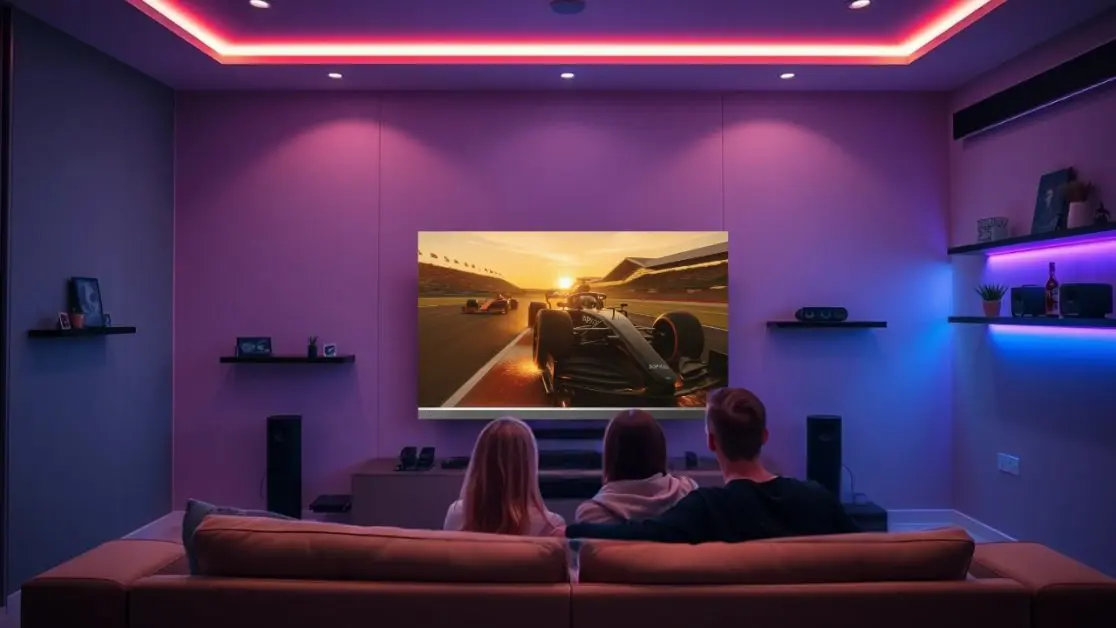
Here’s the irony: the faster the race, the more you need slow motion. That’s not just true in Monza. It’s true in life.
Festivals, family dinners, late-night cricket sessions they all move fast. The laughter, the drama, the arguments over who took the last laddoo. Without a way to replay, they blur into memory.
Smart TVs quietly solve this problem by embedding three layers of hidden systems:
- Adaptive visuals – Features like Dolby Vision IQ adjust brightness and colour to your room’s light, so you see details whether it’s a sunny Sunday or a monsoon evening.
- Immersive sound – Harman Kardon with Dolby Atmos makes the roar of the Tifosi sound like it’s coming from all directions. Not loud. Alive.
- Seamless control – Hands-free voice commands let you rewind without fumbling for the remote. In the heat of a family watch party, that matters.
The principle is universal: when life moves fast, good systems let you slow it down without breaking the flow.
Why Indian households replay more than they realize
Replays aren’t just about racing. They’re about rhythm. Indian homes already live in replay mode.
- Families rewatching a Shah Rukh Khan monologue for the fourth time.
- Couples reliving wedding videos during anniversaries.
It’s not nostalgia. It’s a ritual.
And in rituals, quality matters. Watching a low-res replay on a small screen is like listening to an orchestra through a cracked speaker. The emotion gets lost in translation.
That’s why large-format Smart TVs like the Haier M95 Mini LED 189cm (75) with 144Hz MEMC matter. They don’t just show you the replay. They make it feel truer than the first time.
Team tech at home: three parallels with Monza
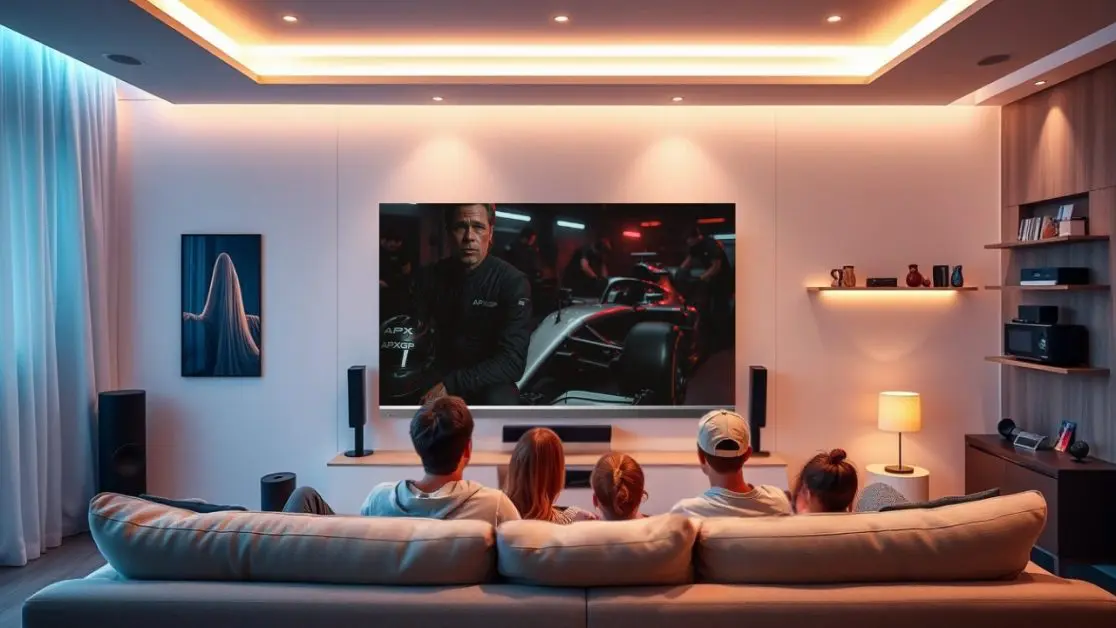
The pit stop = the refresh button
Just as McLaren’s slow wheel gun shifted the entire race dynamic, the smallest glitch in home tech can throw off a moment. That’s why features like low-latency Game Mode (VRR/ALLM) matter; they make sure your “pit stop” between apps is seamless.
The driver swap = content handover
Piastri letting Norris through was controversial. At home, the equivalent is deciding who controls the remote. Voice-first TVs remove that tension. Anyone can say, “Play highlights of yesterday’s race,” and the system responds. No more power struggles.
The Tifosi = your living room crowd
Just as Ferrari fans fill Monza with colour and noise, every Indian living room becomes a stadium during big matches or family movie nights. The difference is scale. A 189cm (75) Mini LED screen with 60-watt audio doesn’t just show the moment it creates an arena inside four walls.
The bigger picture: why replay culture matters
Here’s the hidden system most people miss: Replay isn’t about the past. It’s about control of the present.
When you can replay, you no longer fear missing out. You can focus on the moment knowing you can revisit it. That changes how you watch and how you live.
- Students replaying lectures to grasp concepts.
- Parents replaying their child’s first dance performance.
- Cricket fans replayed the last over just to feel the adrenaline again.
Replay culture gives us ownership of memory. And in a country where time often feels too short, that ownership is priceless.
But does tech slow us down too much?
There’s a valid counterpoint. If we keep replaying, do we stop living in real time?
That’s why balance matters. Smart tech should enable, not trap. A good Smart TV gives you options live when you want to feel the adrenaline, replay when you want to relive it.
Think of it as an F1 strategy. Too many pit stops and you lose time. Too few, and you burn your tires. The art is knowing when to switch.
Everyday decisions that feel like team orders
We often underestimate how many “team orders” happen at home.
- A parent telling the kids, “Dinner first, then cartoons.”
- A couple decided, “Movie tonight, cricket tomorrow.”
- Roommates splitting the Sunday binge list into equal turns.
These are small, domestic versions of McLaren’s Monza call. They carry the same trade-offs: fairness, timing, emotion.
Smart TVs soften the edge. With multiple profiles, curated recommendations, and voice control, everyone feels heard. No drama. Just flow.
The cost-benefit equation of smart replay
Benefits:
- Relive fleeting sports moments in ultra clarity
- Share memories with family without tech hassles
- Reduce FOMO during busy schedules
Costs:
- Higher upfront price compared to basic TVs
- Risk of over-reliance on replay instead of live experience
- Occasional need for strong Wi-Fi or streaming bandwidth
The principle: The benefits outweigh the costs when you see replay as a lifestyle tool, not a distraction. It’s about amplifying life, not replacing it.
So, what does this mean for us?
Formula 1 teaches us that systems win races. Drivers may get the spotlight, but it’s strategy, coordination, and tech that make champions.
Homes are no different. The moments that matter whether it’s Verstappen’s lap, Hamilton’s Ferrari debut, or your kid’s first cricket six all deserve replay power.
And replay is no longer a luxury. It’s an everyday expectation.
The smart home isn’t about gadgets for show. It’s about building systems that let you live at full speed, while never missing the details.
Closing insight
The Italian GP showed us that even in a sport obsessed with speed, the moments we treasure are the ones we can revisit.
That’s the promise of smart tech at home. Not just to show us life in motion. But to give us the ability to pause, reflect, and replay until the fleeting becomes unforgettable.