
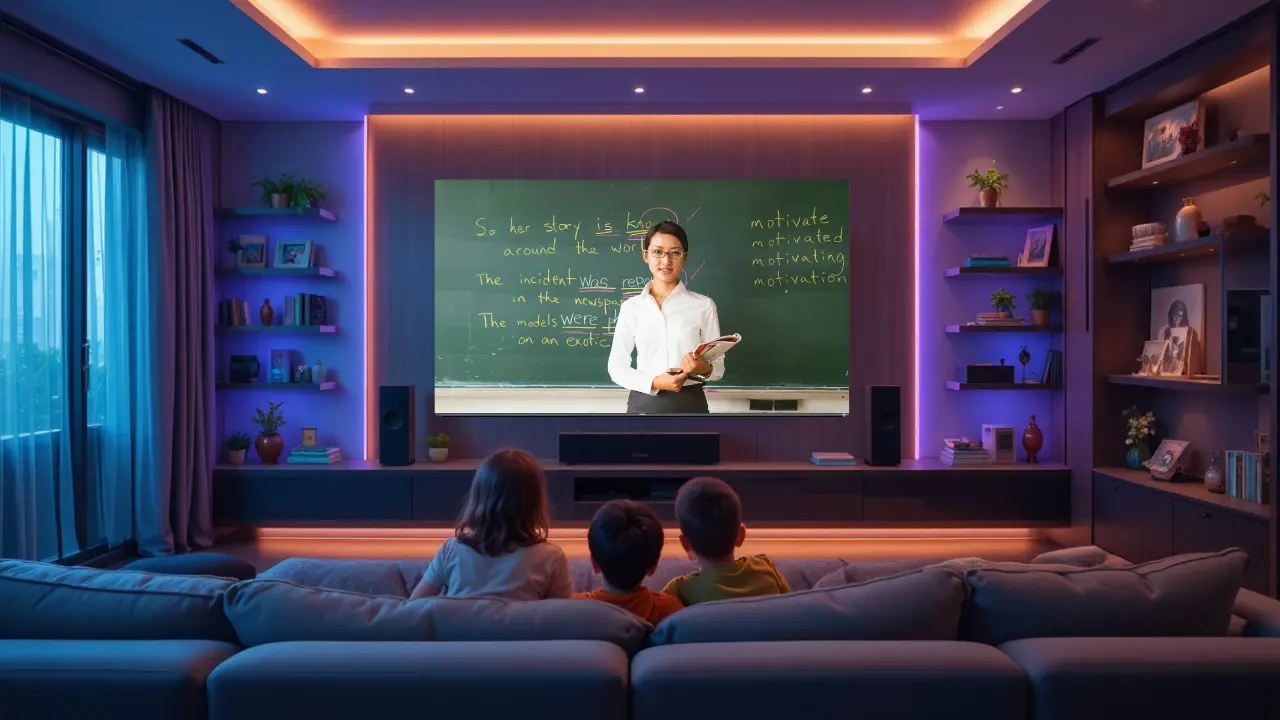

New-generation Smart TVs are turning into after-school learning hubs by supporting EdTech apps directly on large screens, offering kids immersive visuals, better sound, and hands-free navigation.
For parents, this means less juggling between phones and laptops and more family-friendly, distraction-free learning right in the living room.
Why the Living Room Became a Classroom

Every parent in India knows the scene.
The school bag drops, the shoes are kicked off, and within minutes the living room fills with chatter, cartoons, and sometimes YouTube tutorials that count as “study.”
But in the past few years, a shift has happened.
Education is no longer confined to school hours or coaching centres. Apps like Byju’s, Vedantu, Toppr, and WhiteHat Jr. have crept into the everyday rhythm of families. Homework time often involves a screen whether it’s watching an explanation of quadratic equations or following along with a coding challenge.
The challenge?
Phones are too small. Laptops are clunky and often tied up with office work. Which leaves families looking for a screen that is both entertaining and educational. That’s where the new generation of Smart TVs steps in.
What Makes a TV an EdTech Partner?
A television used to be a passive device, something you “watched.” Today, it’s closer to a personal computer with a 140cm (55) screen and an interface that even grandparents can use.
The essentials that make Smart TVs learning-ready:
- Google TV integration: lets you download EdTech apps directly, so kids can switch from Netflix to Byju’s in seconds.
- Hands-free voice control: no fumbling with remotes; kids can say “Open Khan Academy” and jump straight in.
- High-resolution display (4K + Dolby Vision): makes diagrams, maps, and experiments look closer to real-life clarity.
- Premium sound (Sound by KEF Audio + Dolby Atmos): for interactive quizzes, music lessons, or even language pronunciations that demand crisp clarity.
- Smooth refresh rates (DLG 120Hz): reduces blur during interactive animation-heavy apps where speed matters.
Haier’s new Mini-LED range ticks all these boxes. Which means the “TV time” parents used to dread can now double as “study time.”
The Hidden System: Why Big Screens Improve Learning

There’s a principle in education that often gets overlooked.
- A child trying to read a biology diagram on a 6-inch phone will squint, zoom, and get distracted by notifications.
- Put the same diagram on a 165cm (65) TV, and suddenly the heart valves or plant cells are as large as life.
- Add surround sound, and the teacher’s explanation feels like sitting in the front row of a class.
This isn’t just convenient. It’s cognitive science. Larger screens reduce cognitive load, meaning kids spend less energy on “figuring out what’s on the screen” and more on actually learning.
In short: when learning feels effortless, retention improves.
Real-World Scenarios Indian Families Will Recognise
- The sibling tug-of-war: One wants to watch cartoons, the other needs a maths revision class. With Smart TV multi-user profiles, switching between kid-friendly Netflix and a Vedantu lesson is seamless.
- The working-parent dilemma: Parents in work calls no longer need to hand over their laptop. The TV became an independent study station.
- The grandparent connect: Many Indian households have grandparents helping with homework. A large screen makes it easier for them to “sit together” and guide kids without struggling with small fonts.
- Festival breaks: Diwali or summer vacations used to mean kids losing touch with academics. Now, 20 minutes on an interactive app daily on the living room TV keeps the rhythm alive without making it feel like tuition.
The System of Choices: How Families Can Use TVs for EdTech

There are three broad ways families are adapting Smart TVs for learning:
1. The Companion Model
Kids use the TV as a companion to regular study streaming history documentaries, Khan Academy math explainers, or coding tutorials after finishing their textbooks.
2. The Replacement Model
For many households where laptops aren’t available for every child, the TV becomes the primary device for classes. Especially useful in Tier 2 and Tier 3 towns, where shared resources are the norm.
3. The Hybrid Model
Kids mirror their phone/tablet screens to the TV (via Chromecast) when they want a bigger view then switch back when it’s time for writing or typing.
Each option has its cost and benefit.
The companion model prevents over-reliance, the replacement model ensures access, and the hybrid model balances flexibility.
The Role of Design: How Haier Fits Into This Shift
When Haier builds a TV with Mini-LED, Dolby Vision, and Sound by KEF Audio, it’s not just aiming at cinema nights. It’s quietly creating a multi-role screen.
- In the morning, it’s a news briefing device for parents.
- In the afternoon, it’s a whiteboard for a child’s science project.
- In the evening, it’s a cricket match in Dolby Atmos.
- At night, it’s the family movie hub.
That versatility is what makes investment in a Smart TV less about luxury and more about everyday utility.
Parents’ Concerns: Screen Time vs. Smart Time
Every Indian parent asks the same question: Isn’t this just more screen time?
The better question is: What kind of screen time?
- Passive scrolling on social media? That’s a waste.
- Watching cartoons endlessly? That’s indulgence.
- Solving math puzzles on a large screen? That’s enrichment.
The difference is not in hours spent but in what those hours deliver.
New TVs let parents create boundaries. With Google TV parental controls, you can set app limits, bedtime reminders, or even pause access remotely.
Instead of fighting over screens, families can set shared rules that actually stick.
A Table of Value: Entertainment vs. Education on Smart TVs
| Feature | Old TV Use Case | New Smart TV Use Case (EdTech) |
| Large Display | Cricket Matches | Interactive Science Lessons |
| Premium Audio | Bollywood Movies | Music & Language Classes |
| App Integration | Netflix, Prime Video | Byju’s, Vedantu, Coding Apps |
| Hands-Free Voice | Channel Surfing | Instant App Launch for Kids |
| Solar Remote | Convenience | Sustainability Lesson in Itself |
Notice the pattern?
Every entertainment feature has an equal, often overlooked, educational upside.
The Festival Effect: Why 2025 Is the Right Time
This festive season, Indian households are upgrading TVs not just for cinema-like experiences but for family needs that go beyond leisure.
Think about it.
Parents are spending more on tuition, EdTech subscriptions, and extracurricular activities. A one-time investment in a Smart TV that supports all those apps turns into a multiplier.
The big implication:
Buying a TV in 2025 is no longer just a lifestyle choice. It’s becoming an educational decision.
So, What Does This Mean for the Future of Learning?

We often say, education follows culture.
When culture moves to the living room screen, education follows.
Schools are experimenting with blended learning. Coaching institutes are going hybrid. Parents are demanding flexibility. And now, devices like Haier’s Mini-LED Smart TVs are quietly stitching these threads together giving kids access, parents peace of mind, and families one less device to argue about.
Final Insight: The Living Room Is the New Classroom
If the 90s were defined by tuition centres, and the 2000s by coaching apps on phones, the 2020s might well be remembered as the decade when the living room TV turned into India’s biggest classroom.
The smartest families aren’t asking “Should kids learn on TV?” anymore.
They’re asking “How do we use it best?”
Because technology doesn’t just entertain. In the right setting, it teaches, guides, and grows with us.
And when a screen as big as your wall starts pulling double duty cricket by night, coding by day you know you’re not just buying a TV. You’re building a future-ready home.