
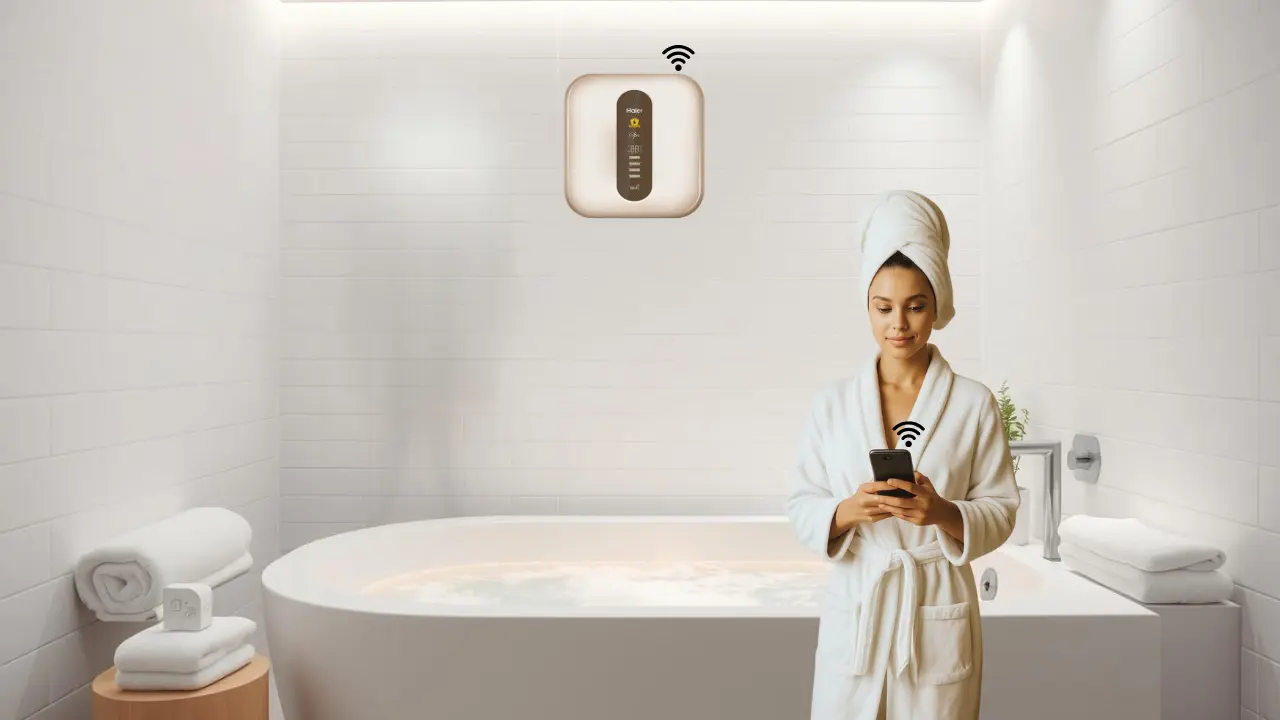

Smart WiFi water heaters aren’t just about hot water. They’re about control, convenience, and safety designed to match the unpredictable rhythms of modern Indian households.
Why your old water heater feels outdated

Picture this: it’s a Monday morning in Delhi winter. You’ve snoozed twice, the bathroom queue is forming, and by the time it’s your turn, the geyser has already run cold. Or worse, it overheated and tripped.
Traditional water heaters did one job: heat water. But the job description of a modern appliance has changed. Today, the question is not just does it heat water? but does it adapt to the way my family lives?
And that’s where Smart WiFi water heaters step in.
So, what makes a water heater “smart”?
A smart WiFi water heater connects to your home WiFi and gives you app-based control. That means you can:
- Switch it on or off remotely from your phone.
- Set timers for your daily routine.
- Check live water temperature.
- Activate eco-modes to save electricity.
In essence, it learns your rhythm. Morning rush, late-night shower, or festival guests’ hot water is ready on your schedule, not the other way around.
Key differences between traditional and smart WiFi water heaters
| Feature | Traditional Water Heater | Smart WiFi Water Heater |
| Control | Manual switch | Mobile app & remote |
| Energy efficiency | Runs until switched off | Smart timers, eco-modes |
| Safety features | Basic thermostat | Dual thermal proof, shock proof, anti-bacterial heating |
| Convenience | Wait for water to heat | Preheat remotely, auto-off |
| Integration with lifestyle | One-size-fits-all | Adapts to daily routines |
Safety is no longer optional
The first fear Indian families share about geysers is safety. Leaks, shocks, and overheating are real concerns. Smart WiFi water heaters build confidence here:
- Shock Proof design lowers voltage in case of leakage.
- Dual Thermal Proof (TTS) cuts power automatically if water overheats.
- Over-pressure and over-voltage protection shields you from electrical fluctuations.
In a country where voltage drops and spikes are everyday stories, this isn’t a luxury. It’s peace of mind.
Hot water that stays clean

Here’s something most people don’t think about: water inside a geyser tank can go stale. Stagnant water is a breeding ground for bacteria.
Haier’s IBPS (I-Bacteria Proof System) tackles this by heating water at 80°C in BPS mode, inhibiting bacterial growth. Combine that with RSC U-turn Flow Technology, which circulates water to prevent stagnation, and you have hot water that isn’t just hot, but also fresh and safe.
It’s the kind of detail you never notice until you realise how quietly it keeps your family healthier.
Energy efficiency that shows on your bill
Electricity is one of the fastest-growing household costs. Traditional heaters are notorious for wasting energy by reheating water repeatedly.
Smart WiFi models fix this with:
- PUF insulation that keeps water hot for hours without reheating.
- Smart timers to switch on only when needed.
- Eco-modes that optimize power usage.
Some even let you choose between 1, 2, or 3 kW power settings. That means you’re not just saving energy, you’re controlling the speed of heating depending on your day.
Built for Indian realities
Every Indian home is a story of constraints: small bathrooms, high-rise apartments, hard water, and joint families with different schedules.
Smart WiFi water heaters respond to these realities:
- 8 Bar pressure resistance for high-rises.
- Glass-lined tanks and magnesium rods that fight corrosion from hard water.
- IPX4 waterproofing that survives the typical splash-heavy bathroom.
This isn’t western tech transplanted into Indian homes. It’s technology shaped by our realities.
Everyday scenarios where smart water heaters change the game
- For parents: Schedule heating at 6:30 am so kids never face a cold shower before school.
- For working professionals: Switch it on from your phone while leaving the office, so hot water is ready by the time you’re home.
- For festive homes: No awkward wait times when cousins line up for showers the heater adjusts to higher demand.
- For solo renters: Forget about remembering switches the app switches it off if you doze off.
In each case, the difference isn’t in watts and litres. It’s in how stress quietly disappears.
Why WiFi is the real unlock
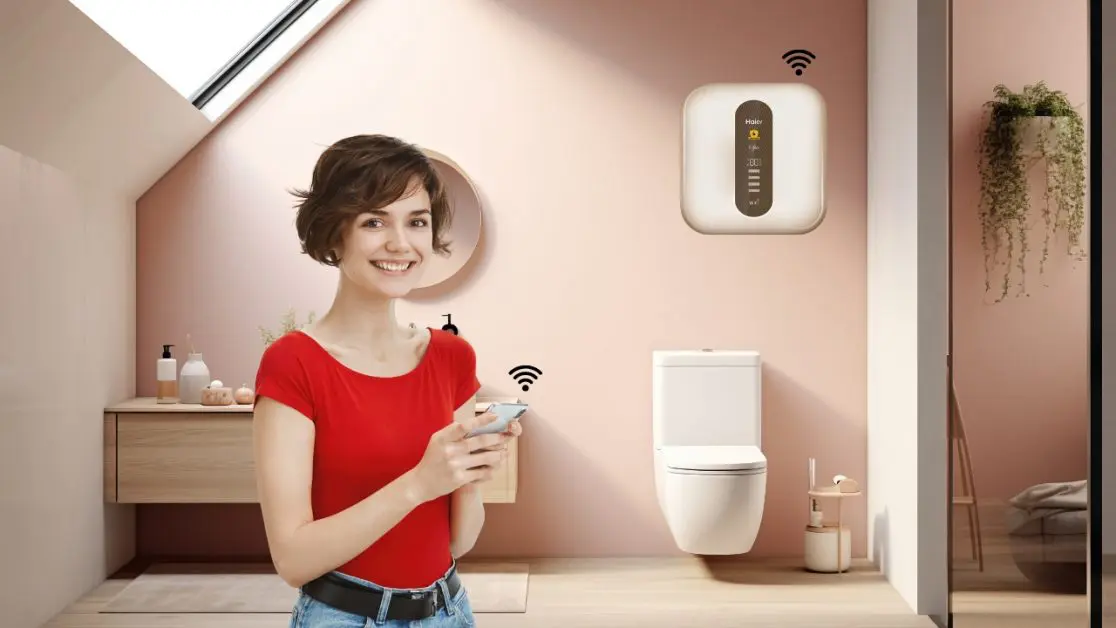
Some might ask: why WiFi for a water heater? Isn’t it overkill?
The answer lies in one word: integration.
We already use phones to manage lights, ACs, and TVs. A geyser is part of the same ecosystem. When your entire home responds to one device, your phone, the daily chaos starts to feel orchestrated.
And that orchestration is what makes a house feel like a smart home.
Haier’s take on the smart water heater
Haier’s 15L Smart WiFi Water Heater (ES15V-SD WIFI) blends these features into a compact form:
- 5-star energy rating for efficiency.
- Remote control and LED display for clarity.
- Shock proof, dual thermal cut-off, and over-pressure safety.
- Anti-bacterial mode with 80°C sterilisation.
- Long-lasting incoloy 800 SS heating element.
- Champagne gold finish that looks at home in a modern bathroom.
It’s not just about adding WiFi. It’s about embedding intelligence and reliability into something as everyday as a morning bath.
The bigger picture: why this matters now
Indian households are changing. Nuclear families, busy work schedules, rising energy bills every small decision adds up to how we live.
A smart WiFi water heater might look like a minor upgrade, but it’s part of a larger shift: homes becoming adaptive ecosystems rather than static spaces.
We no longer just buy appliances. We buy peace of mind, time saved, and routines simplified.
Final thought
Smart WiFi water heaters are not about luxury. They’re about making the unseen parts of daily life smoother.
When your bathroom, the most chaotic space in the house, runs on predictability and safety everything else feels a little easier.
That’s the real difference. And once you experience it, you wonder how you ever lived without it.