
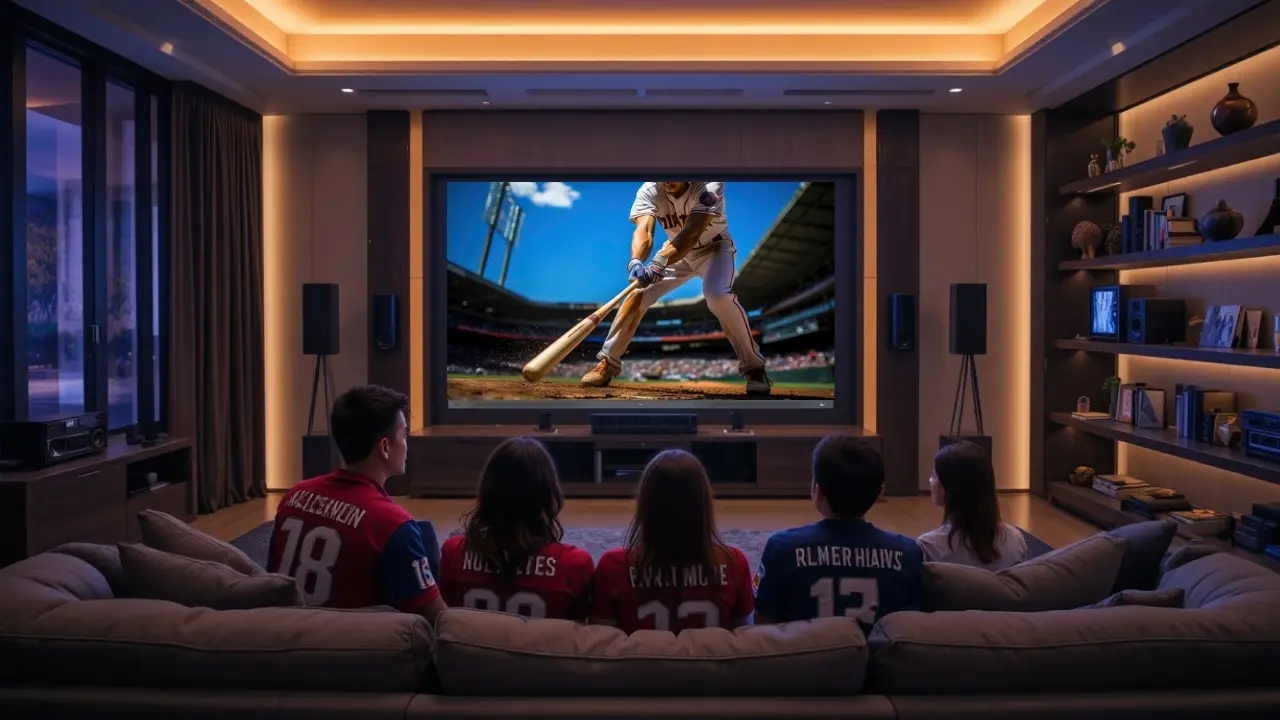

Big screens win because they change how the brain experiences motion, scale, and emotion.
In sports, they restore the sense of being inside the stadium.
In movies, they turn passive watching into shared immersion.
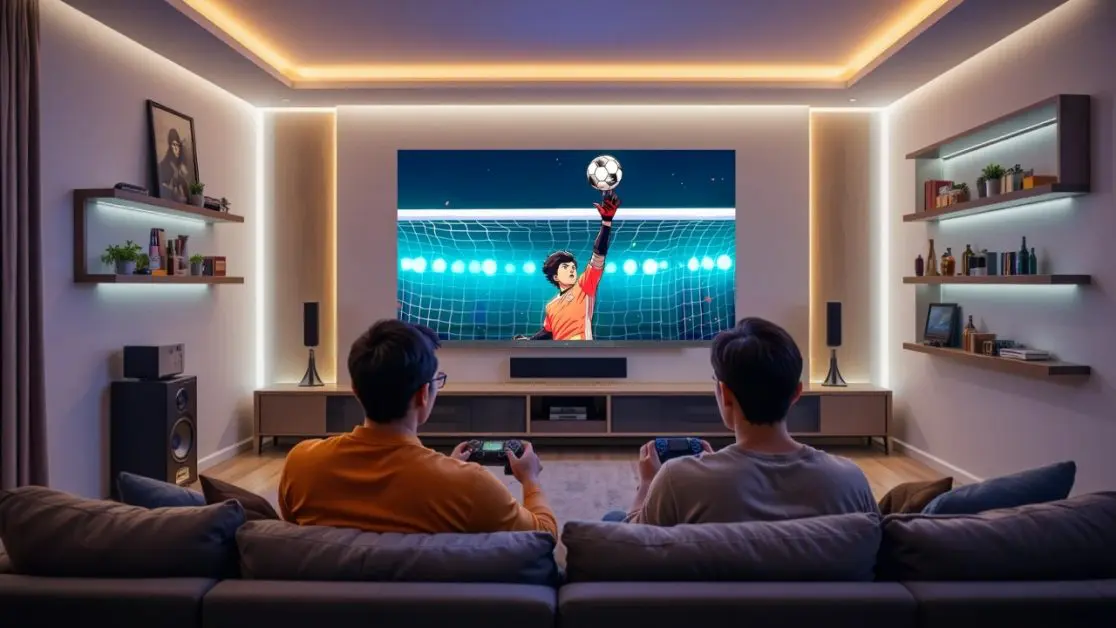
In gaming, they give players spatial awareness that smaller screens simply cannot deliver.
This is not about luxury.
It is about how humans process stories, speed, and spectacle at home.
It usually starts with a familiar scene
It is a weekday evening.
Dinner plates are still warm.
One person scrolls on their phone.
Someone else switches on the TV “just to check the score.”
The match is under floodlights now.
The ball moves faster.
The crowd noise swells.
And suddenly, the screen feels… small.
Not broken.
Just limited.
That moment explains everything.
Big screens do not add content.
They restore proportion.
Why size changes experience, not just visuals
A larger screen does something subtle but powerful.
It fills more of your field of vision.
Once that happens, your brain stops treating what you see as background information and starts treating it as environment. This is a known effect in visual cognition and cinema design.
In simple terms:
- Small screens encourage checking
- Big screens encourage staying
And staying is where emotion builds.
The living room has quietly become a stadium
Indian homes have changed.
Matches are no longer watched alone.
They are group events again.
Cricket nights.
Football finals.
Last overs with chai refills.
On a big screen, sports regain three things smaller TVs lose.
1. Peripheral action
On large displays, you notice off-ball movement, field placements, and crowd reactions without effort. This mirrors how we watch live sport.
2. Motion clarity
Fast sports demand high refresh rates. A bigger panel makes motion flaws more visible, which is why smoother refresh matters more as screen size increases.
3. Collective energy
A screen that dominates the wall invites people to sit together instead of multitasking apart.
Big screens do not make sports louder.
They make them communal again.
Movies were never meant to be watched small

Cinema was designed around scale.
Wide frames.
Long shots.
Silent pauses.
Shrink the screen, and something breaks.
Not the image.
The intention.
Why movies feel “better” on big screens
It is not just resolution. It is composition.
Directors frame scenes assuming a certain visual width. On a large screen:
- Faces carry emotion without exaggeration
- Landscapes feel expansive instead of decorative
- Dark scenes retain depth instead of flattening
This is why people describe big screen movie nights as “theatre-like,” even without perfect sound or lighting.
The screen does most of the work.
A quiet upgrade families do not talk about enough
Parents often mention one unexpected benefit.
Less distraction.
When the screen is large and comfortable to watch:
- Kids stop leaning forward
- Eyes strain less
- People look up instead of down
A single big screen often replaces multiple small ones running at the same time.
Fewer devices.
One shared experience.
That is not nostalgia.
That is design influencing behaviour.
Gaming changes completely when scale enters the picture

Ask anyone who has shifted from a small monitor to a large TV for gaming.
The reaction is always the same.
“I did not know what I was missing.”
Why gamers prefer bigger screens
1. Spatial awareness
Racing games, open-world titles, and sports games benefit massively from a wider field of view.
You react faster because you see more.
2. Motion stability
Higher refresh rates matter more as screens grow. Big panels expose blur instantly, which is why gaming-focused TVs now prioritise refresh and latency.
3. Comfort over time
Long gaming sessions on larger screens reduce the need to hunch forward. Posture improves. Fatigue drops.
Gaming becomes sustainable, not just exciting.
The hidden system at work
Here is the pattern most people miss.
As screens get bigger, processing quality matters more than resolution.
A large screen magnifies everything.
- Good motion looks incredible
- Poor motion looks terrible
- Smart optimisation becomes essential
This is why modern big TVs lean heavily on AI-driven processing that adjusts picture, sound, and motion scene by scene.
Not to impress.
But to stabilize the scale.
Where big screens fit into modern Indian homes
Space is always the concern.
But the reality is simpler than most assume.
One option is wall mounting as a design anchor
A large TV replaces artwork, cabinets, and clutter. Minimalism follows.
The second option is treating it as a flexible zone
Living rooms now double as movie rooms, match rooms, and gaming zones.
The third option is choosing fewer but better devices
One big screen replaces multiple smaller displays across rooms.
Big screens often reduce visual noise instead of increasing it.
Why smart features matter more at larger sizes
Once screens cross a certain size, manual adjustment becomes tiring.
This is where intelligent features quietly improve daily life.
- Automatic brightness adjustment for day and night
- Scene-based tuning for sports, films, and games
- Audio optimisation that matches room size
These are not luxury extras.
They are fatigue reducers.
A well-tuned big screen disappears into the experience.
A real example from current big-screen design
Take Haier’s large-format TVs, such as the M96 Series 254 cm (100) QD Mini LED models.
What stands out is not just size, but balance.
- High refresh rates designed for live sports and gaming
- AI-based picture processing that adapts scene by scene
- Low-reflection panels that hold contrast even in bright rooms
- Integrated sound systems tuned for scale rather than volume
These design choices exist because large screens expose weakness quickly.
They reward systems that think holistically.
Details referenced from product specifications highlight how large-screen engineering prioritises processing, motion, and comfort alongside size
The cost question everyone asks
Big screens look expensive.
But value behaves differently over time.
Initial cost
Yes, higher than small TVs.
Daily cost
Lower than expected when one screen replaces multiple devices.
Emotional return
Shared experiences last longer than individual consumption.
This is not an upgrade you feel once.
It compounds nightly.
Why big screens keep winning across use cases
Sports.
Movies.
Gaming.
These are different activities, but they share one requirement.
Immersion without effort.
Big screens deliver that by aligning with how humans naturally see and feel.
Small screens ask you to lean in.
Big screens invite you to settle back.
The quiet truth
The screen is no longer just a display.
It is a gathering point.
A decompression tool.
A shared pause at the end of busy days.
In homes juggling work calls, study hours, and endless notifications, big screens create something rare.
Undivided attention.
What this means going forward
As homes get smarter, screens will not compete with life.
They will support it.
- Fewer interruptions
- More shared moments
- Better use of space and time
The biggest upgrade is not the inches on the wall.
It is the way people stay longer, talk more, and look up together.
Big screens win because they do not just show content.
They restore presence.