
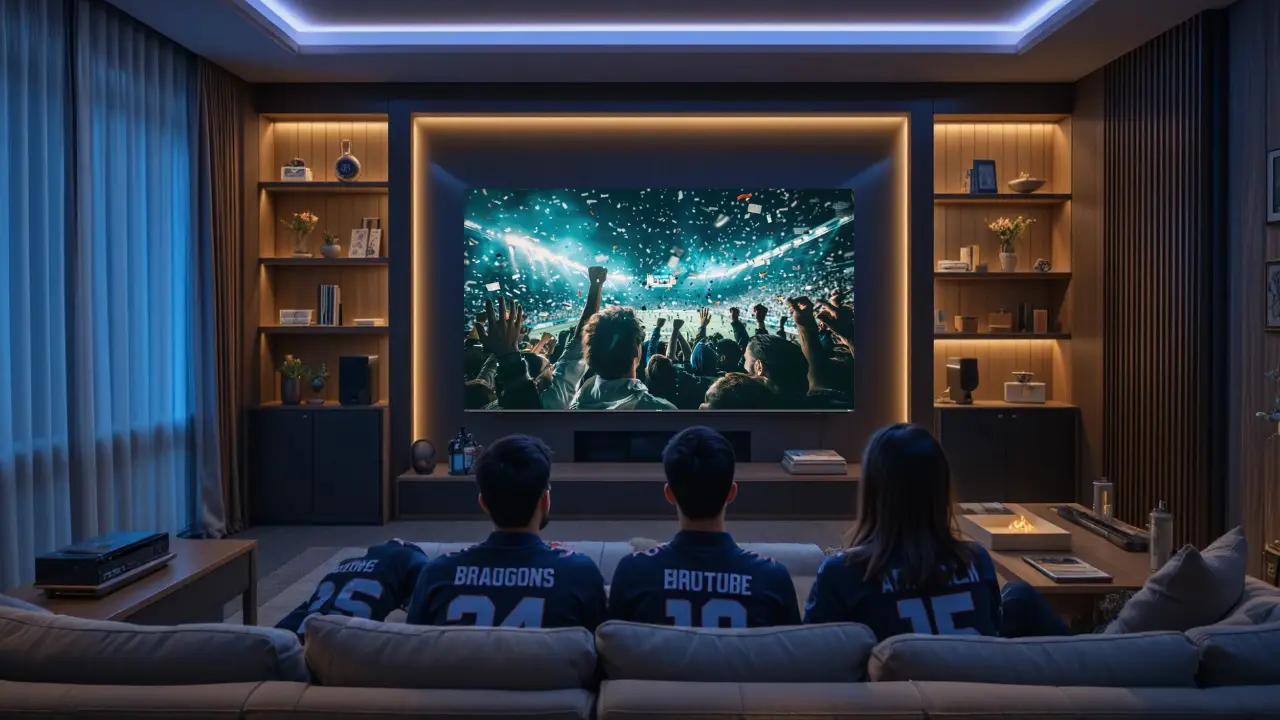

Stadium-style sports viewing at home is no longer about screen size alone.
It is about scale, clarity, sound, and intelligence working together so the match feels alive in your living room. When the picture adapts to light, motion stays smooth, and sound surrounds you, the distance between the stadium and your sofa quietly disappears.
That is the short answer.
The longer story lives inside Indian homes on match nights.
It always starts with a familiar scene
It is a Sunday evening.
Dinner is pushed slightly earlier. The coffee table is cleared. Phone chargers appear near the sofa. Someone asks, “What time is the toss?”
In stadiums, the atmosphere is built into the space. At home, we build it ourselves.
This is where stadium-style sports viewing really begins. Not with technology. With intent.
You are not just watching a game.
You are hosting an experience.
Why live sports feel different from movies or shows

Sports are unpredictable by nature.
A camera cuts from a wide aerial shot to a close-up sprint. Daylight turns into floodlights. Silence breaks into sudden noise. Motion never pauses.
Most screens were designed for linear content. Sports punish those assumptions.
Here is what live sports demand simultaneously:
- High motion clarity so fast plays do not blur
- Consistent brightness across changing light conditions
- Large-scale visuals so the field feels expansive
- Directional sound so commentary, crowd noise, and impact feel layered
When any one of these breaks, the illusion collapses.
Stadium-style viewing is really about keeping the illusion intact.
The hidden system behind great sports viewing
People often assume better sports viewing comes from turning settings up.
More brightness. More contrast. Louder sound.
That approach misses the system at work.
Stadium experiences are immersive because they adapt in real time. The environment responds faster than the audience can think.
At home, the same principle applies.
The best sports setups reduce decision-making. They sense. They adjust. They stay invisible.
Good technology gives control.
Great technology takes responsibility.
What actually makes sports feel stadium-like at home
1. Scale that changes perception
A large screen does not just show more. It changes how your brain reads distance.
On a smaller TV, the game feels framed. On a truly large display, it feels surrounded.
This is why bigger screens consistently score higher for sports satisfaction. Viewers stop scanning. They start absorbing.
The field feels like a place, not a picture.
2. Motion that keeps its promise
Live sports expose weak refresh rates instantly.
A high refresh rate keeps fast action intact. Every sprint, every swing, every sudden turn remains readable.
Smooth motion is not a feature. It is a trust signal.
If motion breaks, immersion breaks.
3. Brightness that survives real homes
Indian living rooms are rarely pitch dark.
Curtains are half drawn. Kitchen lights stay on. Afternoon matches spill sunlight across walls.
Screens that adapt to ambient light preserve contrast without washing out detail. This matters more than peak brightness numbers.
Consistency beats intensity.
4. Sound that places you inside the crowd
Stadiums are not loud in one direction. They are layered.
Commentary stays clear. Crowd noise wraps around. Impact sounds land with weight.
Multi-channel audio with proper tuning recreates this spatial feel. You do not just hear the game. You sit inside it.
A quick comparison that clarifies the difference
| Viewing Element | Regular TV Setup | Stadium-Style Home Setup |
| Screen size | Adequate | Expansive and immersive |
| Motion handling | Acceptable | Smooth under pressure |
| Brightness control | Fixed | Adapts to room light |
| Sound | Front-facing | Multi-directional |
| User effort | Constant adjustments | Minimal thinking |
This is the real upgrade.
Less effort. More presence.
Why AI quietly changes sports viewing forever
The biggest shift in home sports viewing is not hardware. It is intelligence.
Modern TVs increasingly understand context.
They recognise sports content. They track motion density. They adjust the picture and sound dynamically.
Instead of asking viewers to tune settings for every match, the system tunes itself.
This is where technologies like AI-based picture processing and ambient-aware tuning matter.
For example, the Haier M96 QD Mini LED TV integrates AI-driven visual and audio processing with a 144Hz refresh rate, Dolby Vision IQ, and a 6.2.2 channel Speaker sound system.
Together, these elements allow the TV to adapt automatically as lighting, motion, and scene intensity change during live sports
The important part is not the specification list.
It is the absence of friction.
The Indian living room factor
Indian homes are multi-purpose by default.
The same space hosts:
- Afternoon matches
- Evening family conversations
- Late-night highlights
- Kids walking in and out
- Snacks, tea, and interruptions
Stadium-style viewing must survive real life.
This is why adaptive picture modes, energy-conscious performance, and voice-based controls matter more here than in controlled demo rooms.
Technology that respects chaos wins.
Three ways households approach sports viewing today
One option is tolerance
You watch on whatever screen you have. You adjust mentally.
It works. But it never feels special.
The second option is enhancement
You add speakers. You tweak settings. You dim lights.
The experience improves, but effort remains constant.
The third option is integration
Screen, sound, and intelligence work together automatically.
This is where stadium-style viewing becomes repeatable.
The cost is higher upfront. The mental load is lower every match after.
What parents, couples, and solo viewers all want
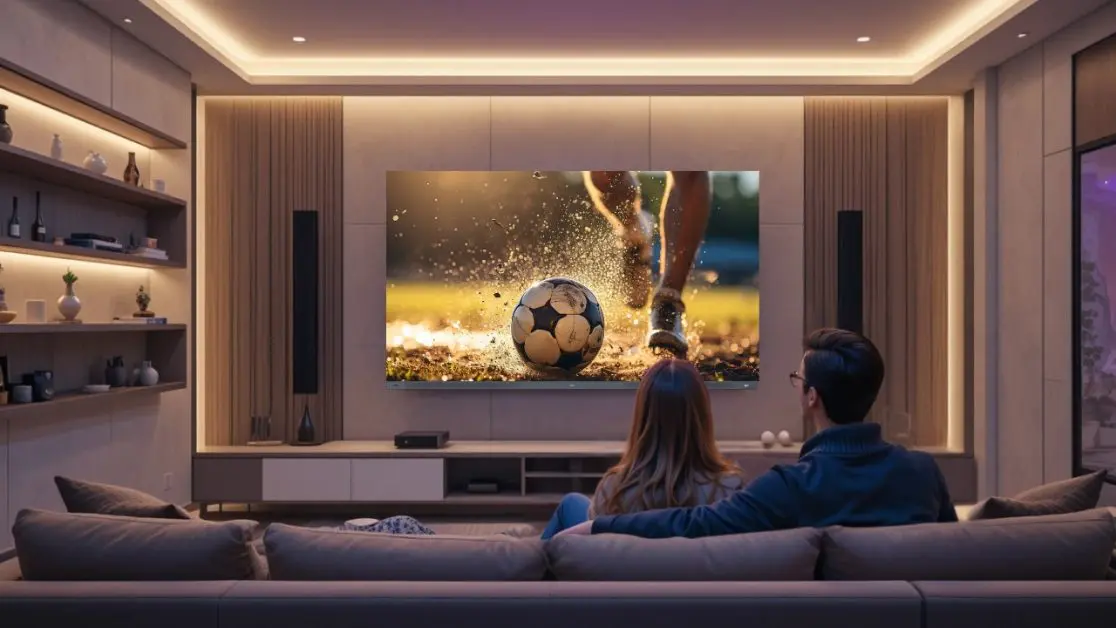
Different households. Same underlying desire.
Parents want clarity without volume wars.
Couples want shared experiences without setup stress.
Solo viewers want immersion without complication.
The common thread is ease.
Great sports viewing is generous.
It gives more while asking less.
Why bigger screens feel like fewer distractions
This sounds counterintuitive.
But large, immersive screens actually reduce phone usage during matches.
When the visual field fills your attention, there is less urge to scroll. Less need to multitask.
Presence increases.
This is not about discipline. It is about design.
Sound matters more than people admit
Most people upgrade screens first. Sound comes later.
In stadiums, sound arrives first.
Crowd noise signals momentum. Commentary anchors understanding. Impact sounds create emotion.
Multi-channel sound with spatial tuning changes how long people stay engaged.
It keeps the room alive even when eyes wander briefly.
Energy awareness is part of modern viewing
Stadium-scale experiences do not have to mean waste.
Smarter displays manage power efficiently during long matches. AI-based systems balance brightness and performance instead of running at full load constantly.
This matters in India, where matches can stretch for hours and energy consciousness is rising.
Comfort now includes conscience.
The real takeaway most people miss
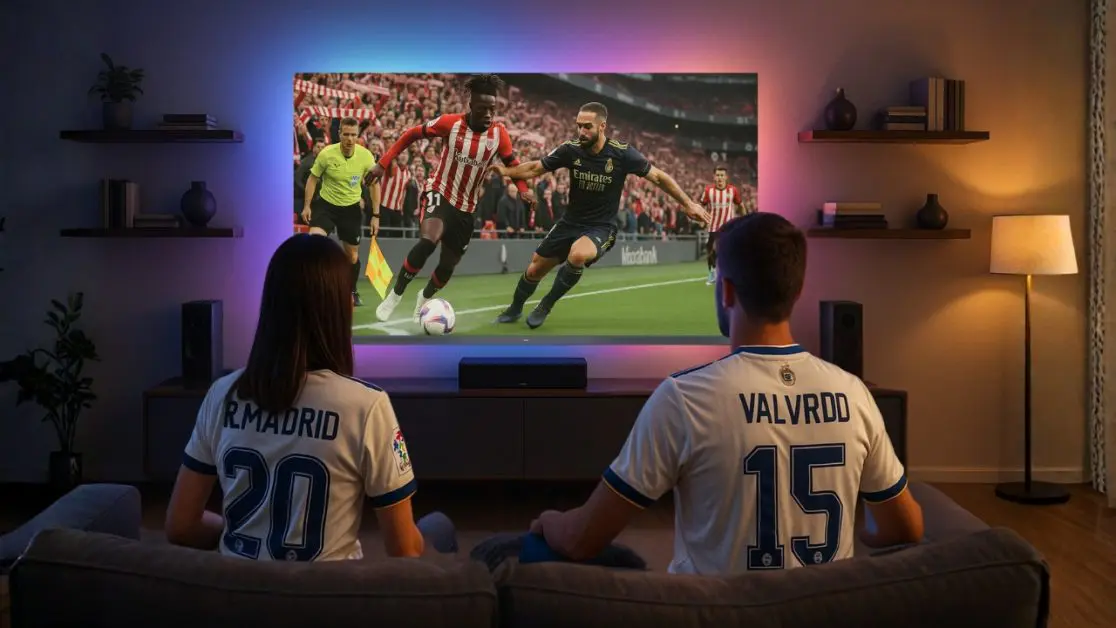
Stadium-style sports viewing is not about recreating a stadium.
It is about recreating how the stadium makes you feel.
Present. Invested. Carried by the moment.
Technology works best when it fades into the background and lets emotion lead.
What this shift means for how homes evolve
Living rooms are no longer passive spaces.
They are becoming experience hubs. Not just for entertainment, but for connection.
Sports nights bring families together. Friends gather. Conversations pause. Cheers erupt.
When the experience works effortlessly, people remember the moment, not the device.
That is the future of home technology.
A final thought worth keeping
You do not upgrade screens to watch sports better.
You upgrade them to feel less distant from moments that matter.
When the pass feels faster, the cheer feels closer, and the silence before impact feels heavier, the stadium is already home.
Everything else is just hardware.
Frequently Asked Questions
Why do I keep adjusting brightness and sound every time I watch a live match?
Live sports constantly shift lighting and motion. If your TV doesn’t auto-adapt, you end up manually correcting settings as scenes change.
I just want to sit down and enjoy the game. Why does my TV make me think so much?
Many setups require active tuning. Stadium-style systems reduce decision-making by automatically adjusting picture and sound in real time.
Do I really need to tweak settings for every match, or should my TV just handle it?
Ideally, it should handle it. AI-based picture and audio processing can detect sports content and optimize performance automatically.
I’m tired of arguing over volume at home. Is there a way to make commentary clear without blasting the sound?
Yes. Multi-channel audio systems separate dialogue from crowd noise, reducing the need for constant volume battles.
My living room has sunlight during afternoon matches. Why does the screen look washed out?
TVs without ambient light adaptation struggle in bright environments. AI-driven brightness control preserves contrast even with sunlight.
I can’t darken my room like a home theatre. Does that mean I can’t get immersive sports viewing?
Not at all. Stadium-style viewing depends on adaptive brightness, not just peak brightness.
Kids walk in and out, lights are on, snacks are everywhere does that ruin the experience?
A smart, adaptive system is built for real-life chaos. It adjusts dynamically without requiring perfect viewing conditions.
Does energy usage spike during long IPL or football matches?
Smarter displays balance brightness and performance using AI instead of running at full power continuously.