


Modern refrigerators with convertible sections let you switch between freezer and fridge modes through a simple temperature toggle.
You choose the mode, set the temperature, wait for the chamber to stabilize, and restructure your storage accordingly. Models like Haier’s Lumiere Series even allow up to convertible space to adapt during festivals, batch cooking, weddings, and weekly routines.
Everything else in this article explains why this small feature solves a big modern problem.
Why the ability to switch modes matters more than we think
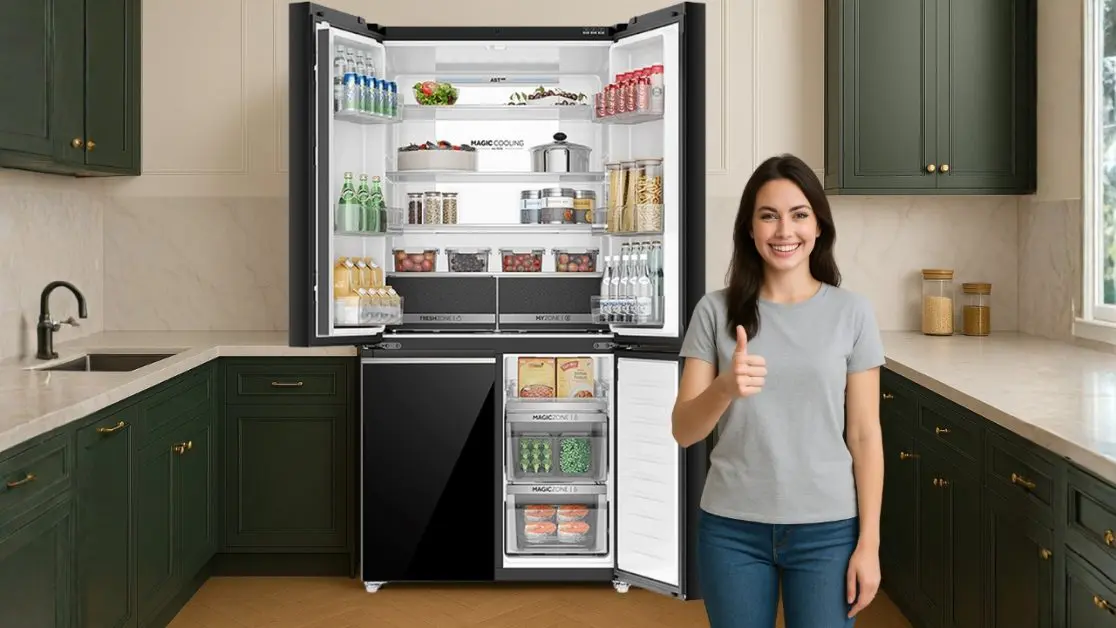
A refrigerator looks like a storage box. Until life happens.
A cousin arrives from Bengaluru with homemade masala packets.
Your weekly chicken prep expands from two kilos to five.
Or winter wedding season hits, and suddenly there are five extra bowls of gajar ka halwa that need chilling.
Storage is rarely static. Yet most fridges were designed as if life were predictable.
Convertible modes change this equation. They give the freezer the power to behave like a fridge. Or the fridge has the power to step aside when you need more freezer space. And this shifts how a home functions.
The real story is not the mode switch.
The real story is flexibility.
What switching between freezer and fridge modes actually does
At the simplest level, it changes temperature ranges.
A freezer is built for a deep cold. A fridge is built for steady chill.
But the hidden system underneath is more interesting.
When you convert a freezer to a fridge, you are:
- Reducing the temperature load
- Increasing usable space
- Slowing energy consumption
- Extending freshness instead of freezing it
When you convert a fridge space into a freezer, you are:
- Expanding long term storage
- Preparing for festival months
- Making room for bulk meat or ice cream
- Giving your weekly cooking rhythm more breathing space
Most homes don’t think in these terms. Yet switching modes is less about temperature and more about rebalancing how a home lives.
Aphorism worth remembering:
Space is not just physical. It is emotional clarity disguised as storage.
How convertible zones work inside modern refrigerators

Every refrigerator follows a similar principle.
A cooling system pushes cold air. Sensors regulate flow.
Convertible sections change how these sensors behave.
But engineering becomes more intuitive with examples.
Example 1: The wedding week fridge
You convert the freezer to a fridge because:
- You are storing sweets, milk packets, fresh vegetables
- You need short term cooling, not deep freezing
- You want your fridge to feel like a pantry, not a puzzle
Example 2: The monthly stocking fridge
You convert one half of the fridge to a freezer because:
- You bought bulk chicken
- Milk and vegetables are minimal this week
- Long-term storage matters more than daily grab-and-go convenience
Example 3: The long weekend fridge
A road trip is coming.
You cook ahead.
Your freezer expands to hold parathas, cut vegetables, and frozen gravy bases.
Patterns repeat across households.
Convertible modes simply recognise them.
How to switch between freezer and fridge modes the right way
Here is the answer you came for.
But now with the depth it deserves.
Step 1: Empty or reorganise the section
A freezer turned into a fridge warms up.
A fridge turned into a freezer becomes colder.
Both require one small discipline: remove or reposition items.
Freezer to fridge conversion needs you to:
- Remove ice creams or frozen meat
- Shift delicate items to another shelf
- Allow airflow for fresh mode to stabilise
Fridge to freezer conversion needs you to:
- Clear fruits, dairy, and greens
- Replace with freezer-suitable containers
- Keep items spaced apart initially for airflow
Step 2: Activate the mode from the control panel

Modern refrigerators simplify this to a tap.
For example, the Haier 630L Lumiere Series has a dynamic panel that lets you set different temperature modes for each section with clarity and precision.
On most convertible systems, you are choosing from:
- Freezer mode
- Fridge mode
- Soft freeze
- Chill mode
- Deep freeze
The real benefit is predictability. You know exactly what temperature each section is moving toward.
Step 3: Allow 1 to 3 hours for the conversion
A freezer becoming a fridge is like a room shifting from winter to early morning chill.
It cannot happen instantly.
Sensors calibrate.
Airflow adjusts.
Temperature stabilises.
You know the shift is complete when:
- The walls stop feeling extremely cold
- Items no longer frost
- The panel shows a stable temperature
Step 4: Store items based on the new mode
Here is where most Indian households get it wrong.
A fridge converted from a freezer behaves differently.
Its airflow can be slightly sharper.
Its cooling pattern is more directional.
The fix is simple.
Fridge mode (converted):
- Keep vegetables in baskets
- Place milk and dairy on central shelves
- Use airtight boxes
- Avoid keeping delicate herbs near the back panel
Freezer mode (converted):
- Use freezer safe containers
- Avoid glass with tight lids
- Stack lightweight items near the top
- Keep meats or bulk items at the bottom for stable temperature
A small structural rearrangement leads to better efficiency.
Why Indian homes need convertible systems more than ever
India is a country of seasons, festivals, sudden guests, and unpredictable grocery habits.
Storage is not linear.
The problem is not food.
The problem is fluctuation.
Convertible sections solve the real pain point.
1. The festive spike scenario
From Diwali to Christmas to Pongal, refrigerator usage jumps.
A 103 litre flexible zone, like the one in Haier’s Lumiere Series, becomes a lifesaver during these stretches.
You can switch that space into a fridge for sweets and fresh dishes.
Or into a freezer for bulk ice cream or prepped dishes.
2. The batch cooking weekend
Working professionals cook in batches.
Lunch boxes are planned.
Dal, sabzi, chicken curry, chapati dough, all occupy space.
A convertible freezer gives you room to pre-chill containers without cramming your main shelves.
3. The winter low consumption phase
In winter, vegetables last longer.
Groceries reduce.
You don’t need a full fridge.
Turning one section into a freezer optimises energy usage.
Lumiere’s Smart Sense AI even adjusts temperature based on habits.
4. The summer season of cold drinks and fruits
Peak summer inflates fridge occupancy.
More water bottles.
More fruit bowls.
More ready to eat packs.
Converting the freezer into a fridge creates comfortable breathing space.
5. The expanded family phase
Parents visiting.
Children back from hostel.
Friends staying over.
Storage expands overnight.
Convertible flexibility absorbs the chaos without stress.
The hidden system: mode switching is not technology, it is strategy
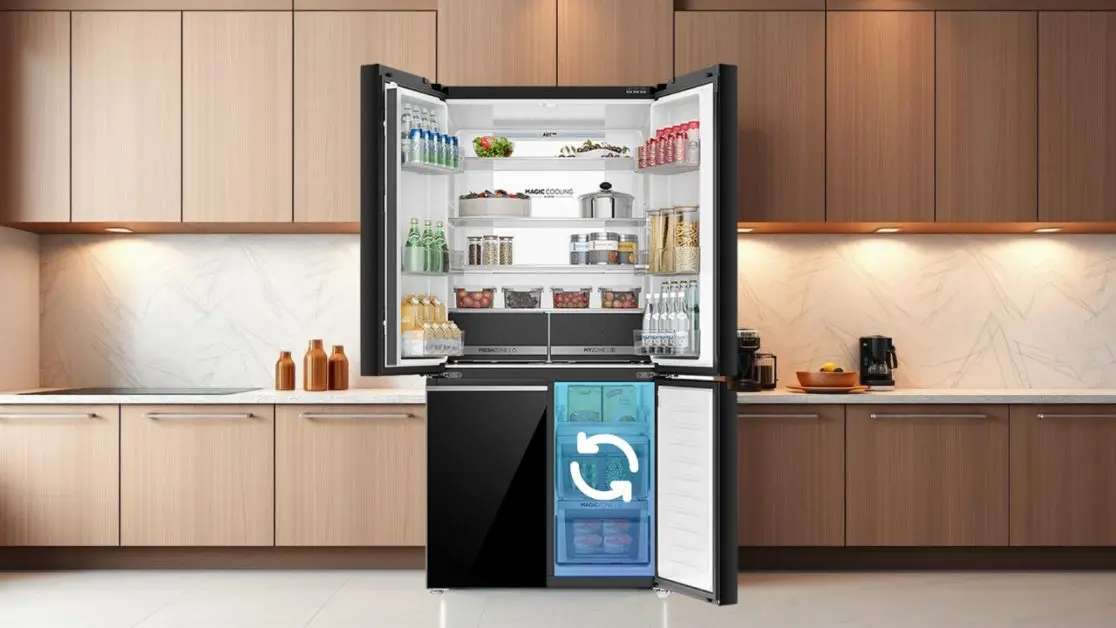
A refrigerator is an appliance.
A convertible refrigerator is a strategy.
It lets you:
- Align cooling with lifestyle
- Reduce waste
- Optimise energy
- Prevent clutter
- Expand or shrink capacity on your terms
A freezer is not a freezer.
A fridge is not a fridge.
Both are simply spaces waiting to be assigned a purpose.
This is the insight most people miss.
The real innovation is not the sensors or the panel.
The real innovation is adaptability.
Table: When to use which mode
| Household situation | Best mode to switch to | Why it works |
| Festival food overload | Freezer to fridge | More space for short term storage |
| Bulk meat purchase | Fridge to freezer | Longer preservation and organised stacking |
| Weekly meal prep | Expand freezer | Better for semi cooked preps |
| Guests at home | Freezer to fridge | More beverage and dairy space |
| Summer drinks season | Convert freezer to fridge | More cooling space for large bottles |
| Minimal winter groceries | Shrink fridge space | Lower energy use and fewer empty shelves |
How the Haier Lumiere Series makes this easier
Mentioning the product makes sense here because it embodies the convertibility this article explains.
The 630L Lumiere Series refrigerator offers:
- A massive 528 litre fresh food space
- A flexible 103 litre convertible zone
- Up to convertible space across compartments
- A dynamic display that lets you set temperature modes instantly
- Smart Sense AI for energy saving based on usage patterns
- ABT Pro technology for purity and odour control
- Motion sensor display and 360 degree cooling for even temperature
These features matter because they reflect a larger idea.
Technology is useful only when it blends into life.
Most modern homes require refrigerators that expand and contract like living things.
The Lumiere Series simply aligns with how Indian families actually live and cook.
What this teaches us about modern living
A refrigerator is a mirror of daily habits.
How we store things reveals how we plan, adapt, and prepare for our days.
Three truths emerge.
1. Flexibility beats capacity
A large fridge is helpful.
A flexible fridge is life changing.
2. Organisation is a form of self care
When your fridge feels sorted, your day feels sorted.
3. Purposeful storage reduces stress
Clutter is not a storage problem.
It is a clarity problem.
Convertible modes remove the friction between what you want and what fits.
Final insight: Appliances shape behaviour more than settings
The real gift of switching between freezer and fridge modes is not the extra space.
It is the quiet sense of control it brings.
Life changes.
Seasons shift.
Families evolve.
Your refrigerator should keep up.
Not the other way around.
Convertibility is not about cooling.
It is about choosing how you want your home to function today, this week, and this season.
That choice is powerful.