

Late night movie quality depends less on how loud your TV can go and more on how precisely it can deliver dialogue, detail and spatial cues at low volumes. A good audio output keeps the house asleep and keeps the story alive.
Because sound is the part of cinema we only notice when it breaks.
Do late night movies feel different because of the hour or because of the audio?
Every home in India has its own version of the late night movie ritual.
The kids are asleep. The building is quiet. The last pressure cooker whistle of the day has passed.
And then the question arrives.
Is the movie going to sound clean at a low volume, or are we about to start the awkward dance of raise volume, drop volume, turn on subtitles, squint at the screen?
Late night viewing reveals something important.
Your TV’s audio is not just about volume.
It is about clarity at restraint.
Good audio whispers without losing meaning.
Cinema depends on details. Late night viewing exposes what your TV can or cannot deliver.
Think about how films are built.
A thriller depends on footsteps.
A rom-com depends on the softness of conversations.
A sci-fi film depends on atmospheric layers.
At daytime volumes, even an average speaker hides its flaws.
But late at night, the truth comes out.
This is the hidden system behind most movie frustration.
When the volume goes down, bad speakers compress sound.
Dialogue becomes muddy. Bass disappears. The atmosphere collapses.
And you feel it.
Not as a technical flaw, but as a broken mood.
Why clarity beats loudness during late night hours
Here is the late night paradox.
You want to hear everything.
But you cannot let everything be heard.
This is why clarity matters more than power.
A TV’s audio output determines how clearly it can reproduce:
- Human speech
- Low frequency ambience
- Instrument separation
- Spatial movement
- Background nuance
These are the layers that make cinema feel alive.
A well tuned speaker system replicates detail even at low volume.
A poorly tuned one loses depth. Movies feel flatter, smaller, thinner.
The principle is simple.
Volume measures loudness.
Audio output measures truth.
Dialogue intelligibility is the real late night test
Most families watch late night movies at 20 to 40 percent volume.
This is where many TVs struggle.
Why?
Because dialogue lives in a narrow frequency band that cheap speakers cannot reproduce cleanly at low levels.
The result is familiar.
You raise the volume to hear the dialogue.
Suddenly an action scene erupts and wakes the whole house.
Great audio prevents this.
For example, Haier’s Mini LED TVs with Sound by KEF tuned audio are designed specifically to preserve clarity and detail at controlled volumes. The 2.1 channel speakers and 50W output ensure richer mids and stable lows even when the sound is restrained.
This is not about loudness.
It is about maintaining shape in the sound.
The science: why low volume listening breaks cheap speakers
Sound behaves like photography.
When light is low, you need better sensors.
Similarly, when volume is low, you need better engineering.
Three issues affect late night listening:
1. Dynamic compression
Cheap audio compresses the dynamic range. Quiet parts become unclear. Loud parts become too sharp.
2. Poor frequency reproduction
Bass disappears. Treble becomes harsh. Mid-tones get lost.
3. Weak spatial imaging
Without proper separation, all sounds blend together.
Late night viewing is when you discover if your TV understands silence as well as it understands noise.
What does great audio output actually look like in everyday life?
Let us bring this back to real homes.
Scenario 1: Parents watching a series after the kids sleep
You want clean dialogue without raising the volume.
A good TV output gives crisp voice reproduction at low gain.
Scenario 2: A couple watching a movie in a small apartment
Thin walls. Sleeping neighbours.
Balanced speakers prevent sound leakage but keep detail intact.
Scenario 3: A working professional unwinding at 1 AM
Atmospheric soundtracks matter.
A well tuned TV keeps ambient layers alive even at modest settings.
Great audio output is not about showing off.
It is about respecting the hour.
The role of Dolby Atmos in late night storytelling
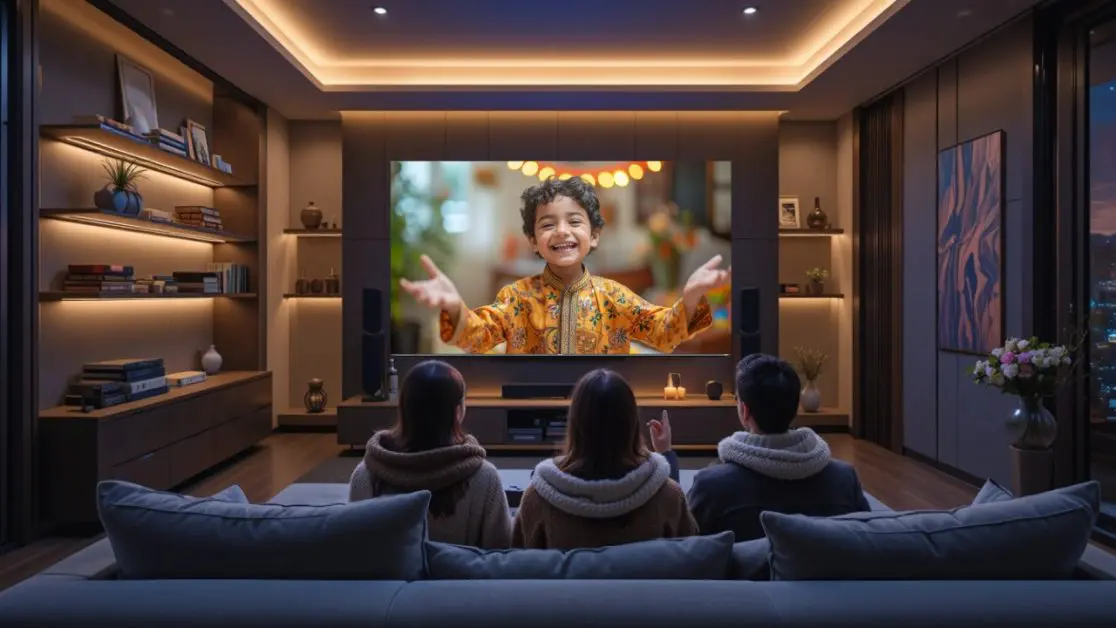
Dolby Atmos is often associated with power and immersion.
But its late night strength is precision.
It distributes sound across a 3D space which reduces the need for loudness.
You feel the world of the film without turning the dial up.
Atmos moves sound like a director moves the camera.
It gives intentions shape.
Haier’s Mini LED range integrates Dolby Atmos in its 55, 65, 75 and 215cm (85) models, ensuring spatial clarity that stays consistent even at restrained volume
This is the part of audio technology people underestimate.
Immersion without disturbance.
Why Sound by KEF-tuned systems matter even more at night
Sound by KEF is known internationally for acoustic engineering that prioritises purity and geometry of sound waves.
In the late night context, this becomes invaluable.
Sound by KEF tuning does three things:
- Ensures richer bass without boom
- Improves dialogue clarity in the mid-range
- Preserves spatial details and instrument separation
On Haier’s Mini LED TVs, Sound by KEF tuned sound gives a consistent, cleaner listening experience across all volume levels .
This means you hear intention, not distortion.
Three types of TV viewers and the audio output they need
A systems thinking approach helps.
There are three typical late night viewing behaviours.
1. The Quiet Listener
Watch movies at minimal volume to avoid disturbing others.
Needs:
- High clarity at low levels
- Stable dialogue
- Controlled bass
2. The Balanced Listener
Keep volume moderate. I want detail without noise.
Needs:
- Wide frequency response
- Spatial imaging
- Clean mids
3. The Immersive Listener
Uses headphones at times but prefers TV speakers.
Needs:
- 2.1 channel depth
- Atmos layered audio
- Smooth transitions between scenes
Good audio output satisfies all three without compromise.
A quick comparison: what changes when audio output improves
| Experience | Low Quality Audio | High Quality Audio |
| Dialogue | Muffled, uneven | Clear and stable |
| Ambient Detail | Lost | Preserved |
| Bass | Boomy or absent | Tight and balanced |
| Volume Control | Constant adjustments | Set once, relax |
| Late Night Comfort | Stressful | Effortless |
A better TV does not just upgrade entertainment.
It upgrades peace of mind.
So what does this mean for Indian homes?
We are a country of night owls.
Students study late.
Parents unwind late.
Professionals return home late.
Couples find their quiet time late.
Late night viewing is not a rare moment.
It is a lifestyle pattern.
This is why audio output is not a technical detail.
It is a quality of life consideration.
A TV that respects silence while preserving detail fits naturally into Indian homes.
It adapts to real routines and real constraints.
And this is where thoughtfully engineered TVs like Haier’s Mini LED lineup feel relevant, not promotional.
They solve a lived problem.
They let you enjoy cinema without waking the world.
The hidden principle behind good audio
Good sound is not about making things louder.
It is about making moments clearer.
This is the aphorism at the heart of late night viewing.
Clarity is quiet confidence.
Loudness is misplaced strength.
Sound is not decoration.
It is architecture.
The better the structure, the more meaning stays intact.
Final thought: late night movies are a small joy. Your audio should protect it
A long day ends.
A quiet room waits.
A film begins.
The story deserves to reach you as it was intended, even at low volume.
Your family deserves uninterrupted sleep.
And you deserve immersion without guilt.
Audio output is not the first thing people think about when buying a TV.
But it is the thing they feel every night.
That is why it matters.