
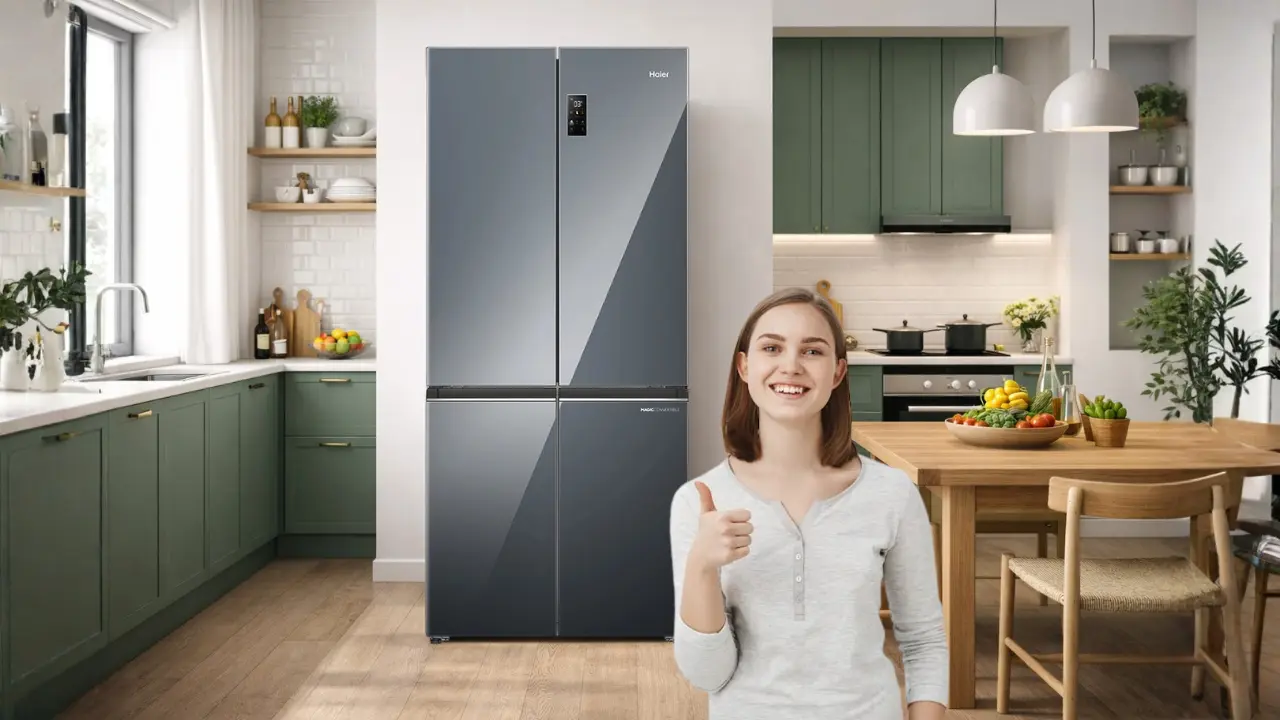

Wall-free design improves storage efficiency by removing rigid internal partitions and replacing them with flexible storage zones.
This creates uninterrupted space, better visibility, and layouts that adapt to real household usage.
In practical terms, it means less wasted space, fewer forgotten items, and storage that adjusts to festivals, families, and changing routines instead of forcing homes to adapt to the appliance.
The problem shows up the moment the fridge fills up.
Open your refrigerator on a normal weekday evening.
Not during Diwali.
Not after a monthly grocery haul.
Just a regular day.
You notice it immediately.
Tall bottles leaning awkwardly.
Leftovers stacked with care and hope.
Containers placed where they fit, not where they belong.
The fridge is big.
But it feels crowded.
This is not about capacity.
It is about how space is divided.
Most traditional refrigerators still rely on internal walls and fixed compartments. They assume food storage is predictable.
Indian homes prove otherwise every single week.
Why internal walls quietly waste space
Walls inside refrigerators appear organised.
They feel structured.
But they introduce three hidden problems.
1. They lock space into fixed roles
A freezer stays a freezer even when you need extra fridge space.
2. They reduce visibility
Food hides behind partitions and corners. Forgotten food turns into waste.
3. They create unusable gaps
Awkward spaces where containers never quite fit.
The irony is simple.
More litres do not guarantee more usable storage.
Efficiency comes from flexibility.
What wall-free design really means
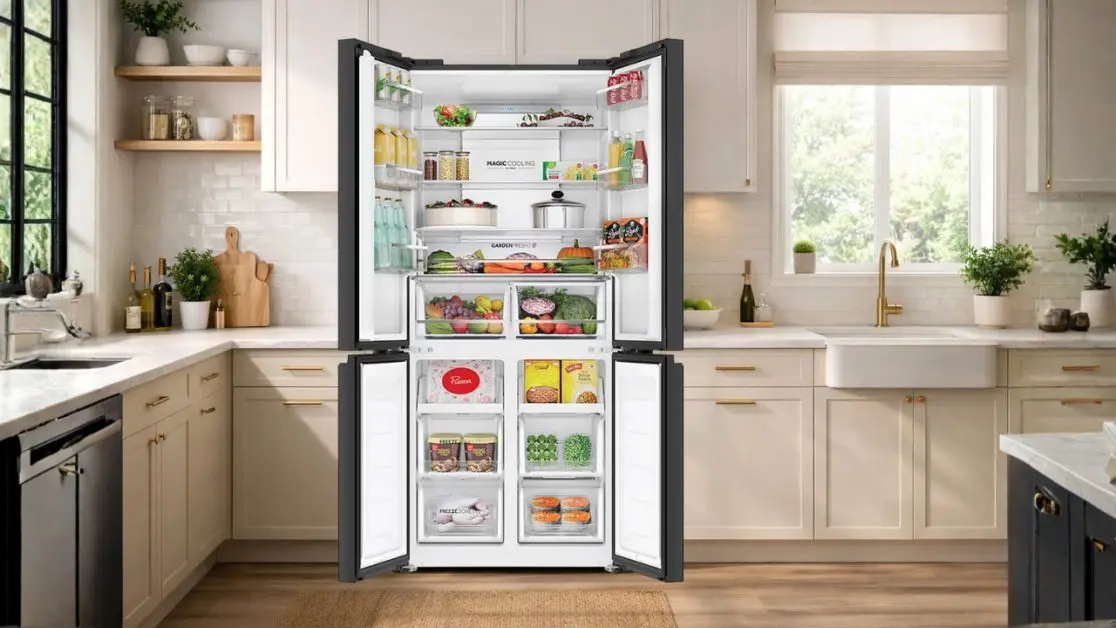
Wall-free design is not about removing order.
It is about replacing rigidity with intelligence.
Think of a well-designed wardrobe.
Adjustable shelves.
Open sections.
Spaces that change based on what you own today, not what the designer imagined years ago.
Wall-free refrigerator design follows the same logic.
Instead of fixed compartments, you get large uninterrupted zones that can be shaped around real storage needs.
How wall-free design improves storage efficiency in daily life
Let us look at this as a system, not a feature list.
1. Continuous space replaces fragmented compartments
When internal walls disappear, storage becomes fluid.
Large utensils fit without negotiation.
Big containers sit naturally.
Tall bottles finally stand upright.
You stop arranging food around the fridge design.
The fridge starts working around your food.
This matters in Indian kitchens where storage changes constantly.
Vegetables one week.
Leftovers the next.
Festival prep soon after.
One fixed layout cannot handle all three.
2. Better visibility reduces everyday food waste
Food waste rarely happens because people forget to cook.
It happens because they forget what exists.
Wall-free layouts improve sightlines.
You see more in one glance.
You remember what needs to be used.
When storage is visually clear, decisions become faster and waste reduces naturally.
Efficiency here is mental as much as physical.
3. Zones adapt when compartments cannot
A compartment dictates usage.
A zone adapts to it.
Zones stretch, shrink, and convert.
This is why convertible storage is becoming essential rather than optional.
You can turn freezer space into fridge space when guests arrive.
You can expand cooling during festive cooking weeks.
You can scale down during travel or low-usage periods.
No rearranging.
No compromise.
Why Indian households benefit the most
Indian kitchens are living systems.
They support working professionals, joint families, school routines, fasting days, festivals, and sudden guests.
No two weeks look the same.
Wall-free design supports this rhythm.
It works for:
- Weekly vegetable shopping
- Large vessels used during celebrations
- Bulk storage during family gatherings
- Light usage during travel periods
Rigid storage struggles in dynamic homes.
Flexible storage fits in quietly.
The connection between wall-free design and energy efficiency
This part often goes unnoticed.
Poor storage layout affects cooling performance.
Blocked airflow.
Overpacked corners.
Uneven temperature zones.
Wall-free interiors allow cold air to circulate evenly. Fewer obstructions mean stable temperatures and faster recovery after door openings.
This reduces compressor strain and unnecessary energy use over time.
Energy efficiency is not only about technology.
It is also about how air moves through space.
What wall-free design looks like in real products

Modern multi-door refrigerators bring this thinking into everyday homes.
Instead of one large fixed cavity, they use:
- Multiple doors to reduce cold air loss
- Convertible zones that change function
- Adjustable shelves that respond to storage needs
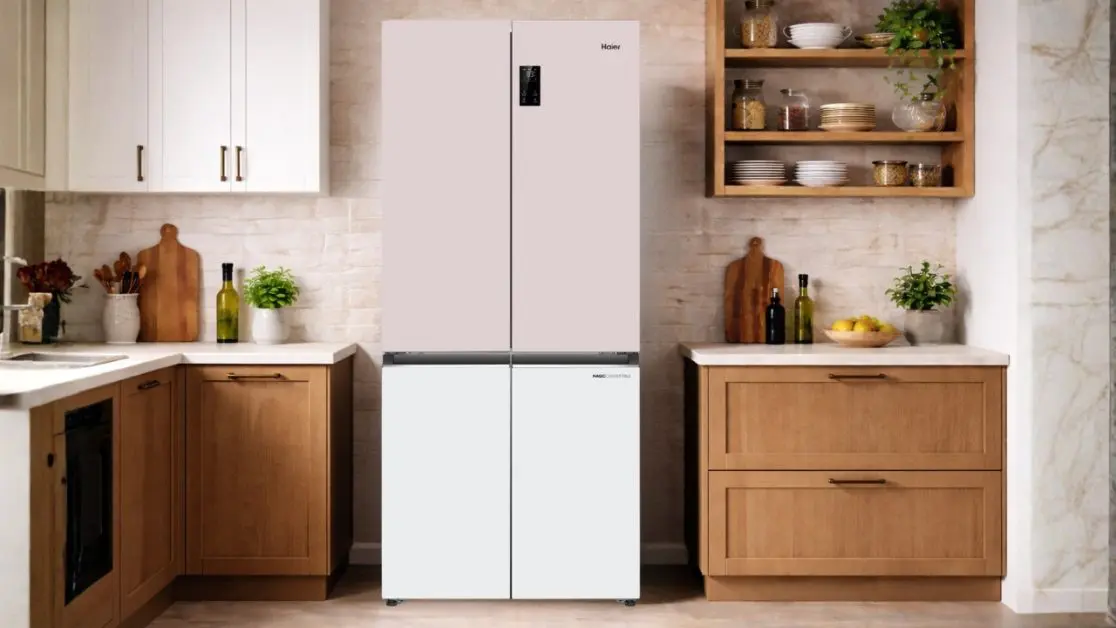
A strong example of this approach is the Haier Vogue Lumiere 520L 4 Door Convertible Refrigerator range, including models HRB-600MP (Mauve Pink), HRB-600PW (Pearl White), and HRB-600RW (Rosette White).
These refrigerators use a wall-free, zone-based interior with up to 85 percent convertible fridge space, allowing households to customize storage depending on how life looks that week.
The design does not ask users to plan.
It adapts quietly.
Three storage choices every home is making
Every household eventually falls into one of these patterns.
Option 1: Fixed storage
- Predictable layout
- Minimal flexibility
Cost: wasted space and daily frustration.
Option 2: Semi-flexible storage
- Adjustable shelves
- Limited conversion
Cost: partial efficiency with ongoing constraints.
Option 3: Wall-free, zone-based storage
- Convertible zones
- Open layouts
- High adaptability
Cost: slightly more thought in design.
Benefit: long-term ease and efficiency.
Modern homes naturally move toward the third option.
Why design philosophy matters more than features
Features change every year.
Design philosophy lasts far longer.
Wall-free design responds to how people live today.
Smaller homes.
Busier schedules.
More variety in storage needs.
Appliances that assume fixed behaviour fall behind.
Those that adapt stay relevant.
That is why thoughtful brands like Haier Appliances India invest in layout intelligence, not just capacity numbers.
A simple rule for judging storage efficiency
Here is a useful way to think about it.
If you need to pause and think before storing something, the design is already limiting you.
Good design stays out of the way.
Great design adjusts automatically.
Wall-free storage does not demand planning.
It absorbs reality.
What this means for future Indian homes
Homes are getting more compact.
Life inside them is getting fuller.
Storage systems built on rigid assumptions will create friction.
Flexible systems will quietly earn trust.
Wall-free design is not about removing walls.
It is about removing outdated thinking.
And when thinking changes, efficiency follows.
Not loudly.
But consistently.
That is how well-designed homes start feeling calmer, one small decision at a time.
Frequently Asked Questions
Why does my fridge feel full even when it has a large capacity?
Because capacity in litres doesn’t equal usable space. Fixed internal walls divide storage into rigid compartments, creating wasted gaps and awkward areas that don’t match real household storage needs.
Is the problem my fridge size or its design?
It’s almost always the design. Storage efficiency comes from flexibility and uninterrupted space, not just a higher litre number.
Can fridge design really reduce food waste?
Yes. Wall-free interiors improve sightlines so you can see more food at a glance, helping you remember what needs to be used.
Why don’t tall bottles and big utensils fit properly?
Internal walls and fixed shelf heights create unusable gaps. Wall-free zones allow tall and wide items to fit naturally.
What does “wall-free design” actually mean in a refrigerator?
It means removing rigid internal walls and replacing them with large, open, adaptable zones that can be reshaped based on current needs.
Why is convertible fridge space becoming important?
Because storage needs fluctuate. Convertible zones let you turn freezer space into fridge space or expand cooling when required.
Can wall-free design improve long-term energy efficiency?
Yes. Fewer obstructions mean faster temperature recovery after door openings and more stable cooling overall.
What kind of refrigerators use wall-free, zone-based design?
Modern multi-door refrigerators with convertible zones and adjustable shelves, such as the Haier Vogue Lumiere 520L 4 Door Convertible Refrigerator range from Haier Appliances India.