

Yes, a water heater can silently inflate winter electricity bills, especially when it heats inefficiently, reheats too often, or lacks insulation. The good part is that smarter water heating systems can reduce this power load dramatically.
Winter arrives with a simple ritual in Indian homes.
The first shiver in the morning.
The impatient call from the bathroom.
“Is the water hot yet?”
And that one small moment captures a bigger seasonal truth.
A water heater becomes the most used appliance in the house. The quiet workhorse that switches on before sunrise and again after sunset. The one appliance that affects every family member, every routine, every electric bill.
So the real question is not whether a water heater uses power.
The real question is whether it uses more power than it should.
This article explores that hidden system.
The habits, settings, and device behaviors that quietly increase winter electricity bills. And the smarter choices that reduce them without reducing comfort.
The Hidden Cost of Hot Water
Every Indian home has felt it.
November turns into December and the electricity bill starts climbing like the temperature inside a shower.
It feels normal. Expected. Seasonal.
But here is the overlooked pattern.
Electricity bills don’t rise only because winter is cold. They rise because most water heaters work harder than they need to.
A few examples from real homes show the pattern clearly.
- A family of four uses hot water across two bathrooms. The heater remains on standby all day.
- A young couple prefers long showers but forgets to switch off the water heater after bathing.
- A working professional turns on the heater, gets busy with chores, and ends up reheating the same tank thrice.
In every scenario, waste happens in small pockets.
Five minutes here. Twenty minutes there.
The cumulative result shows up on the bill.
Hot water is a comfort.
Reheating the same water repeatedly is a cost.
What Actually Drives Water Heater Electricity Consumption?
Most people blame the appliance.
The real issue is usually the system around it.
Here are the invisible forces that quietly raise power bills.
1. Frequent Reheating Cycles
When water cools down quickly, the heater starts again.
This cycle repeats throughout the day.
Why it happens:
- Poor insulation
- Low-grade heating elements
- Heat loss due to tank material
- Leaving the heater switched on for long durations
Energy impact:
A typical 15L to 25L heater can reheat 4 to 7 times a day in winter.
2. Inefficient Heating Elements
Older heating elements convert less electricity into heat.
They take longer.
They consume more.
According to multiple appliance engineers, stainless steel based Incoloy elements retain performance far longer than standard elements. The ES15V SD WiFi model from Haier uses an Incoloy 800 SS heating element for longer life and stable heating efficiency .
3. Poor Insulation
If heat escapes easily, electricity works overtime.
The uploaded file, the product diagram highlights PUF and EPS insulation designed to retain heat for long durations. This reduces reheating cycles and directly reduces power usage .
4. Wrong Temperature Settings
Most heaters run at maximum temperature by default.
That is unnecessary for daily use and increases reheating frequency.
5. Old or Damaged Tanks
A corroded tank loses heat faster.
A glass-lined tank performs significantly better.
The Haier model’s glass-lined tank improves durability and long-term heat retention, lowering electricity needs over time .
How to Know if Your Water Heater Is Wasting Power

A few signals offer clarity.
1. Your electricity bill spikes the moment winter begins
This usually means high reheating cycles inside the tank.
2. You wait too long for hot water
Slow heating often hints at an aging heating element.
3. The water cools down too fast
This points towards low insulation or mineral scaling.
4. You switch the heater on multiple times a day
A sign that your heater cannot hold temperatures long enough.
5. The tank runs out faster than expected
This can indicate sediment buildup or weak thermostat control.
How Smart Water Heating Changes the Equation
Hot water is non-negotiable in winter.
But high power bills don’t have to be.
Modern Indian homes have begun adopting smarter water heating systems because they change one important variable:
Control.
Not just ON or OFF.
But timing. Temperature. Memory. Protection. Circulation.
Smart water heaters replace guesswork with predictable, efficient heating.
What Makes a Water Heater Energy Efficient?
Energy-efficient water heating systems are built on five pillars.
1. Smart Scheduling
You heat water only when needed.
The ES15V SD WiFi model includes a Smart Timer and Smart Memory, highlighted in the specification. It learns your heating routines and optimises power usage automatically .
2. High-Quality Heating Elements
Incoloy 800 elements shorten heating time and reduce energy loss.
3. Strong Insulation
PUF insulation prevents heat loss for hours.
4. Better Temperature Controls
A dual-thermostat system avoids overheating and unnecessary reheating.
The Dual Thermal Proof (TTS) system shows how two sensors manage accurate temperature cutoff, which prevents electricity wastage due to overheating .
5. Tank Durability
Glass-lined tanks resist corrosion, slowing down heat loss over years.
Three Real-World Scenarios That Reveal the Cost of Inefficient Heating
Scenario 1: The Family Bathroom
A family of five uses the heater from 6 am to 10 am.
The heater is left on till noon.
Outcome:
The water reheats multiple times.
Electricity usage rises by 20 to 35 percent.
Scenario 2: The Young Couple
They prefer long showers.
But they use the heater at different times.
Outcome:
The heater heats twice daily for two people, using roughly 3 to 5 units extra per week.
Scenario 3: The Working Professional
Turn the heater on. Gets busy. Forgets.
Returns to find the water reheated again.
Outcome:
At least one additional reheating cycle per day.
So What Can You Do This Winter?
Not all solutions require an appliance upgrade.
Some are simple behavior shifts that save electricity immediately.
1. Use Smart Heating Schedules
Heat water only during window use.
2. Reduce the Thermostat Setting
A temperature of 55 to 60 degrees is ideal.
3. Avoid Keeping the Heater On Standby
Switch it off after use unless your model supports heat-retention modes.
4. Upgrade to Better Insulation
This alone reduces consumption significantly.
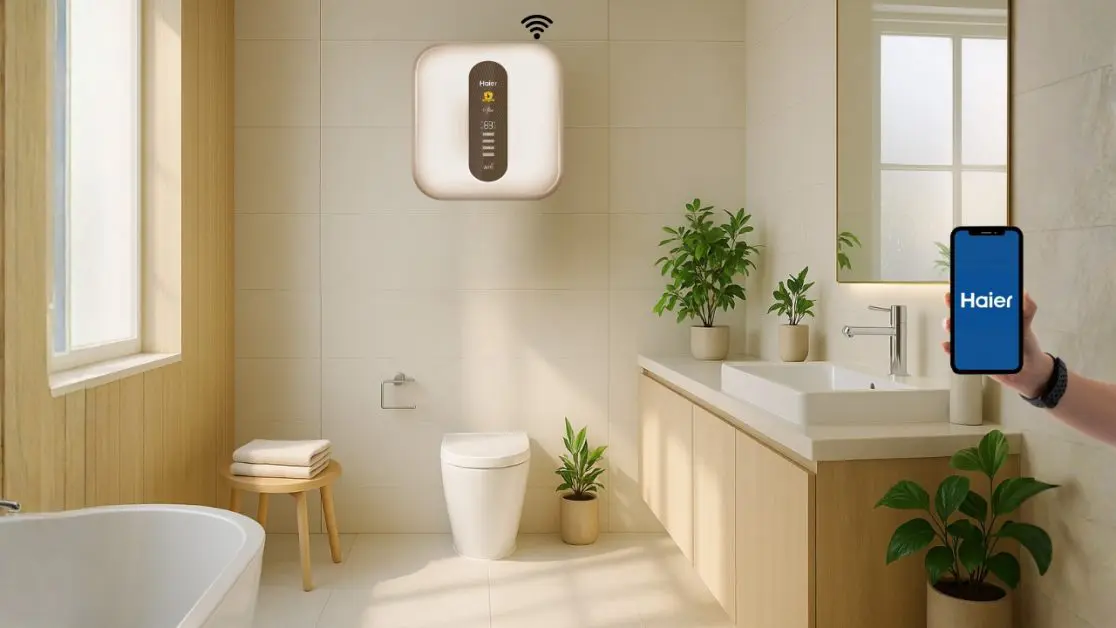
5. Move to WiFi-Controlled Heating When Possible
Remote on-off control saves power when family routines are unpredictable.
The Haier model’s remote control feature, as listed under Eco-Smart, lets users turn the heater on or off through a smartphone, which prevents unnecessary reheating across the day .
Why Smart Water Heaters Are Becoming a Winter Essential in Indian Homes
Winter creates a simple constraint.
You need hot water before your day begins.
But energy-efficient systems show that constraints can spark better design.
A smart water heater does three important things for modern households:
- Cuts electricity waste
- Predicts your schedule
- Keeps comfort consistent
RSC U-turn Flow Technology, which maintains consistent water flow and prevents stale water from sitting inside the tank. This reduces energy use by ensuring fresh water heats predictably without repeated cycles .
The Bacteria Proof System shows BPS mode, which heats water at 80 degrees to inhibit bacterial growth. This is not just a hygiene benefit. It also creates predictable heating cycles that optimise electricity usage in the long run .
When you combine insulation, smart memory, remote control, and high-grade heating elements, the impact on your winter bill is significant.
A Simple Table That Shows Why Some Heaters Consume More Power
| Factor | Old Heaters | Modern Smart Heaters |
| Insulation | Basic | PUF/EPS Superior Insulation |
| Heating Element | Standard coil | Incoloy 800 SS |
| Overheat Control | Single thermostat | Dual Thermal Proof (TTS) |
| Reheating Cycles | High | Optimised via Smart Memory |
| Fresh Water Flow | None | RSC Flow Technology |
| Hygiene Mode | None | BPS antibacterial heating |
| Remote Control | No | Yes, WiFi enabled |
All features above are shown in the Haier ES15V SD WiFi
So Is Your Water Heater the Reason for High Power Bills?
Yes.
But the story doesn’t end there.
The real cause is not the water heater alone.
It is the system built around it.
Old insulation.
Inefficient heating cycles.
Irregular usage patterns.
Continuous reheating.
Lack of smart timing.
Weak tank durability.
When these forces combine, bills rise.
When they are corrected, bills fall just as fast.
Smart heating is not about luxury.
It is about control.
Control over temperature.
Control over timing.
Control over electricity usage.
Control over what winter feels like inside your home.
And any system that gives control back to the user feels like an upgrade.
Especially on a cold morning at 6 am.