


The right way to store dry fruits for winter snacking is to keep them in airtight containers, protect them from moisture, control their temperature, and separate varieties based on oil content.
Using a refrigerator with dedicated zones and humidity control ensures almonds, cashews, dates and figs stay fresh, crisp, and flavourful through winter.
Why Dry Fruits Become a Winter Essential
Every Indian home has a winter ritual that starts quietly.
A jar of almonds next to the morning chai. A handful of raisins in warm kheer. Cashews disappear from the box faster than anyone admits. Dry fruits are not snacks in winter. They are comfort, immunity, and warmth packed into small, potent bites.
Yet there is a pattern every home has seen.
Dry fruits turn soft. Pistachios lose crunch. Cashews start tasting slightly oily. Raisins clump together. You open the jar thinking you will snack, and instead you wonder when the freshness slipped away.
This is the hidden system behind winter snacking.
Dry fruits do not go bad overnight. Their freshness fades in small, predictable steps. Understanding those steps is how you store better.
And winter is the perfect season to get this right.
What Actually Spoils Dry Fruits in Winter?
Three forces work silently.
1. Moisture in the air
Cooler evenings, closed windows, and indoor cooking raise humidity. Dry fruits absorb this instantly, which leads to soft textures and off flavour.
2. Natural oils turning stale
Cashews, walnuts, pistachios and almonds have high oil content. These oils oxidise when exposed to warmth or sunlight, creating an unpleasant smell and taste.
3. Temperature fluctuations
A kitchen that warms during cooking and cools at night speeds up spoilage.
You are not just storing dry fruits.
You are managing air, light, temperature, and oils.
Once you see the system clearly, the solution becomes simple.
How Much Storage Does Winter Snacking Really Need?

A surprising amount.
Families buy larger quantities in December due to:
- Weddings
- House parties
- Christmas and New Year gifting
- Work-from-home munching
- Morning winter rituals like almond milk or badam halwa
If you store 1 to 2 kilos of assorted dry fruits, your fridge becomes part of your winter plan. This is where smart zoned storage helps.
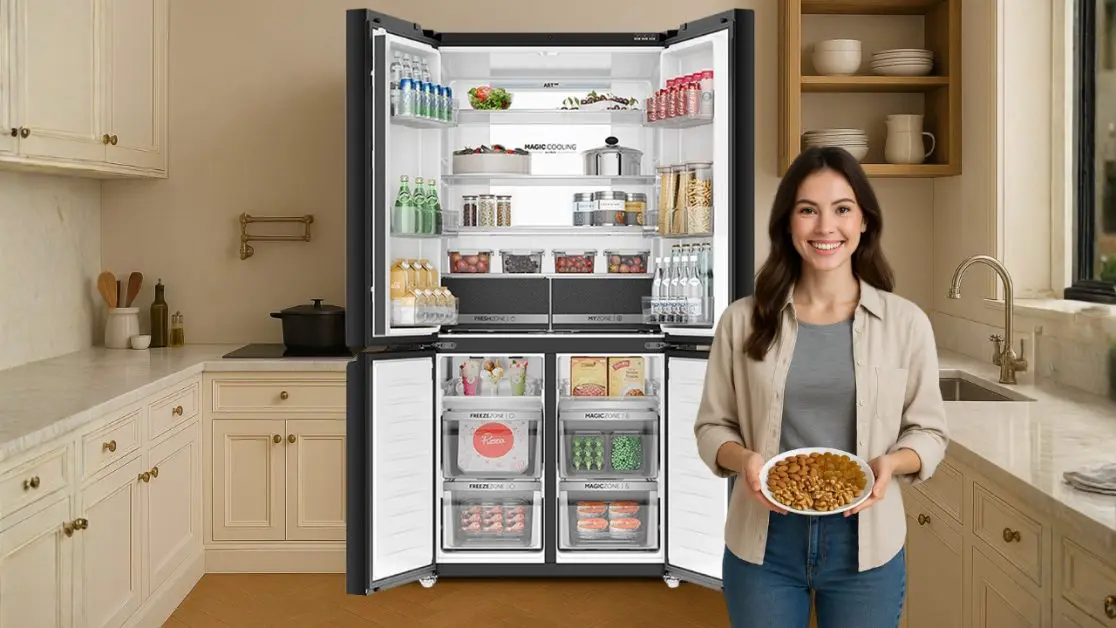
In refrigerators like the Haier 630L Lumiere Series, the My Zone drawer lets you pre-set an ideal temperature dedicated to dry fruits, chocolates, cheese, or cool drinks . It works like a personal pantry inside the fridge. One space. One purpose. Maximum freshness.
This is how modern homes simplify the chaos of seasonal stocking.
The Four-Part Framework for Storing Dry Fruits the Right Way
Every winter kitchen can follow this. It works because it aligns with how dry fruits behave, not just how we like to store them.
1. Separate dry fruits by oil content
Not all dry fruits age the same.
| Category | Examples | What they need |
| High oil | Cashews, walnuts, pistachios, almonds | Cool temperature, airtight container |
| Low oil | Raisins, figs, apricots | Darkness, low humidity |
| Mixed | Trail mixes, flavoured nuts | Airtight storage and stable temperature |
Why does this matter?
Oils go rancid faster. Sugars attract moisture faster. Mixing the two is a recipe for uneven spoilage.
One option is to divide them into airtight jars.
The second option is to keep them in dedicated fridge zones.
The third option is to create a dry fruit box with inner separation trays.
The pattern is simple.
Manage their differences instead of treating them the same.
2. Use vacuum or airtight containers
Freshness is a battle between your food and the air around it.
When air wins, flavour loses.
Airtight jars solve this. Glass works well because it is non reactive. Steel is excellent because it stays cool. Plastic works only when high quality.
Vacuum jars add an extra layer of protection. They delay oil oxidation and stop moisture migration.
This is not about buying fancy jars.
It is about buying jars that honour the quality of ingredients you paid for.
3. Keep temperature stable and cool
Temperature swings are the enemy of dry fruits. Winter kitchens experience:
- Heat from cooking
- Steam from geysers
- Cold nights
- Sunny mornings
A stable cool zone solves this.
Refrigerators with convertible sections offer a smart approach. The 528L convertible fridge space in the Lumiere Series lets you convert a large section into an extended fridge area with precise cooling control.Dry fruits love this environment.
Consistent temperature.
Low humidity.
No heat shocks.
That is the invisible advantage that keeps dry fruits crisp for months.
4. Block light and humidity
Light triggers oil breakdown.
Humidity encourages mold.
The simplest way to block both is:
- Store jars away from direct sunlight
- Avoid keeping jars near cooking zones
- Place them in drawers rather than top shelves
- Use refrigerators with LED lighting that stays off until needed
The Lumiere refrigerator’s motion-activated display and Sun Lit interior ensure light is functional rather than continuous or harsh, which helps maintain the natural colour and freshness of stored food .
This is a small design meeting a big purpose.
How Refrigerators Quietly Shape Winter Snacking
Modern winter cooking does not happen on the stove anymore.
It happens in the fridge.
The fridge decides:
- How long ingredients last
- How fresh your snacks taste
- How effortless your hosting becomes
- How often you need to restock
In a month filled with weddings, travel plans, late-night football replays, and weekend potlucks, the fridge becomes the quiet assistant your winter depends on.
This is where technology steps in without shouting.
The Lumiere Series refrigerator uses:
- ABT Pro to remove up to 99.99 percent of bacteria and maintain hygiene
- Smart connectivity to let you track stored items or create shopping lists
- Inverter compressor for stable cooling and energy efficiency
You do not buy these features for the sake of technology.
You buy them for the sake of everyday calm.
Dry fruits stay fresh because the fridge does the quiet work.
How Long Should You Store Each Dry Fruit in Winter?
A simple table makes decisions easier.
| Dry fruit | Shelf life outside fridge | Shelf life inside fridge |
| Almonds | 1 to 2 months | 6 months |
| Cashews | 3 to 4 weeks | 4 months |
| Pistachios | 6 to 8 weeks | 6 months |
| Walnuts | 3 to 4 weeks | 6 months |
| Raisins | 2 months | 12 months |
| Figs | 6 weeks | 3 to 4 months |
Patterns to notice.
Almonds and pistachios behave similarly.
Raisins and figs thrive in cool-dark zones.
Cashews and walnuts spoil fastest because of high oil.
A refrigerator with humidity control and clean airflow extends life significantly.
The Hidden Advantage of Zoned Refrigeration
Every modern Indian home deals with the same winter storage challenge.
A fridge packed with vegetables.
A freezer packed with meat or ice cream.
A crisper full of greens.
Suddenly dry fruits have no place.
This is where zoned food management is a game changer.
The Lumiere 4-door design gives 103 litres of convertible space and 425 litres of structured refrigeration. That includes fruit trays, fresh food shelves, and the My Zone drawer designed for items that need customised temperature control .
This means dry fruits get:
- A dedicated drawer
- A consistent cooling range
- No odour transfer
- Low humidity
- Space away from heavy storage items
Winter snacking becomes effortless when storage stops being improvisation.
What Smart Homes Already Know About Dry Fruit Storage

Smart kitchens follow three rules.
Rule one
Buy seasonal ingredients once. Store them right for weeks.
Rule two
Use your fridge as a long term pantry, not just a perishable box.
Rule three
Let technology remove friction from everyday routines.
Smart refrigerators with app connectivity help you log what you have, track expiry patterns, and create shopping lists automatically. The Lumiere Series supports this with food management tools inside the Haismart app, so you never have to guess what needs restocking .
This is not luxury.
This is modern living built around clarity and calm.
A Simple Checklist for Winter Dry Fruit Storage
- Use airtight or vacuum jars
- Refrigerate high oil dry fruits
- Separate raisins and figs from nuts
- Use a cool, dark drawer
- Avoid frequent opening
- Do not store near spices or onions
- Keep them away from sunlight
- Use refrigerator zones for stable cooling
When followed consistently, your dry fruits taste the same from the first day of winter to the last.
The Bigger Insight Behind All This
Storing dry fruits is not a kitchen skill.
It is a lesson in how the small systems at home either create ease or friction.
One well organised drawer can save you money.
One airtight jar can save flavour.
One reliable refrigerator zone can keep winter snacking joyful instead of disappointing.
When homes run smoothly, people feel lighter.
And winter is the season that rewards these small systems the most.
Closing Thought
A handful of almonds should feel crisp every time.
A pistachio should snap when you open it.
A raisin should taste like concentrated sunshine.
Freshness is not an accident.
It is a system.
And once you understand that system, your winter snacks become a daily pleasure.
If your refrigerator helps you create that system with zones, sensors, and stable cooling, that is the kind of appliance that fits into the rhythm of real Indian homes. Quietly. Reliably. Beautifully.