
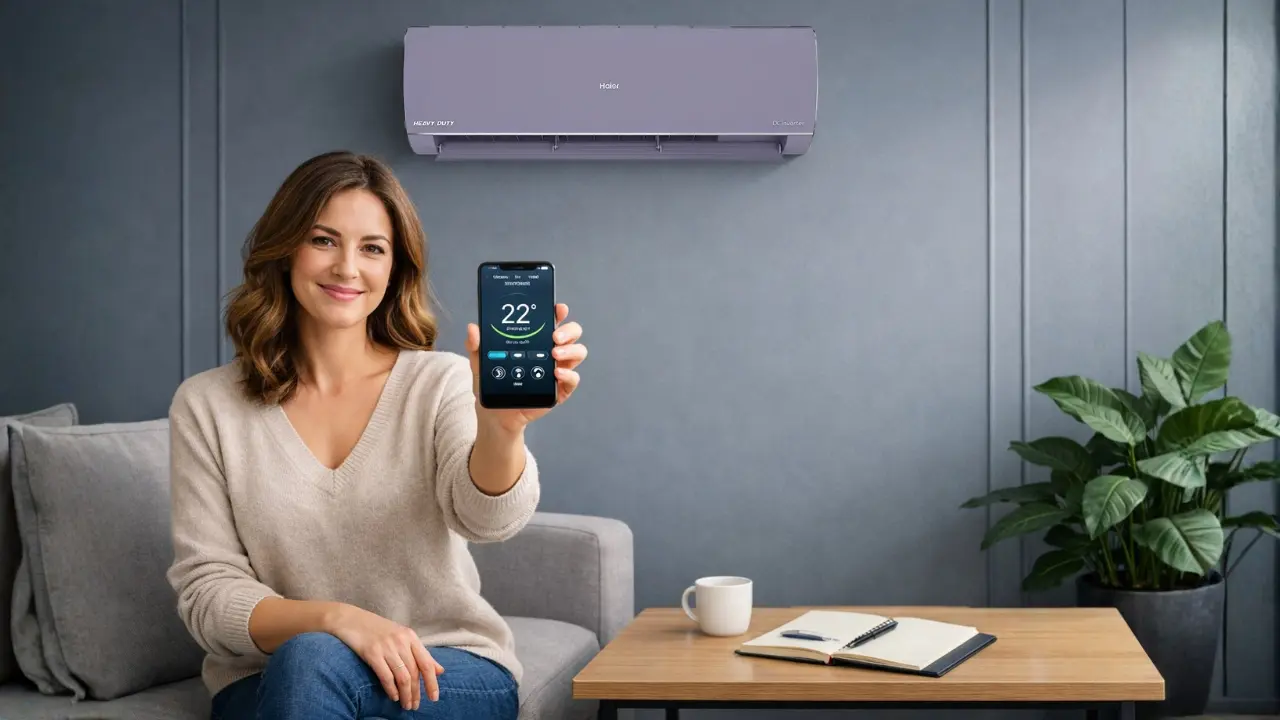

When the weather changes every hour but your room does not
When the weather shifts constantly outside, your room should stay steady inside. Modern Indian homes need intelligent cooling that adapts automatically to humidity, heat spikes, and occupancy.
Technology like AI Climate Control maintains consistent comfort, reduces energy waste, and removes the need for constant manual adjustments.
Stability is the real luxury.
Not marble floors.
Not bigger balconies.
Not even a skyline view.
Stability.
Step outside in Mumbai at 11 am. It feels like June.
Check again at 4 pm. Clouds gather. Humidity rises.
By 8 pm, a breeze arrives.
Delhi swings from dry afternoons to chilly evenings within weeks. Bengaluru can give you three seasons in one day. According to the India Meteorological Department, urban temperature fluctuations in transitional months often vary by 6 to 10 degrees within hours.
The weather is unpredictable.
But your room does not have to be.
Indian Weather Is Not a Background Detail. It Is a Daily Variable.
We treat weather like noise. Something to complain about.
But it shapes productivity, sleep, mood, even family conversations.
A 2023 study published in Nature Climate Change highlights how indoor thermal discomfort reduces cognitive performance by up to 10 percent* during peak heat waves. The Bureau of Energy Efficiency reports that cooling accounts for nearly 40 percent of household electricity use in urban India.
The hidden system is simple:
- Outdoor heat rises
- Indoor discomfort increases
- Manual AC adjustments begin
- Energy consumption spikes
The friction is subtle. But it compounds.
The Problem Is Not Heat. It Is Inconsistency.
Think about a normal weekday.
Morning. Mild.
Afternoon. Harsh sunlight.
Evening. Humid air after a brief shower.
Traditional air conditioners rely on fixed settings. A set temperature. A timer. Manual switching.
They assume the environment stays stable.
Indian homes never do.
And when technology assumes stability in a volatile environment, inefficiency follows.
That is not just climate science. That is technology thinking.
Comfort Is Not a Temperature. It Is a Balance.
We reduce comfort to a number. 24 degrees. 26 degrees.
But comfort is a moving target.
It depends on:
- Humidity levels
- Sunlight intensity
- Number of people in the room
- Airflow direction
- Time of day
According to ASHRAE global thermal comfort standards, perceived comfort changes even when temperature remains constant if humidity shifts by 10 to 15 percent*.
So the real question becomes:
Is your cooling system reacting to reality, or reacting to your remote?
Three Ways Homes Handle Changing Weather
One option is manual control.
The second option is scheduled control.
The third option is adaptive AI control.
Manual control feels empowering. But it consumes attention.
Timers create routines. But they ignore sudden humidity spikes or unexpected arrivals.
Adaptive AI learns patterns. It adjusts automatically. It reduces overcooling and energy waste.
The difference is not convenience.
It is system intelligence.
What Happens When the Room Thinks Ahead
Consider this scenario.
You leave work at 6 pm. Traffic slows. Your phone enters a predefined geofence near home. The AC predicts arrival and begins pre-cooling automatically.
By the time you open the door, comfort is waiting.
This is not fantasy. AI Pre-Cooling models use geo-detection and behavioral data to anticipate occupancy and prepare the room in advance.
The insight is powerful:
Good technology removes waiting.
Now zoom out.
Pre-cooling avoids peak surge cooling. Target cooling directs airflow only where needed instead of cooling the entire room.
Efficiency increases. Waste decreases.
Stability improves.
Target Cooling Changes the Economics of Comfort
Traditional ACs cool the entire volume of air uniformly.
AI Target Cooling uses installation data and airflow intelligence to direct cooling toward the occupied zone.
Why does that matter?
Because cooling unused space is silent energy leakage.
The International Energy Agency reports that optimized airflow technology can reduce cooling energy consumption by 15 to 20 percent* in residential settings.
Cooling only where needed:
- Lowers electricity bills
- Reduces compressor strain
- Extends equipment life
It is the same principle as watering only the roots of a plant.
Precision beats excess.
Energy Awareness Is the New Household Skill
Electricity costs are rising. According to India’s Central Electricity Authority, peak demand crossed 240 GW recently. Tariff revisions continue across states.
Cooling remains one of the highest contributors to summer bills.
But most families do not track consumption daily.
Smart electricity monitoring changes that.
technology like Atmox Power Manager display usage in graphical formats, track eco mode duration, and convert consumption into currency terms.
When you see energy in rupees, behavior shifts.
That is human psychology.
Five Practical Signals Smart Cooling technology Provide
- Real-time power usage tracking
- Graphical and calendar-based reports
- Eco vs Normal mode comparison
- Currency-based consumption display
- Custom energy-saving targets
Data builds awareness. Awareness builds discipline.
And discipline builds long-term savings.
This is not about tech features.
It is about informed living.
Adaptive Cooling Reduces Emotional Friction Too
Comfort influences relationships.
A room that feels too warm during a family dinner invites irritation. A humid bedroom disrupts sleep cycles. Research from the Sleep Foundation links stable indoor temperature to improved REM sleep quality.
Now add human detection.
If the room empties, AI Human Detection activates energy-saving mode automatically.
No reminders. No manual switching.
After inactivity, the system shifts levels intelligently, even powering off when necessary.
It is like a colleague who notices when a meeting ends and turns off the lights.
Silent efficiency.
Self-Cleaning Is Not a Luxury. It is Performance Insurance.
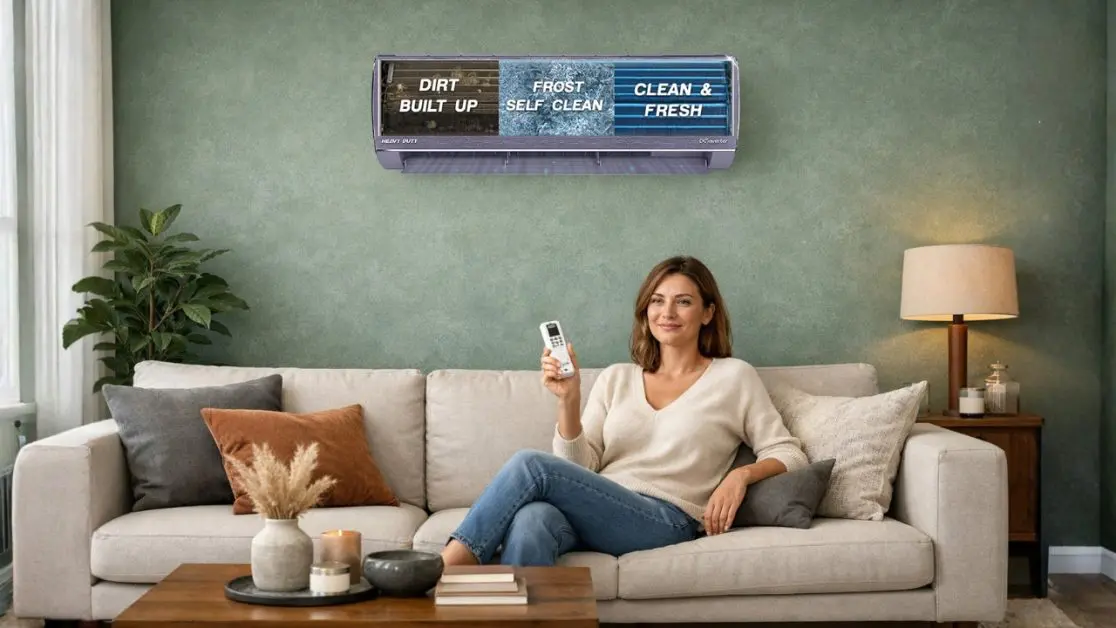
Dust accumulation reduces cooling efficiency by up to 5 to 15 percent* annually, according to HVAC maintenance data.
Indoor Frost Self Clean cycles and outdoor Cyclone Clean technology reverse airflow to clear dust automatically.
Cleaner coils mean:
- Faster cooling
- Lower power bills
- Reduced maintenance cost
Maintenance is the invisible cost nobody budgets for.
Automation reduces that burden.
So What Does This Mean for Modern Indian Homes?
The weather will keep changing.
Urban climates will become more unpredictable. Heat waves are intensifying across India, with IMD data showing rising average summer temperatures over the last decade.
But your home can become stable.
The question is no longer:
“Does this AC cool well?”
The better question is:
“Does this system adapt intelligently without my constant intervention?”
Because real comfort is not reactive.
It is proactive.
Three Frameworks to Think About Before Buying
- Stability Over Peak Power
Look for technology that balances temperature, humidity, and occupancy automatically. - Intelligence Over Intensity
Target cooling and eco optimization reduce waste without sacrificing comfort. - Awareness Over Guesswork
Electricity monitoring builds transparency into usage patterns.
When a system learns, adapts, and self-cleans, the homeowner stops micro-managing.
And that shift is psychological as much as physical.
The Bigger Pattern: Future Homes Will Feel Calm Even When Cities Do Not
Indian cities are growing denser. Climate variability is increasing. Remote work blurs boundaries between office and home.
In unstable environments, stable interiors become strategic advantages.
Think of your room as an operating system.
Outside is volatile.
Inside should be controlled.
Technology that predicts arrival, detect presence, optimize airflow, and monitor power create that buffer.
Not loudly.
Quietly.
That is the future of smart cooling.
And perhaps the most important insight is this:
When the outside world accelerates, the smartest homes slow things down.
The weather may change every hour.
But your room does not have to.
Frequently Asked Questions
Why do I keep changing my AC temperature throughout the day?
Because outdoor weather, humidity, sunlight, and room occupancy keep changing but traditional ACs don’t adapt automatically. Fixed settings can’t respond to 6–10°C outdoor swings common in Indian cities, so you end up manually compensating.
Is it normal that my room feels different at the same temperature every day?
Yes. Comfort isn’t just temperature. Humidity shifts of even 10–15% can change how cool a room feels. That’s why 24°C can feel perfect one day and uncomfortable the next.
I feel like I’m constantly “managing” my AC. Is there a smarter way?
Adaptive AI cooling systems adjust automatically based on humidity, time of day, occupancy, and patterns. They reduce the need for manual intervention which lowers both mental load and energy waste.
My AC cools slower than before. Is it aging or just dirty?
Dust buildup on coils can reduce cooling efficiency by 5–15% annually. Dirty components restrict airflow, strain the compressor, and increase electricity bills.
I rarely service my AC. How much does that actually affect performance?
Significantly. Accumulated dust not only lowers efficiency but also increases power consumption and long-term repair costs. Self-cleaning technologies reduce this maintenance burden.
Is pre-cooling my room before I arrive home wasteful?
Not necessarily. AI pre-cooling using geofencing avoids sudden peak surge cooling. It cools gradually and efficiently before arrival, often reducing overall strain.
Does cooling only part of the room really save money?
Yes. Target cooling directs airflow toward occupied zones instead of cooling unused space. Optimized airflow can reduce cooling energy consumption by 15–20%.
What is AI Climate Control in simple terms?
It’s a system that automatically adjusts cooling based on:
Humidity
Occupancy
Time of day
Sunlight exposure
Usage patterns
It reacts to real conditions, not just a fixed temperature setting.