
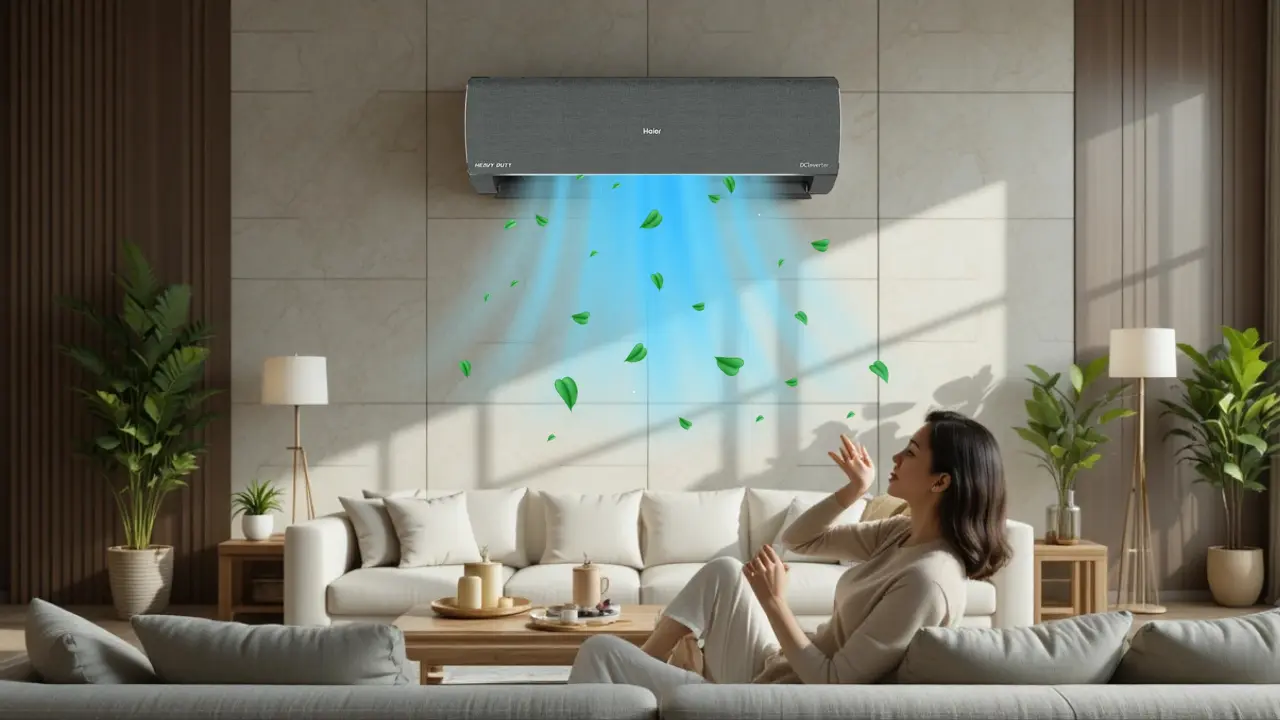

AI climate control is a smarter way of cooling that learns how you live, senses your environment in real time, and adjusts temperature, airflow, and energy use automatically.
Instead of forcing your body to adapt to a fixed setting, it adapts to you. That is why rooms feel more comfortable, not colder or louder, just right.
The problem most Indian homes quietly live with
It is 7:30 pm.
You walk in after work. Shoes off. Phone down.
The AC is on, but the room feels… wrong.
Too cold near the bed.
Too warm near the sofa.
Dry air on the face.
A blanket in May.
This is not because your AC is weak.
It is because it is blind.
Traditional air conditioners work on a simple rule. You set a temperature. The machine chases that number. It does not know who is in the room, where they are sitting, or how long they will stay.
Comfort, in Indian homes, is more complex than a number on a remote.
That is where AI climate control changes the equation.
What exactly is AI climate control
AI climate control uses sensors, machine learning, and usage data to continuously adjust cooling based on real conditions. Not preset assumptions.
In simple terms, it observes, learns, and acts.
It looks at:
- Room temperature changes across the day
- Humidity and seasonal patterns
- How many people are present
- Where activity is happening
- How long the AC usually runs
- Power consumption patterns
And then it adjusts cooling automatically. No manual tweaking. No guesswork.
Haier’s AI Atmox system is built on this idea. It combines climate sensing, behavioural learning, and energy optimisation into one adaptive loop .
Why AI cooling feels different from normal cooling
The biggest difference is not speed.
It is alignment.
Traditional ACs cool rooms.
AI climate control cools situations.
A late-night Netflix binge does not need the same airflow as a Sunday afternoon nap. A kitchen-adjacent living room behaves differently from a closed bedroom. AI systems factor that in automatically.
Comfort improves because the machine stops overdoing its job.
The hidden system behind “this feels nicer”
Comfort is not about temperature alone. It is about stability.
Human bodies dislike sudden changes.
They prefer consistency.
AI climate control works by reducing micro-fluctuations. Instead of aggressive cooling bursts followed by pauses, it maintains a steady thermal experience.
This is why people describe AI-cooled rooms as:
- Softer
- Less drying
- Easier to sleep in
- Less fatiguing over long hours
The machine stops reacting and starts anticipating.
AI Pre-Cooling: comfort starts before you enter
One of the smartest shifts is pre-cooling.
AI systems like Atmox Neuro use location and usage patterns to predict arrival times. When you enter a predefined zone near your home, the AC prepares the room in advance .
No timers. No schedules.
The benefit is subtle but powerful:
- No blast of cold air when you enter
- No waiting period
- Lower peak power draw
Comfort begins quietly, before you notice it.
Target cooling: why cooling the whole room is inefficient
Most rooms are only partially used at any given time.
You sit on the sofa.
The dining area is empty.
The far corner does not need cooling.
AI target cooling uses installation data and spatial modelling to direct airflow where it is needed most .
This does two things at once:
- Reaches you faster
- Uses less energy
Cooling becomes precise, not wasteful.
Why this matters in Indian homes
Indian homes are rarely static.
Parents move between rooms.
Children play on the floor.
Work-from-home shifts posture every hour.
Doors open. Fans run. Windows leak heat.
AI climate control adapts to these patterns without constant remote use.
It works quietly in the background, adjusting instead of demanding attention.
Energy efficiency without sacrifice
Most people think energy saving means discomfort.
Sweating slightly more.
Turning the AC off early.
Compromising sleep.
AI climate control changes that trade-off.
Systems like AI Eco 2.0 mode dynamically adjust power levels based on the gap between room temperature and target comfort range .
For example:
- Larger gap equals higher capacity
- Smaller gap equals reduced power
- Near-stable state equals minimal energy draw
The result is lower electricity usage without abrupt changes.
According to India’s Bureau of Energy Efficiency, cooling can account for over 40 percent of household electricity use in peak summer months. Intelligent modulation, not shorter usage, is the biggest lever for savings.
Electricity awareness changes behaviour
Another overlooked benefit is visibility.
AI-powered Electricity monitoring 2.0 shows:
- Daily usage
- Mode-wise consumption
- Cost estimates in currency
- Seasonal comparisons
When people see patterns, behaviour adjusts naturally. Shorter usage windows. Better temperature choices. Less anxiety about bills.
Awareness creates efficiency.
Human detection: when the room understands absence
One of the quietest comfort upgrades is automatic absence detection.
AI systems detect movement and occupancy. If no activity is sensed, the AC gradually shifts to energy-saving modes or powers down safely .
No panic about forgetting the AC on.
No guilt when leaving home in a hurry.
This matters in real life. School pickups. Late meetings. Power cuts. Routine disruptions.
The system compensates when humans forget.
Clean air stays comfortable air
Comfort also depends on air quality.
AI-enabled self-cleaning systems maintain indoor and outdoor unit efficiency automatically.
Frost self-cleaning and cyclone cleaning remove dust buildup that normally reduces airflow and increases power draw over time .
Cleaner coils mean:
- Faster cooling
- Lower energy use
- Fewer odours
- More consistent airflow
Comfort is preserved not just today, but months later.
Three ways people experience AI climate control differently
One option is hands-off living
You set preferences once. The system handles the rest.
The second option is conscious optimisation
You track usage, tweak targets, and actively manage energy.
The third option is hybrid comfort
AI handles daily patterns, you override occasionally.
The system supports all three without friction.
The bigger shift happening quietly
AI climate control is not about smarter machines.
It is about calmer homes.
When appliances stop demanding attention, mental load reduces. Parents worry less. Professionals focus better. Sleep improves.
Comfort becomes ambient, not managed.
This is why AI cooling feels different. It removes decisions instead of adding features.
What this means for the future of Indian homes
As homes become multifunctional, cooling must become contextual.
One room hosts work, rest, play, and family time. Static systems struggle here. Adaptive systems thrive.
AI climate control fits into this future naturally. It does not shout innovation. It earns trust over time.
The best technology feels invisible when it works well.
And comfort, when done right, should never ask to be noticed.
Frequently Asked Questions
What is AI climate control in simple terms?
It is a system that observes your room, learns your habits, and adjusts cooling automatically. Instead of you managing the AC, the AC manages comfort for you.
How is AI climate control different from inverter ACs?
Inverter ACs adjust power based on temperature difference. AI climate control goes further by factoring in humidity, occupancy, time of day, usage history, and room behavior.
Does AI climate control mean I lose control?
No. You can choose hands-off automation, active optimization, or a hybrid approach where AI handles daily patterns and you override occasionally.
Why does AI cooling feel calmer even if it’s not blasting cold air?
Because comfort is about consistency, not speed. AI systems avoid aggressive cooling cycles and instead maintain a steady thermal environment that your body prefers.
Why does AI cooling feel better for sleep?
Human bodies dislike sudden temperature changes. AI climate control reduces night-time fluctuations, making rooms easier to sleep in for long hours.
Why is cooling the whole room wasteful when I’m only sitting in one spot?
Most rooms are partially occupied. AI target cooling directs airflow where activity is detected instead of cooling unused corners.
Why does AI climate control matter more in Indian homes?
Indian homes are dynamic, doors open, fans run, people move constantly. AI adapts quietly to these changes without repeated remote adjustments.