
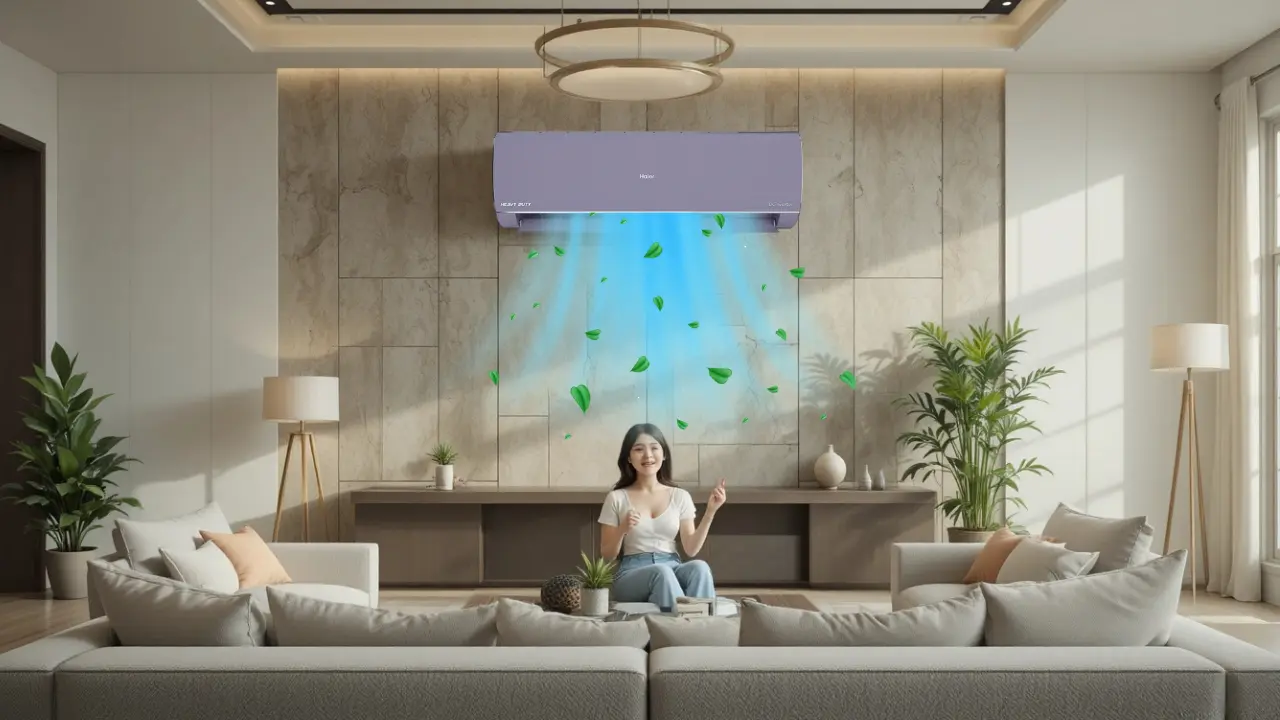

AI Pre Cooling is a smart cooling approach where an air conditioner learns your daily patterns, weather conditions, and room behaviour to cool your space before you feel uncomfortable.
Instead of reacting late, the system predicts when cooling is needed and prepares the room efficiently, using less power and delivering steadier comfort.
That is the difference.
Reaction versus anticipation.
The familiar Indian moment that explains everything
It is 6:30 pm.
You step in after a long commute.
The room feels heavy.
The AC remote comes out instantly.
Ten minutes later, the air finally turns pleasant.
Another ten minutes, and now it feels too cold.
You adjust again.
And again.
This small back and forth happens in millions of Indian homes every single day.
Not because people do not know what temperature they want.
But because traditional cooling systems respond late.
AI Pre Cooling exists to solve this exact gap.
Cooling has always been reactive. That is the hidden problem
Most air conditioners work on a simple loop.
- You feel hot
- You switch on the AC
- The machine starts cooling
- Comfort arrives late
This system assumes discomfort is unavoidable.
It accepts that rooms must heat up first.
AI Pre Cooling challenges that assumption.
It asks a better question.
What if comfort arrives before discomfort does?
That shift changes everything.
So what exactly is AI Pre Cooling
AI Pre Cooling uses artificial intelligence to predict cooling needs instead of waiting for manual input.
It looks at patterns, not just temperature.
These patterns include:
- Time of day usage
- Outdoor weather trends
- How fast your room heats up
- When people usually enter the room
- Past temperature preferences
Over time, the AC builds a behavioural model of your space.
Not just the room.
The life inside it.
How AI Pre Cooling actually works behind the scenes
Think of it like soaking rajma before cooking.
You do not wait till hunger peaks.
You prepare in advance.
AI Pre Cooling follows a similar logic.
Step 1: It learns your rhythm
The system observes:
- When the AC is usually switched on
- What temperature is set most often
- How long it runs
- How the room responds
After a few weeks, patterns emerge.
Weekdays look different from weekends.
Evenings behave differently from afternoons.
Step 2: It reads the environment
AI systems continuously factor in:
- Outdoor temperature and humidity
- Seasonal changes
- Heat retention of the room
A west-facing bedroom heats differently than a shaded study.
The system remembers this.
Step 3: It starts cooling earlier, gently
Instead of blasting cold air suddenly, AI Pre Cooling:
- Starts earlier
- Uses lower intensity
- Stabilises room temperature gradually
By the time you enter, the room feels right.
Not cold.
Not warm.
Just settled.
Why this feels different from normal cooling
Traditional cooling works like a light switch.
On or off.
AI Pre Cooling works like dimming lights at sunset.
Gradual. Predictable. Comfortable.
The room does not shock your body.
It welcomes it.
That difference is subtle.
But once you notice it, you do not want to go back.
The energy angle people often miss
Here is the counterintuitive part.
Cooling earlier often uses less electricity than cooling late.
Why?
Because sudden temperature drops demand higher compressor effort.
Gradual cooling keeps the system in an efficient range.
AI Pre Cooling focuses on:
- Avoiding power spikes
- Maintaining steady temperatures
- Reducing overcooling
The result is comfort without waste.
Three common household scenarios where AI Pre Cooling shines
1. The working professional living solo
You return home at roughly the same time every day.
AI Pre Cooling learns this.
Instead of walking into a warm room and waiting, comfort is already there.
No manual adjustments.
No guesswork.
2. Families with children or elders
Sudden cold air is uncomfortable for sensitive bodies.
AI Pre Cooling avoids abrupt cooling.
The temperature stabilises slowly, creating a gentler indoor climate.
This matters more than people realise.
3. New homes with variable usage
Some rooms are used occasionally.
Others daily.
AI systems adapt room by room, not with one rigid setting.
That flexibility reduces unnecessary cooling.
What AI Pre Cooling is not
It is not about flashy screens.
It is not about voice commands alone.
It is not about making things complicated.
AI Pre Cooling works best when you forget it exists.
The best systems are invisible.
How Haier approaches AI Pre Cooling
Haier designs AI cooling around real home behaviour, not ideal lab conditions.
Indian homes deal with:
- Power fluctuations
- High humidity
- Irregular schedules
- Multi purpose rooms
Haier’s AI Climate Control systems focus on learning these realities over time instead of forcing preset modes.
The goal is not perfect temperature.
The goal is predictable comfort.
Why this matters more as homes become smarter
Homes today do more.
They host work calls.
They host family dinners.
They host rest.
When one space serves many roles, temperature stability becomes critical.
AI Pre Cooling supports this shift quietly.
No learning curve.
No daily tweaking.
Just a system that adapts as life changes.
The bigger insight hiding here
Technology works best when it removes decisions.
AI Pre Cooling is not about control.
It is about reducing cognitive load.
One less thing to manage.
One less adjustment to make.
In a world full of micro decisions, that matters.
What this means for how we choose appliances now
The question is no longer:
“How fast can it cool?”
The better question is:
“How well does it understand my life?”
Speed matters.
Efficiency matters.
But anticipation matters more.
A thought to leave with
Comfort is not a moment.
It is a system.
AI Pre Cooling does not just cool rooms.
It aligns machines with human rhythms.
And when appliances start understanding patterns instead of commands, homes stop feeling mechanical.
They start feeling thoughtful.
That is the quiet future of living.
Frequently Asked Questions
What exactly is AI Pre Cooling in an air conditioner?
AI Pre Cooling means my AC doesn’t wait for me to feel hot. It quietly learns my routine, my room’s heat behavior, and outdoor conditions, then begins cooling before discomfort sets in.
Does AI Pre Cooling really reduce mental effort, or is that exaggerated?
It genuinely removes one daily micro-decision. Over weeks, that predictability becomes noticeable comfort.
Does AI Pre Cooling cool the room slower?
It cools earlier, not slower. Because it starts gently in advance, it doesn’t need aggressive bursts later.
Why does sudden cooling feel uncomfortable on my skin?
Rapid temperature drops shock the body. AI Pre Cooling avoids that by stabilizing temperature gradually.